
UNITED STATES
SECURITIES AND EXCHANGE COMMISSION
Washington, D.C. 20549
_________________________
FORM 10-Q
_________________________
(Mark One)
QUARTERLY REPORT PURSUANT TO SECTION 13 OR 15(d) OF THE SECURITIES EXCHANGE ACT OF 1934 | |||||
For the quarterly period ended June 30, 2026
OR
TRANSITION REPORT PURSUANT TO SECTION 13 OR 15(d) OF THE SECURITIES EXCHANGE ACT OF 1934 | |||||
For the transition period from ____________ to _______________
Commission file number 001-42271
_________________________
(Exact name of registrant as specified in its charter)
_________________________
(State or other jurisdiction of incorporation or organization) | (I.R.S. Employer Identification No.) | ||||||||||
(Address of Principal Executive Offices) | (Zip Code) | ||||||||||
Registrant’s telephone number, including area code
Securities registered pursuant to Section 12(b) of the Act:
Title of each class | Trading Symbol(s) | Name of each exchange on which registered | ||||||
Indicate by check mark whether the registrant (1) has filed all reports required to be filed by Section 13 or 15(d) of the Securities Exchange Act of 1934 during the preceding 12 months (or for such shorter period that the registrant was required to file such reports), and (2) has been subject to such filing requirements for the past 90 days.
Indicate by check mark whether the registrant has submitted electronically every Interactive Data File required to be submitted pursuant to Rule 405 of Regulation S-T (§ 232.405 of this chapter) during the preceding 12 months (or for such shorter period that the registrant was required to submit such files).
Indicate by check mark whether the registrant is a large accelerated filer, an accelerated filer, a non-accelerated filer, a smaller reporting company, or an emerging growth company. See the definitions of “large accelerated filer,” “accelerated filer,” “smaller reporting company,” and “emerging growth company” in Rule 12b-2 of the Exchange Act.
Large accelerated filer | o | Accelerated filer | o | |||||||||||
☒ | Smaller reporting company | |||||||||||||
Emerging growth company | ||||||||||||||
If an emerging growth company, indicate by check mark if the registrant has elected not to use the extended transition period for complying with any new or revised financial accounting standards provided pursuant to Section 13(a) of the Exchange Act.
Indicate by check mark whether the registrant is a shell company (as defined in Rule 12b-2 of the Act).
Yes o No ☒
As of August 6, 2026, the registrant had 66,172,934 shares of common stock, $0.0001 par value per share, outstanding.
Table of Contents
Page | ||||||||
Item 1A. | Risk Factors | |||||||
SUMMARY OF THE MATERIAL RISKS ASSOCIATED WITH OUR BUSINESS
We are subject to numerous risks and uncertainties, including those further described below in the section titled “Risk Factors” in this Quarterly Report on Form 10-Q, that represent challenges that we face in connection with the successful implementation of our strategy and the growth of our business. In particular, the following considerations, among others, may offset our competitive strengths or have a negative effect on our business strategy, which could materially adversely affect our business, financial conditions, results of operations, future growth prospects, or cause a decline in the price of our common stock:
•We are a clinical-stage biopharmaceutical company with a limited operating history, which may make it difficult to evaluate our current business and predict our future success and viability. We have incurred significant financial losses since our inception and anticipate that we will continue to incur significant financial losses for the foreseeable future.
•If we are unable to raise capital when needed, or on acceptable terms, we may be unable to complete the development and commercialization of ficerafusp alfa or any future product candidates.
•Our business is highly dependent on the success of ficerafusp alfa. If we are unable to successfully complete clinical development, obtain regulatory approval for or commercialize ficerafusp alfa, or if we experience delays in doing so, our business will be materially harmed.
•We face significant competition from other biotechnology and pharmaceutical companies, and our operating results will suffer if we fail to compete effectively.
•Our business is dependent on our ability to advance ficerafusp alfa and future product candidates through clinical trials, obtain marketing approval and ultimately commercialize them.
•Clinical development involves a lengthy and expensive process with uncertain outcomes. We may incur additional costs and experience delays in developing and commercializing or be unable to develop or commercialize ficerafusp alfa and any future product candidates.
•Ficerafusp alfa or any future product candidates may cause undesirable side effects or have other properties when used alone or in combination with other approved products or investigational new drugs that could halt their clinical development, delay or prevent their regulatory approval, limit their commercial potential or result in significant negative consequences.
•We rely, and expect to continue to rely, on third parties, including independent clinical investigators and contract research organizations to conduct our preclinical studies and clinical trials. If these third parties do not successfully carry out their contractual duties or meet expected deadlines, we may not be able to obtain regulatory approval for or commercialize our product candidates and our business could be substantially harmed.
•We currently and in the future may depend on other third-party collaborators for the discovery, development and commercialization of ficerafusp alfa and any of our future product candidates. If our collaborations are not successful, we may not be able to capitalize on the market potential of these product candidates.
•The regulatory approval processes of the U.S. Food and Drug Administration and comparable foreign authorities are lengthy, time-consuming and inherently unpredictable, and if we are ultimately unable to obtain regulatory approval for our product candidates, our business will be materially harmed.
•The commercial success of ficerafusp alfa or any future product candidates will depend upon the degree of market acceptance of such product candidates by physicians, patients, healthcare payors and others in the medical community.
•Our ability to compete may decline if we do not adequately protect our proprietary rights.
•Unfavorable global economic and geopolitical conditions could adversely affect our business, financial condition, stock price and results of operations.
4
•Our ability to develop product candidates, leverage our potential and our future growth depends on attracting, hiring and retaining our key personnel and recruiting additional qualified personnel. If we are not successful in attracting, motivating and retaining highly qualified personnel, we may not be able to successfully implement our business strategy. Additionally, we will need to grow the size of our organization, and we may experience difficulties in managing this growth.
The summary risk factors described above should be read together with the text of the full risk factors in the section titled “Risk Factors” and the other information set forth in this Quarterly Report, including our condensed consolidated financial statements and the related notes, as well as in other documents that we file with the Securities and Exchange Commission, or SEC. The risks summarized above or described in full elsewhere in this Quarterly Report are not the only risks that we face. Additional risks and uncertainties not presently known to us, or that we currently deem to be immaterial may also materially adversely affect our business, financial condition, results of operations and future growth prospects.
5
SPECIAL NOTE REGARDING FORWARD-LOOKING STATEMENTS
This Quarterly Report on Form 10-Q contains express or implied forward-looking statements that are based on our management’s belief and assumptions and on information currently available to our management. Although we believe that the expectations reflected in these forward-looking statements are reasonable, these statements relate to future events or our future operational or financial performance, and involve known and unknown risks, uncertainties and other factors that may cause our actual results, performance or achievements to be materially different from any future results, performance or achievements expressed or implied by these forward-looking statements. Forward-looking statements in this Quarterly Report on Form 10-Q include, but are not limited to, statements about:
•the timing, progress, results and cost of our development activities for ficerafusp alfa, including the FORTIFI-HN01 Phase 2/3 pivotal trial, the expansion cohorts of our Phase 1/1b trial, and our alternate dose study, as well as our research and development programs and any current and future preclinical and clinical studies;
•the ability and the potential to secure pembrolizumab for our clinical trials and successfully manufacture our drug substances and ficerafusp alfa for preclinical use, for clinical trials and on a larger scale for commercial use, if approved;
•our expectations for the potential safety, efficacy and therapeutic effects of ficerafusp alfa, and the ability of our clinical trials to demonstrate such results;
•our expectations for the development of ficerafusp alfa with a loading and every-three-week maintenance dosing regimen;
•the timing, scope and likelihood of regulatory filings and approvals, including potential accelerated approval, for ficerafusp alfa and future product candidates;
•our ability to initiate, recruit and enroll patients in and conduct and successfully complete our clinical trials at the pace that we project;
•our ability to maintain and further develop the specific shipping, storage, handling and administration of ficerafusp alfa at the clinical sites;
•the ability and willingness of our third-party strategic collaborators to continue research and development activities relating to our development candidates and ficerafusp alfa;
•our ability to obtain funding to continue development and commercialization of ficerafusp alfa;
•our ability to obtain and maintain regulatory approval of ficerafusp alfa;
•our ability to commercialize ficerafusp alfa, if approved;
•the potential pricing and reimbursement of ficerafusp alfa, if approved;
•the implementation of our business model, and strategic plans for our business, ficerafusp alfa and technology;
•the scope of protection we are able to establish and maintain for intellectual property rights covering ficerafusp alfa and other product candidate we may develop, including the extensions of existing patent terms where available, the validity of intellectual property rights held by third parties and our ability not to infringe, misappropriate or otherwise violate any third-party intellectual property rights;
•estimates of our future expenses, revenues and capital requirements, our needs for additional financing and ability to raise capital, including under our “at-the-market” offering program;
•future agreements with third parties in connection with the development and commercialization of ficerafusp alfa and any other approved product;
•the size and growth potential of the markets for ficerafusp alfa and our ability to serve those markets;
6
•the rate and degree of market acceptance of ficerafusp alfa;
•regulatory developments in the U.S., Canada, European Union and other foreign countries;
•our ability to contract with third-party suppliers and manufacturers and their ability to perform adequately;
•the success of competing therapies that are or may become available and ficerafusp alfa’s differentiation from competitors;
•our ability to attract and retain key personnel;
•the impact of laws and regulations;
•developments relating to our competitors and our industry; and
•other risks and uncertainties, including those listed under the caption “Risk Factors.”
In some cases, forward-looking statements can be identified by terminology such as “may,” “should,” “expects,” “intends,” “plans,” “anticipates,” “believes,” “estimates,” “predicts,” “potential,” “continue,” or the negative of these terms or other comparable terminology. These statements are only predictions. You should not place undue reliance on forward-looking statements because they involve known and unknown risks, uncertainties and other factors, which are, in some cases, beyond our control and which could materially affect results. Factors that may cause actual results to differ materially from current expectations include, among other things, those listed under the section titled “Risk Factors” and elsewhere in this Quarterly Report. If one or more of these risks or uncertainties occur, or if our underlying assumptions prove to be incorrect, actual events or results may vary significantly from those implied or projected by the forward-looking statements. No forward-looking statement is a guarantee of future performance. You should read this Quarterly Report and the documents that we reference in this Quarterly Report and have filed with the SEC, as exhibits hereto completely and with the understanding that our actual future results may be materially different from any future results expressed or implied by these forward-looking statements.
The forward-looking statements in this Quarterly Report represent our views as of the date of this Quarterly Report. We anticipate that subsequent events and developments will cause our views to change. However, while we may elect to update these forward-looking statements at some point in the future, we have no current intention of doing so except to the extent required by applicable law. You should therefore not rely on these forward-looking statements as representing our views as of any date subsequent to the date of this Quarterly Report.
In addition, statements that “we believe” and similar statements reflect our beliefs and opinions on the relevant subject. These statements are based upon information available to us as of the date of this Quarterly Report, and while we believe such information forms a reasonable basis for such statements, such information may be limited or incomplete, and our statements should not be read to indicate that we have conducted an exhaustive inquiry into, or review of, all potentially available relevant information. These statements are inherently uncertain and you are cautioned not to unduly rely upon these statements.
This Quarterly Report also contains estimates, projections and other information concerning our industry, our business and the markets for our product candidates. Information that is based on estimates, forecasts, projections, market research or similar methodologies is inherently subject to uncertainties and actual events or circumstances may differ materially from events and circumstances that are assumed in this information. Unless otherwise expressly stated, we obtained this industry, business, market, and other data from our own internal estimates and research as well as from reports, research surveys, studies, and similar data prepared by market research firms and other third parties, industry, medical and general publications, government data and similar sources. While we are not aware of any misstatements regarding any third-party information presented in this Quarterly Report, their estimates, in particular as they relate to projections, involve numerous assumptions, are subject to risks and uncertainties and are subject to change based on various factors, including those discussed under the section titled “Risk Factors” and elsewhere in this Quarterly Report.
7
NOTE REGARDING TRADEMARKS
Bicara Therapeutics Inc. is the owner of the Bicara trademark, as well as certain other registered trademarks, trademark applications and unregistered trademarks and service marks, including design versions of some of these trademarks. The symbols ™ and ® are not used in connection with the presentation of these trademarks in this report and their absence does not indicate a lack of trademark rights. Certain other trademarks used in this report are the property of third-party trademark owners and may be presented with or without trademark references.
All brand names or trademarks appearing in this report are the property of their respective owners. Unless the context requires otherwise, references in this report to “Bicara,” the “Company,” “we,” “us” and “our” refer to Bicara Therapeutics Inc. and its subsidiary.
8
PART I - FINANCIAL INFORMATION
Item 1. Financial Statements (Unaudited)
BICARA THERAPEUTICS INC.
CONDENSED CONSOLIDATED BALANCE SHEETS
(Unaudited, in thousands, except shares and per share data)
June 30, 2026 | December 31, 2025 | ||||||||||
Assets | |||||||||||
Current assets | |||||||||||
Cash and cash equivalents | $ | $ | |||||||||
Prepaid expenses and other assets | |||||||||||
Marketable securities | |||||||||||
Total current assets | |||||||||||
Property and equipment, net | |||||||||||
Right of use asset – operating lease | |||||||||||
Other assets | |||||||||||
Total assets | $ | $ | |||||||||
Liabilities and stockholders’ equity | |||||||||||
Current liabilities | |||||||||||
Accounts payable | $ | $ | |||||||||
Accounts payable – related party | |||||||||||
Accrued expenses and other current liabilities | |||||||||||
Accrued expenses and other current liabilities – related party | |||||||||||
Operating lease liability – current portion | |||||||||||
Total current liabilities | |||||||||||
Operating lease liability – net of current portion | |||||||||||
Total liabilities | |||||||||||
Commitments and Contingencies (Note 7) | |||||||||||
Stockholders' equity: | |||||||||||
Preferred stock $ | |||||||||||
Common stock, $ | |||||||||||
Additional paid-in capital | |||||||||||
Accumulated other comprehensive (loss) income | ( | ||||||||||
Accumulated deficit | ( | ( | |||||||||
Total stockholders' equity | |||||||||||
Total liabilities and stockholders’ equity | $ | $ | |||||||||
See accompanying notes to unaudited condensed consolidated financial statements.
9
BICARA THERAPEUTICS INC.
CONDENSED CONSOLIDATED STATEMENTS OF OPERATIONS AND COMPREHENSIVE LOSS
(Unaudited, in thousands except shares and per share data)
Three Months Ended June 30, | Six Months Ended June 30, | ||||||||||||||||||||||
2026 | 2025 | 2026 | 2025 | ||||||||||||||||||||
Operating expenses | |||||||||||||||||||||||
Research and development - related party | $ | $ | $ | $ | |||||||||||||||||||
Research and development | |||||||||||||||||||||||
General and administrative | |||||||||||||||||||||||
Total operating expenses | |||||||||||||||||||||||
Loss from operations | ( | ( | ( | ( | |||||||||||||||||||
Other income | |||||||||||||||||||||||
Interest income | |||||||||||||||||||||||
Total other income | |||||||||||||||||||||||
Net loss before income taxes | ( | ( | ( | ( | |||||||||||||||||||
Income tax expense | ( | ( | ( | ( | |||||||||||||||||||
Net loss | $ | ( | $ | ( | $ | ( | $ | ( | |||||||||||||||
Net Loss per share, basic and diluted | $ | ( | $ | ( | $ | ( | $ | ( | |||||||||||||||
Weighted-average number of common shares outstanding, basic and diluted | |||||||||||||||||||||||
Other comprehensive loss | |||||||||||||||||||||||
Unrealized loss on marketable securities, net of tax | ( | ( | |||||||||||||||||||||
Total other comprehensive loss | ( | ( | |||||||||||||||||||||
Total comprehensive loss | $ | ( | $ | ( | $ | ( | $ | ( | |||||||||||||||
See accompanying notes to unaudited condensed consolidated financial statements.
10
BICARA THERAPEUTICS INC.
CONDENSED CONSOLIDATED STATEMENTS OF STOCKHOLDERS’ EQUITY
(Unaudited, in thousands except shares)
Common Equity | Additional Paid in Capital | Accumulated Deficit | Total Stockholders' Equity | |||||||||||||||||||||||||||||
Shares | Amount | |||||||||||||||||||||||||||||||
December 31, 2024 | $ | $ | $ | ( | $ | |||||||||||||||||||||||||||
Issuance of common stock upon exercise of stock options | — | — | ||||||||||||||||||||||||||||||
Stock-based compensation | — | — | — | |||||||||||||||||||||||||||||
Net loss | — | — | — | ( | ( | |||||||||||||||||||||||||||
March 31, 2025 | $ | $ | $ | ( | $ | |||||||||||||||||||||||||||
Issuance of common stock upon exercise of stock options | — | — | ||||||||||||||||||||||||||||||
Stock-based compensation | — | — | — | |||||||||||||||||||||||||||||
Net loss | — | — | ( | ( | ||||||||||||||||||||||||||||
June 30, 2025 | $ | $ | $ | ( | $ | |||||||||||||||||||||||||||
See accompanying notes to unaudited condensed consolidated financial statements.
11
BICARA THERAPEUTICS INC.
CONDENSED CONSOLIDATED STATEMENTS OF STOCKHOLDERS’ EQUITY
(Unaudited, in thousands except shares)
Common Equity | Additional Paid in Capital | Accumulated | Accumulated Deficit | Total Stockholders' Equity | ||||||||||||||||||||||||||||||||||
Shares | Amount | Other Comprehensive Income (Loss) | ||||||||||||||||||||||||||||||||||||
December 31, 2025 | $ | $ | $ | $ | ( | $ | ||||||||||||||||||||||||||||||||
Issuance of common stock, and accompanying pre-funded warrants, net of issuance cost | — | — | ||||||||||||||||||||||||||||||||||||
Issuance of common stock upon exercise of stock options | — | — | — | |||||||||||||||||||||||||||||||||||
Stock-based compensation | — | — | — | — | ||||||||||||||||||||||||||||||||||
Unrealized loss on marketable securities, net of tax | — | — | — | ( | — | ( | ||||||||||||||||||||||||||||||||
Net loss | — | — | — | – | ( | ( | ||||||||||||||||||||||||||||||||
March 31, 2026 | $ | $ | $ | ( | $ | ( | $ | |||||||||||||||||||||||||||||||
Issuance of common stock upon exercise of stock options | — | — | — | |||||||||||||||||||||||||||||||||||
Stock-based compensation | — | — | — | — | ||||||||||||||||||||||||||||||||||
Unrealized loss on marketable securities, net of tax | — | — | — | ( | — | ( | ||||||||||||||||||||||||||||||||
Net loss | — | — | — | — | ( | $ | ( | |||||||||||||||||||||||||||||||
June 30, 2026 | $ | $ | $ | ( | $ | ( | $ | |||||||||||||||||||||||||||||||
See accompanying notes to unaudited condensed consolidated financial statements.
12
BICARA THERAPEUTICS INC.
CONDENSED CONSOLIDATED STATEMENT OF CASH FLOWS
(Unaudited, in thousands)
Six Months Ended June 30, | |||||||||||
2026 | 2025 | ||||||||||
Operating activities: | |||||||||||
Net loss | $ | ( | $ | ( | |||||||
Adjustments to reconcile net loss to cash used in operating activities: | |||||||||||
Stock-based compensation | |||||||||||
Depreciation | |||||||||||
Non-cash lease expense | |||||||||||
Net amortization of premiums and discounts on marketable securities | |||||||||||
Changes in operating assets and liabilities: | |||||||||||
Prepaid expenses and other assets | |||||||||||
Accounts payable and accrued expenses | ( | ||||||||||
Accounts payable and accrued expenses – related party | ( | ||||||||||
Operating lease liabilities | ( | ( | |||||||||
Net cash used in operating activities | ( | ( | |||||||||
Investing activities: | |||||||||||
Purchase of marketable securities | ( | ||||||||||
Proceeds from maturities and sales of marketable securities | |||||||||||
Purchase of property and equipment | ( | ||||||||||
Net cash used in investing activities | ( | ||||||||||
Financing activities: | |||||||||||
Proceeds from issuance of common stock and accompanying pre-funded warrants, net of issuance costs | |||||||||||
Proceeds from exercise of options | |||||||||||
Net cash provided by financing activities | |||||||||||
Net decrease in cash and cash equivalents | ( | ( | |||||||||
Cash and cash equivalents at beginning of period | |||||||||||
Cash and cash equivalents at end of period | $ | $ | |||||||||
Supplemental disclosure of cash flow information: | |||||||||||
Cash paid for taxes | $ | $ | |||||||||
Non-cash investing and financing activities: | |||||||||||
Right-of-use asset obtained in exchange for lease liability | $ | $ | |||||||||
Vesting of early exercise stock options | $ | $ | |||||||||
See accompanying notes to unaudited condensed consolidated financial statements.
13
Notes to Unaudited Condensed Consolidated Financial Statements
1.Description of Business, Organization, and Liquidity
Bicara Therapeutics Inc. (“Bicara” or the “Company”) was incorporated in the state of Delaware in December 2018 and is a clinical-stage biopharmaceutical company based in Boston, Massachusetts. The Company is committed to bringing transformative bifunctional therapies to patients with solid tumors. Its lead program ficerafusp alfa is a bifunctional antibody that combines a clinically validated epidermal growth factor receptor directed monoclonal antibody bound to a human transforming growth factor beta ligand trap.
Since inception, the Company has operated in the preclinical and clinical stages and has devoted substantially all of its time and efforts to performing research and development activities, raising capital, and recruiting management and technical staff to support these operations. The Company is subject to risks and uncertainties common to early-stage companies in the biotechnology industry including, but not limited to, risks associated with the successful research, development and manufacturing of product candidates, competition from other companies, dependence on key personnel, protection of intellectual property, compliance with government regulations and the ability to secure additional capital to fund operations. Current and future programs will require significant research and development efforts, including extensive preclinical and clinical testing and regulatory approval prior to commercialization. These efforts require significant amounts of additional capital, adequate personnel, and infrastructure. Even if our product development efforts are successful, it is uncertain when, if ever, the Company will realize significant revenue from product sales.
The Company historically has funded its operations from the issuance of common stock in connection with its initial public offering (“IPO”), issuance of common stock in connection with its at-the-market offering program (the “ATM Program”), issuance of equity securities in a public offering in February 2026, redeemable convertible preferred stock and through debt financing.
On September 16, 2024, the Company closed its IPO, through which it issued 20,125,000 shares of common stock with par value of $0.0001 per share and a purchase price of $18.00 per share. The Company raised net proceeds of $332.4 million from the issuance of common stock.
In December 2025, the Company issued 1,604,000 shares of common stock with par value of $0.0001 per share through the ATM Program and raised net proceeds of $29.5 million.
In February 2026, the Company issued and sold 8,581,250 shares of its common stock, including 1,406,250 shares pursuant to the exercise of the underwriters’ option to purchase additional shares, at a price to the public of $16.00 per share. Further, in lieu of common stock to certain investors, the Company sold pre-funded warrants to purchase 2,200,000 shares of common stock at a public offering price of $15.9999 per pre-funded warrant, which represents the per share public offering price of each share of common stock less the $0.0001 per share exercise price for each pre-funded warrant. As a result of the offering, the Company received approximately $161.8 million in net proceeds.
The Company has incurred operating losses since inception and expects such losses and negative operating cash flows to continue for the foreseeable future. As of June 30, 2026, the Company had cash, cash equivalents and marketable securities of $497.3 million and an accumulated deficit of $470.6 million .
The Company expects that its cash, cash equivalents and marketable securities as of June 30, 2026 of $497.3 million will be sufficient to fund the operating expenditures and capital expenditure requirements necessary to advance its research efforts and clinical trials for at least one year from the date of issuance of these unaudited condensed consolidated financial statements.
14
Notes to Unaudited Condensed Consolidated Financial Statements
2.Summary of Significant Accounting Policies
Basis of Presentation
The accompanying unaudited condensed consolidated financial statements are prepared in conformity with accounting principles generally accepted in the United States of America (“U.S. GAAP”). Any reference in these notes to applicable guidance is meant to refer to the authoritative GAAP as found in the Accounting Standards Codification (“ASC”) and Accounting Standards Updates (“ASU”) of the Financial Accounting Standards Board (“FASB”). The accompanying condensed consolidated financial statements have been prepared on a going concern basis, which contemplates the realization of assets and the satisfaction of liabilities and commitments in the ordinary course of business.
The Company’s unaudited condensed consolidated financial statements include the financial position, results of operations and cash flows of Bicara. The Company’s unaudited condensed consolidated financial statements are denominated in U.S. dollars. The unaudited condensed consolidated financial statements include the accounts of the Company and its wholly owned, controlled subsidiary. All intercompany transactions and balances have been eliminated in consolidation.
Unaudited Interim Condensed Consolidated Financial Statements
The condensed consolidated balance sheet as of June 30, 2026, condensed consolidated statements of operations and comprehensive loss, condensed consolidated statement of stockholders' equity for the three and six months ended June 30, 2026 and 2025, and condensed consolidated cash flows for the six months ended June 30, 2026 and 2025 and related notes to condensed consolidated financial statements are unaudited. These unaudited interim condensed consolidated financial statements have been prepared on the same basis as the Company’s annual consolidated financial statements and, in the opinion of management, reflect all adjustments (consisting only of normal recurring adjustments) that are necessary for the fair statement of the Company’s condensed consolidated financial position, results of operations and cash flows for the periods presented. The condensed consolidated results of operations for the three and six months ended June 30, 2026 are not necessarily indicative of the results to be expected for the full year or for any other future annual or interim period. The condensed consolidated balance sheet as of December 31, 2025, included herein, was derived from the audited consolidated financial statements as of that date. As permitted under U.S. GAAP, certain notes and other information have been omitted from the interim unaudited condensed consolidated financial statements presented in this Quarterly Report on Form 10-Q. Therefore, these unaudited condensed consolidated financial statements should be read in conjunction with the Company’s most recent Annual Report on Form 10-K for the year ended December 31, 2025 (the "Form 10-K").
Emerging Growth Company Status
Bicara is an “emerging growth company,” as defined in the Jumpstart Our Business Startups Act of 2012 (the "JOBS Act"), and we may take advantage of reduced reporting requirements that are otherwise applicable to public companies. The Company may take advantage of these exemptions until it is no longer an emerging growth company. Section 107 of the JOBS Act provides that an emerging growth company can take advantage of the extended transition period afforded by the JOBS Act for the implementation of new or revised accounting standards. Bicara has elected to use the extended transition period for complying with new or revised accounting standards, and as a result of this election, its financial statements may not be comparable to companies that comply with public company effective dates. The Company may take advantage of these exemptions up until the last day of the fiscal year following the fifth anniversary of its IPO or such earlier time that Bicara is no longer an emerging growth company. Bicara would cease to be an emerging growth company if it has more than $1.235 billion in total annual gross revenue, it has more than $700.0 million in market value of its stock held by non-affiliates (and it has been a public company for at least 12 months and has filed one annual report on Form 10-K), or it issues more than $1.0 billion of non-convertible debt securities over a three-year period.
Use of Estimates
The preparation of unaudited condensed consolidated financial statements in conformity with U.S. GAAP requires management to make estimates and assumptions that affect the reported amounts of assets, liabilities, revenue, expenses and the related disclosure of contingent assets and liabilities as of and during the reporting period. The Company bases its estimates on historical experience when available and on other assumptions that management believes are reasonable under the circumstances. Significant estimates and assumptions reflected in these unaudited condensed consolidated financial statements include but are not limited to: the estimated costs of research and development activities, and the fair values of pre-IPO common stock and stock awards and associated stock-based compensation expense. The Company assesses estimates on an ongoing basis; however, actual results could materially differ from those estimates.
15
Notes to Unaudited Condensed Consolidated Financial Statements
Marketable Securities
Marketable securities consist of obligations of, and issues guaranteed by the U.S. Treasury, U.S. Agencies and U.S. Government Sponsored Enterprises.
The Company's marketable securities are classified as available-for-sale and are carried at fair value. The Company classifies all available-for-sale securities as current assets. Marketable securities are classified as current assets because they are available to fund current operations.
Any unrealized holding gains or losses on debt securities, including their tax effect, are reported as components of Other comprehensive loss in the condensed consolidated statement of operations and comprehensive loss. Realized gains and losses, included in Interest and other income, net in the condensed consolidated statement of operations and comprehensive loss, are determined using the specific identification method for determining the cost of securities sold.
Declines in fair value below amortized cost related to credit losses (i.e., impairment due to credit losses) are included in the condensed consolidated statement of operations and comprehensive loss, with a corresponding allowance established. If the estimate of expected credit losses decreases in subsequent periods, the Company will reverse the credit losses through current period earnings and adjust the allowance accordingly.
Research and Development Expense
Research and development costs are expensed as incurred in accordance with ASC 730, Research and Development (“ASC 730”). Research and development expenses include costs directly attributable to the conduct of research and development programs, including compensation costs, which includes salaries and benefits, stock-based compensation expense and the cost of services provided by outside contractors.
The Company capitalizes advance payments for goods or services that will be used or rendered for future research and development activities and recognizes expense as the related goods are delivered or services are performed. The Company also records expenses and accruals for estimated costs of research and development activities, including third party contract services for clinical research and contract manufacturing. The Company bases its estimates on the best information available at the time. Costs for certain research and development activities are recognized based on the pattern of performance of the individual arrangements, which may differ from the pattern of billings incurred, and are reflected in the condensed consolidated financial statements as prepaid expenses or as accrued research and development expenses.
The financial terms of these agreements are subject to negotiation, vary from contract to contract, and may result in uneven payment flows to the Company’s vendors. Billing terms and payments are reviewed by management to ensure estimates of outstanding obligations are appropriate as of period end. Tracking the progress of completion for clinical trial and contract manufacturing activities performed by third parties allows the Company to record the appropriate expense and accruals under the terms of the agreements.
General and Administrative Expense
Stock-Based Compensation
The Company accounts for stock-based employee and nonemployee compensation awards in accordance with provisions of ASC 718, Compensation—Stock Compensation (“ASC 718”). ASC 718 requires the recognition of stock-based compensation expense, using a fair-value based method, for costs related to all stock-based compensation awards. We use the Black-Scholes option-pricing model to determine the fair value of options. The Black-Scholes option-pricing model requires the use of judgment to develop input assumptions, some of which are highly subjective, including: (i) the fair value of our common stock on the date of grant; (ii) the expected term of the award; (iii) the expected volatility; (iv) the risk-free interest rate; and (v) expected dividends. In applying these assumptions, we consider the following factors:
Fair Value of Common Stock: The Company’s common stock is listed on the Nasdaq Global Market and its value is determined by the market price on the Nasdaq Global Market as of the date of the grant.
16
Notes to Unaudited Condensed Consolidated Financial Statements
Expected Term: The expected term represents the period that the options granted are expected to be outstanding and is determined using the simplified method (based on the mid-point between the vesting date and the end of the contractual term). The expected life is applied to the stock option grant group as a whole as we do not expect substantially different exercise or post-vesting termination behavior among our employee population.
Expected Volatility: We used an average historical stock price volatility of comparable public companies within the biotechnology and pharmaceutical industry that were deemed to be representative of future stock price trends due to absence of an active market for the Company’s common stock.
Risk-Free Interest Rate: We based the risk-free interest rate over the expected term of the options based on the constant maturity rate of U.S. Treasury securities with similar maturities as of the date of the grant.
Expected Dividend: We have not paid and do not anticipate paying any dividends in the near future. Therefore, the expected dividend yield was zero.
For awards that vest based solely on achievement of a service condition, the Company recognizes expense on a straight-line basis over the period during which the award holder provides such services. The Company recognizes forfeitures as they occur and reverses any previously recognized compensation cost associated with forfeited awards. The Company accounts for share-based compensation for awards granted to non-employees in a similar fashion to the way it accounts for share-based compensation awards to employees.
Warrants
Net Loss Per Common Share
Segments
The Company has one operating segment. The Company’s chief operating decision maker, its Chief Executive Officer, manages the Company’s operations on a consolidated basis for the purpose of allocating resources.
Recent Accounting Pronouncements
The Company reviews new accounting standards as they are issued by the FASB or other standard-setting bodies. The Company did not identify any new standards during the quarter ended June 30, 2026 that it believes will have a material impact on the Company’s financial statements.
Accounting Pronouncements Issued and Not Adopted
Accounting Standards Update 2024-03—Disaggregation of Income Statement Expenses (DISE). This new guidance requires all public entities to incorporate disclosures about specific types of expenses included in the expense captions presented on the face of the income statement as well as disclosures about selling expenses. The standard is effective prospectively for fiscal years beginning after December 15, 2026, and interim reporting periods beginning after December 15, 2027. Early adoption and retrospective application are permitted. We are currently evaluating the impact that ASU 2024-03 will have on our condensed consolidated financial statements.
17
Notes to Unaudited Condensed Consolidated Financial Statements
The Company reviewed additional recent accounting pronouncements and concluded they are either not applicable or that the Company does not expect adoption to have a material effect on the unaudited condensed consolidated financial statements.
3.Fair Value Measurements
The following tables present information about the Company’s financial assets that have been measured at fair value as of June 30, 2026 and December 31, 2025 (in thousands):
Description | Level 1 | Level 2 | Level 3 | June 30, 2026 | |||||||||||||||||||
Assets: | |||||||||||||||||||||||
U.S. Treasury Bills | $ | $ | $ | $ | |||||||||||||||||||
Money market funds included within cash and cash equivalents | |||||||||||||||||||||||
Total | $ | $ | $ | $ | |||||||||||||||||||
Description | Level 1 | Level 2 | Level 3 | December 31, 2025 | |||||||||||||||||||
Assets: | |||||||||||||||||||||||
U.S. Treasury Bills | $ | $ | $ | $ | |||||||||||||||||||
Money market funds included within cash and cash equivalents | |||||||||||||||||||||||
Total | $ | $ | $ | $ | |||||||||||||||||||
4. Marketable Securities
The fair value of available-for-sale marketable securities by type of security was as follows (in thousands):
June 30, 2026 | ||||||||||||||||||||||||||
Amortized Cost | Unrealized Gains | Unrealized Losses | Fair Value | |||||||||||||||||||||||
Marketable Securities: | ||||||||||||||||||||||||||
U.S. Treasury Bills with original maturity of one year or less | $ | $ | $ | ( | $ | |||||||||||||||||||||
U. S. Treasury Bills with original maturity of one to two years | ( | |||||||||||||||||||||||||
Total marketable securities | $ | $ | $ | ( | $ | |||||||||||||||||||||
18
Notes to Unaudited Condensed Consolidated Financial Statements
December 31, 2025 | ||||||||||||||||||||||||||
Amortized Cost | Unrealized Gains | Unrealized Losses | Fair Value | |||||||||||||||||||||||
Marketable Securities: | ||||||||||||||||||||||||||
U.S. Treasury Bills with original maturity of one year or less | $ | $ | $ | $ | ||||||||||||||||||||||
U.S. Treasury Bills with original maturity of one to two years | ||||||||||||||||||||||||||
Total marketable securities | $ | $ | $ | $ | ||||||||||||||||||||||
The following table summarizes the Company's available-for-sale securities in an unrealized loss position, aggregated by type and length of time in a continuous unrealized position (in thousands):
June 30, 2026 | ||||||||||||||||||||||||||||||||||||||
Less than 12 Months | 12 Months or Longer | Total | ||||||||||||||||||||||||||||||||||||
Fair Value | Unrealized Losses | Fair Value | Unrealized Losses | Fair Value | Unrealized Losses | |||||||||||||||||||||||||||||||||
Marketable Securities: | ||||||||||||||||||||||||||||||||||||||
U.S. Treasury Bills | $ | $ | ( | $ | $ | $ | $ | ( | ||||||||||||||||||||||||||||||
Total | $ | $ | ( | $ | $ | $ | $ | ( | ||||||||||||||||||||||||||||||
5. Leases
On August 16, 2023, the Company entered into a 2.5 year lease for 4,617 square feet of office space in Boston, Massachusetts (the “Lease Agreement”). In October 2024, the Company amended its Lease Agreement to lease an additional 4,744 square feet of office space in order to expand the Company’s headquarters to 9,361 square feet of office space. The lease required a security deposit totaling $0.1 million, which the Company has met with cash on deposit.
On June 2, 2025, the Company entered into a Sublease Agreement (the “Sublease”) with J.W. Childs Associates, L.P., as sublandlord, effective on June 4, 2025. Under the Sublease, the Company leased approximately 9,682 square feet of additional office space as part of its corporate headquarters, through June 30, 2027. The base rent of the Sublease is approximately $0.5 million per year. The Sublease required an immaterial security deposit, which the Company has satisfied with cash on deposit.
On June 3, 2025, the Company entered into a second amendment to the Lease Agreement (the Lease Agreement, together with all amendments, the “Amended Lease”) to extend the term for the 9,361 square feet of office space leased under the Amended Lease through June 30, 2027. The modification of the Lease Agreement required the Company to remeasure the value of the asset and liability in accordance with ASC 842, Leases. The base rent under the Amended Lease continues to be approximately $0.6 million per year. The remeasurement did not have a material impact on the Company's right-of-use assets.
19
Notes to Unaudited Condensed Consolidated Financial Statements
6. Accrued Expenses and Other Current Liabilities
Accrued expenses and other current liabilities consisted of the following (in thousands):
| June 30, 2026 | December 31, 2025 | ||||||||||
| Accrued research and development expenses | $ | $ | |||||||||
| Accrued bonus and payroll related expenses | |||||||||||
| Accrued professional fees | |||||||||||
| Accrued other | |||||||||||
| Total | $ | $ | |||||||||
7. Commitments and Contingencies
Legal Matters
From time to time, the Company is involved in lawsuits, arbitrations, claims, investigations and proceedings, consisting of intellectual property, commercial, employment and other matters, which arise in the ordinary course of business. The Company makes provisions for liabilities when it is both probable that a liability has been incurred and the amount of the loss can be reasonably estimated.
On October 22, 2024, a complaint was filed in federal district court in the District of Massachusetts by Y-Trap, Inc. ("Y-Trap"), naming as defendants the Company and Biocon Ltd ("Biocon"), captioned Y-Trap, Inc. v. Biocon Ltd and Bicara Therapeutics Inc., No. 24-cv-12678 (D. Mass.). On January 31, 2025, Y-Trap filed its operative amended complaint. The operative complaint alleges a claim against defendants for correction of inventorship of a number of patents based on a license from The Johns Hopkins University, including patents licensed to the Company relating to ficerafusp alfa. The complaint also alleges claims against defendants for unfair trade practices pursuant to Chapter 93A of the Massachusetts General Laws, unjust enrichment, and civil conspiracy. The operative complaint seeks, among other things, damages (including compensatory, enhanced, and punitive damages), an order correcting the inventorship of the patents at issue, costs and attorney’s fees, and other equitable and injunctive relief. On February 28, 2025, Biocon and Bicara moved to dismiss all of Y-Trap’s claims. On September 30, 2025, the court denied Bicara's motion. On October 30, 2025, Bicara answered the operative complaint, and discovery is ongoing. The Company will continue to vigorously defend against this litigation.
On July 15, 2026, the Patent Trial and Appeal Board (“PTAB”) of the United States Patent and Trademark Office instituted a post-grant review petition brought by the Company against The John Hopkins University, No. PGR2026-00025, concerning a patent in a family alleged to be licensed to Y-Trap, U.S. Patent 12,295,968 (“the ’968 patent”). The Company challenges all claims of the ’968 patent under 35 U.S.C. § 112. It is anticipated that the PTAB will issue a final written decision on or before July 14, 2027.
The Company does not have contingency reserves established for any litigation liabilities as of June 30, 2026 and December 31, 2025.
8. Stockholder's Equity
Preferred Stock
The Company has 10,000,000 shares of preferred stock authorized for issuance, par value $0.0001 per share. As of June 30, 2026 and December 31, 2025, no
Common Stock
The Company has 500,000,000 shares of Common Stock authorized for issuance, par value $0.0001 per share. As of June 30, 2026 and December 31, 2025, 65,931,128 and 56,600,724 shares were issued and outstanding, respectively.
February 2026 Offering
20
Notes to Unaudited Condensed Consolidated Financial Statements
In February 2026, the Company issued and sold 8,581,250 shares of its common stock, including 1,406,250 shares pursuant to the exercise of the underwriters’ option to purchase additional shares, at a price to the public of $16.00 per share, and pre-funded warrants to purchase 2,200,000 shares of common stock (the "pre-funded warrants"), at a public offering price of $15.9999 per pre-funded warrant, which represents the per share public offering price of each share of common stock in the offering, less the $0.0001 per share exercise price for each pre-funded warrant.
Pre-funded Warrants
Subject to certain requirements, the pre-funded warrants, sold in the Company's February 2026 offering, can be exercised by the holder at anytime. As of June 30, 2026, there have not been any exercises of the pre-funded warrants.
The pre-funded warrants meet the criteria to be classified as an equity instrument under ASC 815-40, Derivatives and Hedging — Contracts in Entity’s Own Equity, and funds received were recorded as an increase in additional paid-in capital in the condensed consolidated balance sheets. Funds received upon exercise of warrants will be recorded as common stock in the condensed consolidated balance sheets as the exercise price represents the par value of the underlying common stock.
At-The-Market Program
On October 3, 2025, the Company filed a shelf registration statement on Form S-3 (the “Registration Statement”), with the SEC covering the offering of up to $400.0 million of common stock, preferred stock, debt securities, warrants and/or units. The Registration Statement was declared effective by the SEC on November 26, 2025. Concurrent with the filing of the Registration Statement, the Company entered into a sales agreement, dated October 3, 2025, by and between the Company and TD Securities (USA) LLC, acting as sales agent, to establish the ATM Program, pursuant to which the Company may offer and sell shares of its common stock from time to time. In connection with the ATM Program, the Company filed a prospectus with the Registration Statement for the offer and sale of up to $150.0 million of shares of common stock from time to time through the sales agent. The Company will pay the agent a commission rate up to 3 % of the gross proceeds of any shares sold and has agreed to provide the sales agent with customary indemnification and contributions against certain liabilities. As of June 30, 2026, the Company had remaining available capacity for share issuances of up to $120.0 million under the ATM Program. During the three and six months ended June 30, 2026, there were no sales under the ATM Program.
9. Stock-Based Compensation
2024 Stock Option and Grant Plan
In 2024, in connection with the Company’s IPO, the board of directors adopted, and the Company’s shareholders approved the 2024 Stock Option and Grant Plan (the “2024 Plan”) under which the Company may grant equity-based incentive awards to the Company’s employees, officers, directors, consultants and other key persons of the Company and its affiliates upon whose judgment, initiative, and efforts the Company largely depends for the successful conduct of its business. Following the effectiveness of the 2024 Plan, no shares remained available for future issuance under the 2019 Stock Option and Grant Plan (as amended, the “2019 Plan”). Any other options or awards outstanding under the 2019 Plan remain outstanding and effective.
The 2024 Plan, initially allowed the Company to grant awards up to 2,453,616 shares of Common Stock, plus shares of common stock subject to awards outstanding under the 2019 Plan that are forfeited, canceled, held back upon exercise of an option or settlement of an award to cover the exercise price or tax withholding, reacquired by the Company prior to vesting, satisfied without the issuance of stock or otherwise terminated (other than by exercise). Each year starting on January 1, 2025 and on each January 1 thereafter, the number of shares of stock reserved and available for issuance under the 2024 Plan shall automatically be cumulatively increased by 5 % of the outstanding shares on the immediately preceding December 31 or such lesser number of shares as approved by the Company. Through June 30, 2026, the Company registered 5,552,037 shares of Common Stock for issuance. The terms of equity award agreements, including vesting requirements, were determined by the board of directors and are subject to the provisions of the 2024 Plan. Equity awards granted to employees and non-employees generally vest over to four-year period but may be granted with different vesting terms.
21
Notes to Unaudited Condensed Consolidated Financial Statements
Stock options granted to employees and non-employees expire no more than 10 years from the date of grant and are generally service based. The 2024 Plan allows for awards to contain performance-based vesting criteria and for such awards that are deemed probable of vesting, the Company records expense in the period in which such determination is made through any estimated remaining vesting period. No awards with performance-based vesting criteria have been granted.
2026 Inducement Plan
In January 2026, the Company’s board of directors adopted the Bicara Therapeutics Inc. 2026 Inducement Plan (the “Inducement Plan”) and reserved 1,000,000 shares of common stock for future issuance under the Inducement Plan. In June 2026, the Company amended the Inducement Plan and reserved an additional 700,000 shares of common stock for future issuance under the Inducement Plan.
The Inducement Plan, as amended, has not been approved by the stockholders of the Company and provides for the grant of non-qualified stock options, stock appreciation rights, RSAs, RSUs, unrestricted stock awards and dividend equivalent rights to newly hired employees as a material inducement to accept employment with the Company in accordance with Nasdaq Listing Rule 5635(c)(4).
Stock-Based Compensation Expense
The Company recognized total stock-based compensation expense for non-employees and employees in its statements of operations and comprehensive loss as follows (in thousands):
| Three Months Ended June 30, | Six Months Ended June 30, | ||||||||||||||||||||||
| 2026 | 2025 | 2026 | 2025 | ||||||||||||||||||||
| Research and development | $ | $ | $ | $ | |||||||||||||||||||
| General and administrative | |||||||||||||||||||||||
| Total | $ | $ | $ | $ | |||||||||||||||||||
Stock Options
Stock-based compensation, measured at the grant date based on the fair value of the award, is typically recognized ratably over the requisite service period, using the straight-line method of expense attribution. When utilizing the Black-Scholes option-pricing model to determine the grant date fair value of stock options granted to employees or non-employees, we used the following weighted average assumptions:
Three Months Ended June 30, | Six Months Ended June 30, | |||||||||||||||||||||||||
2026 | 2025 | 2026 | 2025 | |||||||||||||||||||||||
Risk-free interest rate | ||||||||||||||||||||||||||
Expected life (in years) | ||||||||||||||||||||||||||
Volatility | ||||||||||||||||||||||||||
Expected dividend rate | ||||||||||||||||||||||||||
Fair value of common stock | $ | $ | $ | $ | ||||||||||||||||||||||
22
Notes to Unaudited Condensed Consolidated Financial Statements
A summary of options award activity for non-employees and employees of the Company is as follows:
| Shares | Weighted- Average Exercise Price | Weighted Average – Remaining Contractual Life (years) | Aggregate Intrinsic Value (1) (in thousands) | ||||||||||||||||||||
| Outstanding as of December 31, 2025 | $ | ||||||||||||||||||||||
| Granted | |||||||||||||||||||||||
| Exercised | ( | ||||||||||||||||||||||
| Canceled | ( | ||||||||||||||||||||||
| Outstanding as of June 30, 2026 | $ | ||||||||||||||||||||||
| Exercisable as of June 30, 2026 | $ | $ | |||||||||||||||||||||
| Exercisable and expected to vest as of June 30, 2026 | $ | ||||||||||||||||||||||
(1)The aggregate intrinsic value is calculated as the difference between the exercise price of the underlying options and the fair value of the Company’s common stock on June 30, 2026 for the options that were in the money.
The weighted-average fair value of options granted during the six months ended June 30, 2026 and 2025, was $13.98 and $12.16 , respectively.
The aggregate intrinsic value of options exercised for the six months ended June 30, 2026 and 2025 was $11.5 million and $0.8 million, respectively.
The Company had 7,914,415 unvested stock options outstanding as of June 30, 2026. As of June 30, 2026, total unrecognized compensation costs of $71.1 million related to unvested stock options are expected to be recognized as expense over a weighted average period of 3.0 years.
2024 Employee Stock Purchase Plan
On September 5, 2024, the Company’s board of directors adopted, and its stockholders approved, the 2024 Employee Stock Purchase Plan (the "ESPP"), which became effective September 5, 2024. The ESPP initially reserves and authorizes the issuance of up to 507,383 shares of our common stock to participating employees. The ESPP provides that the number of shares reserved and available for issuance will automatically increase on January 1, 2025 and each January 1 thereafter through January 1, 2034, by the least of (i) 1,014,766 shares of common stock, (ii) 1 % of the sum of (A) the number of shares of our common stock issued and outstanding on the immediately preceding December 31, and (B) the number of shares of common stock issuable pursuant to the exercise of any outstanding, pre-funded warrants to acquire such common stock for a nominal exercise price on the immediately preceding December 31, or (iii) such number of shares of common stock as determined by the administrator of the ESPP. The number of shares reserved under the ESPP is subject to adjustment in the event of a stock split, stock dividend, or other change in our capitalization. There has been no activity on this plan to date, and no stock-based compensation expense was recognized during the three and six months ended June 30, 2026.
23
Notes to Unaudited Condensed Consolidated Financial Statements
10. Income Taxes
11. Significant Agreements – Related Parties
The Company entered into a master services agreement on December 15, 2020 (the “Master Services Agreement”) with Biocon. Pursuant to the terms of the master service agreement, Biocon provided services related to research and development, clinical trials, regulatory interactions and manufacturing. The Company incurred $0.1 0.0
On July 23, 2019, the Company entered into a contract manufacturing agreement with a wholly-owned subsidiary of Biocon, Biocon Biologics Limited (“BBL”) formerly Biocon Biologics India Limited, which was amended on November 6, 2024 to extend the term of the contract manufacturing agreement until July 23, 2026. Additionally, the Company entered into a material transfer agreement on August 17, 2023, a quality agreement on October 12, 2023, a service agreement on October 18, 2023, and a manufacturing service agreement on December 15, 2023 (collectively, the “BBL Agreements”). Pursuant to the terms of the BBL Agreements, BBL manufactures and supplies specified quantities of products to Bicara to be utilized in research and development and manufacturing as per purchase orders executed from time to time between the two parties. For the three months ended June 30, 2026 and 2025, the Company incurred $0.1 million and $0.0 million of research and development expenses, respectively, under the BBL Agreements. For the six months ended June 30, 2026 and 2025, the Company incurred $0.2 million and $0.0 million of research and development expenses, respectively, under the BBL Agreements. As of June 30, 2026 and December 31, 2025, the Company owed $0.1 million and $0.0 million, respectively.
The Company additionally entered into a contract manufacturing agreement with a wholly-owned subsidiary of Biocon, Syngene International Limited (“Syngene”), on July 17, 2019, which was amended and restated on April 1, 2020 with the amended and restated manufacturing service agreement, as amended (the “Syngene Manufacturing Services Agreement”), and a master contract services agreement on July 24, 2020, as amended (the “Syngene Master Contract Services Agreement” and together with the Syngene Manufacturing Services Agreement, the “Syngene Agreements”). Pursuant to the terms of the Syngene Agreements, Syngene manufactures and supplies specified quantities of products to Bicara to be used in research and development as per purchase orders executed from time to time between the two parties and performs additional contract research services under the master contract services agreement. The Syngene Manufacturing Services Agreement expires on the later of October 31, 2027 or the completion of services under all work orders under the agreement. The Syngene Master Contract Services Agreement expires on the later of November 1, 2031 or the completion of all services under the statements of work under the agreement. On December 16, 2024, the Company entered into an additional master contract services agreement with Syngene, whereby Syngene agreed to provide the Company with dedicated research laboratories and personnel (“Dedicated Center Agreement”). The Dedicated Center Agreement expires on the later of December 16, 2028 or the completion of all services under all statements of work under the agreement.
24
Notes to Unaudited Condensed Consolidated Financial Statements
12. Significant Agreements
IQVIA
On October 15, 2019, the Company entered into a master clinical contract services agreement with IQVIA RDS Inc. (“IQVIA”), which was amended in December 2023 to include global clinical trials. Pursuant to the terms of the agreement, as amended, IQVIA will provide the Company with certain global clinical-development related services and laboratory services under separately executed statements of work (“SOWs”). In June 2021, the Company entered into an SOW with IQVIA for lab and clinical development services, to be invoiced on a monthly basis based on work performed by IQVIA. Under this SOW, Bicara agreed to provide IQVIA with an initial upfront payment of $1.8 million, of which $1.0 million was a refundable deposit and $0.8 million for investigator grant payment in advance. In December 2022, Bicara entered into an authorized to proceed agreement (“ATP”) with IQVIA. Under the ATP, Bicara agreed to provide IQVIA with an additional refundable deposit of $0.9 million, which was paid in March 2023. Both the initial deposit and the ATP deposit will be held on account and reconciled against final invoices. As of June 30, 2026 and December 31, 2025, the refundable deposit balance was $1.9
On December 18, 2024, the Company entered into a second SOW, as amended in April 2026 (the “second SOW”), for lab and clinical development services with IQVIA, which was incorporated into the master clinical contract services agreement and part of the Company’s FORTIFI-HN01 Phase 2/3 clinical trial. Services will be invoiced on a monthly basis based on work performed by IQVIA. Under the second SOW, Bicara agreed to provide IQVIA with an initial upfront payment of $12.8 million, of which $7.3 million was for investigator grant payments made in advance, $4.5 million was a deposit for IQVIA direct services and $1.0 million was a deposit for pass through costs. The deposits will be held on account with an incremental return starting the month after 75 % of the budgeted costs has been paid by the Company. Under the second SOW, IQVIA is eligible to receive potential additional payments and it is subject to potential penalties based on certain milestone targets.
For the three months ended June 30, 2026 and 2025, the Company incurred $17.3 million and $8.8 million in expenses, respectively and paid $9.2 million and $5.2 million, respectively, to IQVIA. For the six months ended June 30, 2026 and 2025 the Company incurred $27.1 million and $16.8 million in expenses, respectively and paid $16.9 million and $17.5 million, respectively, to IQVIA.
As of June 30, 2026 and December 31, 2025, the Company had $1.3 million and $0.4 million classified in accounts payable, respectively, and $20.0 million and $8.6 million classified in accrued expenses and other current liabilities on the balance sheets.
Clinical Trial Collaboration and Supply Agreement with MSD
On May 19, 2022, we entered into a Clinical Trial Collaboration and Supply Agreement (the "MSD Agreement") with MSD International GmbH ("MSDIG"), and MSD International Business GmbH ("MSDIB" and collectively with MSDIG, "MSD"). Pursuant to the MSD Agreement, we provide ficerafusp alfa and MSD provides pembrolizumab to be used in combination in a clinical trial sponsored by us. The clinical trial is a First-in-Human, Phase 1/1b, Open-label, Multicenter Study intended to characterize the safety, tolerability and recommended dose of single agent ficerafusp alfa and combination ficerafusp alfa plus pembrolizumab. To facilitate such collaboration activities and information exchange and pursuant to the MSD Agreement, we and MSD created a joint development committee with an equal number of representatives from each party.
Pursuant to the MSD Agreement, all clinical data resulting from the portion of the clinical trial involving the combination of ficerafusp alfa and pembrolizumab is jointly owned by both us and MSD. We own all clinical data resulting from the part of the clinical trial involving ficerafusp alfa alone or in combination with other treatments that are not pembrolizumab, and MSD owns all clinical data resulting from the part of the clinical trial involving pembrolizumab alone or in combination with other treatments that are not ficerafusp alfa. There are no accounting considerations for this agreement.
25
Notes to Unaudited Condensed Consolidated Financial Statements
13. Defined Contribution Plan
14. Segment Reporting
The Company has one reportable segment relating to research and development of its product. The segment does not currently generate revenues as it is currently conducting clinical trials and has not commercialized any products.
The Company’s Chief Operating Decision Maker (the “CODM”), its Chief Executive Officer, manages the Company’s operations on an integrated basis for the purposes of allocating resources. When evaluating the Company’s financial performance, the CODM regularly reviews total expenses and expenses by function and the CODM makes decisions using this information on a global basis. The CODM monitors performance at the consolidated level such that the measure of segment loss is consolidated net loss and the measure of reportable segment assets is reported on the balance sheet as total assets.
The table below is a summary of the segment profit or loss, including significant segment expenses (in thousands):
Three Months Ended June 30, | Six Months Ended June 30, | |||||||||||||||||||||||||
2026 | 2025 | 2026 | 2025 | |||||||||||||||||||||||
Expenses | ||||||||||||||||||||||||||
Manufacturing and process development | $ | $ | $ | $ | ||||||||||||||||||||||
Clinical operations and development | ||||||||||||||||||||||||||
Research and development personnel cost and other (including stock-based compensation) | ||||||||||||||||||||||||||
Research | ||||||||||||||||||||||||||
Total research and development | ||||||||||||||||||||||||||
General and administrative personnel costs (including stock-based compensation) | ||||||||||||||||||||||||||
Professional fees | ||||||||||||||||||||||||||
Facility costs, IT, office expense and other | ||||||||||||||||||||||||||
Total general and administrative expenses | ||||||||||||||||||||||||||
Total operating expenses | ||||||||||||||||||||||||||
Operating loss | ( | ( | ( | ( | ||||||||||||||||||||||
Interest income | ||||||||||||||||||||||||||
Total other income | ||||||||||||||||||||||||||
Net income before losses | ( | ( | ( | ( | ||||||||||||||||||||||
Income tax expense | ( | ( | ( | ( | ||||||||||||||||||||||
Segment and consolidated net loss | $ | ( | $ | ( | $ | ( | $ | ( | ||||||||||||||||||
Included within facility costs, IT, office expense and other are depreciation expense, which is disclosed on the Statement of Cash Flows
26
Item 2. Management’s Discussion and Analysis of Financial Condition and Results of Operations.
The following discussion and analysis of our financial condition and results of operations should be read in conjunction with our unaudited financial statements and related notes appearing elsewhere in this Quarterly Report on Form 10-Q. Some of the information contained in this discussion and analysis or set forth elsewhere in this Quarterly Report on Form 10-Q, including information with respect to our future results of operations or financial condition, business strategy and plans and objectives of management for future operations, includes forward-looking statements that involve risks and uncertainties and should be read together with the “Risk Factors” section of this Quarterly Report on Form 10-Q for a discussion of important factors that could cause our actual results to differ materially from those described in or implied by these forward-looking statements contained in the following discussion and analysis. Please also see the section titled “Special Note Regarding Forward-Looking Statements.”
Overview
We are a clinical-stage biopharmaceutical company committed to bringing transformative bifunctional therapies to patients with solid tumors. We have built a platform designed to facilitate the development of bifunctional therapies that precisely target the tumor and deliver a tumor-modulating payload to the tumor site. This dual-targeting approach both enhances drug exposure within the tumor microenvironment, or TME, and limits systemic toxicity. This approach was deployed in the development of our lead program ficerafusp alfa, formerly BCA101, a bifunctional epidermal growth factor receptor-, or EGFR, directed monoclonal antibody bound to a human transforming growth factor beta, or TGF-β, ligand trap.
By combining these two clinically validated targets, ficerafusp alfa has the potential to exert potent anti-tumor activity by simultaneously blocking both cancer cell-intrinsic EGFR survival and proliferation, as well as the immunosuppressive TGF-β signaling within the TME. Ficerafusp alfa directs the TGF-β inhibitor into the immediate TME through the binding of EGFR on tumor cells, which we believe will drive the tumor penetration of immune cells that lead to deep and durable responses and an increase in overall survival.
We believe ficerafusp alfa has the potential to provide meaningful clinical benefit in solid tumors that are challenged by inadequate tumor penetration and where there is a strong biologic rationale for the dual inhibition of both EGFR and TGF-β, such as head and neck cancers and other squamous cell carcinomas which typically overexpress EGFR and TGF-β pathways. We are focusing our efforts and resources on the continued development of ficerafusp alfa in those tumor types for which there is strong biologic rationale and remaining unmet need for enhanced tumor penetration.
Our Pipeline
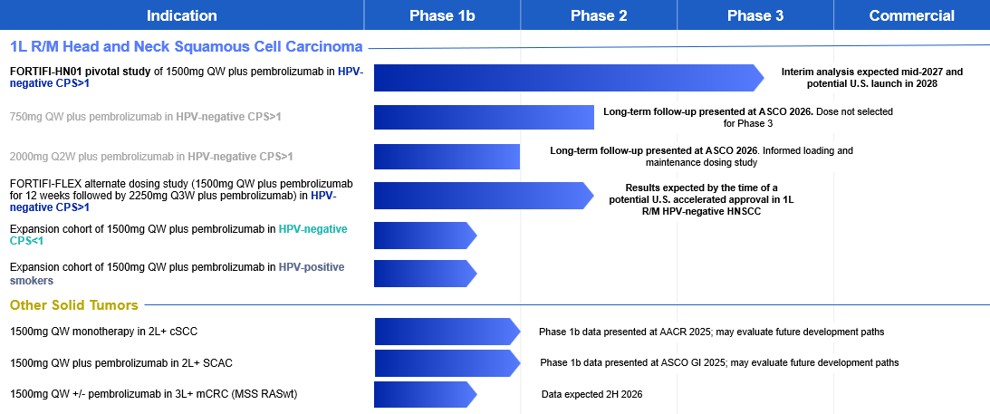
Our current development plan for ficerafusp alfa is summarized in the following pipeline chart:
27
Corporate Highlights, Recent Progress and Key Upcoming Milestones
•FORTIFI-HN01 Phase 2/3 pivotal trial: We are currently conducting a global, randomized, double-blind, Phase 2/3 FORTIFI-HN01 pivotal trial evaluating 1500mg dosed once weekly, or QW, of ficerafusp alfa in combination with pembrolizumab in first-line, or 1L, recurrent/metastatic, or R/M, human papillomavirus infection, or HPV, -negative head and neck squamous cell carcinoma, or HNSCC, whose tumors express programmed death-ligand 1 with combined positive score, or CPS, of ≥1. In January 2026, we announced that 1500mg QW of ficerafusp alfa was selected as the optimal dose to bring forward in the Phase 3 portion of the FORTIFI-HN01 trial. In February 2026, the transition to the Phase 3 portion of the FORTIFI-HN01 trial was completed. The dose determination was informed by the open-label data sets from our Phase 1/1b trial, as well as data from the treatment arms of the Phase 2 portion of the FORTIFI-HN01 trial. The FORTIFI-HN01 will enroll approximately 650 patients, which we believe is sufficiently designed to achieve results to support potential approval by the U.S. Food and Drug Association, or the FDA. We enrolled the first patients in the FORTIFI-HN01 trial in February 2025. We expect to achieve substantial enrollment by the end of 2026 to enable an interim analysis in mid-2027 to support potential accelerated approval and U.S. launch in 2028.
•Alternate dose study to evaluate loading and every-three-week maintenance regimen: In August 2026, we announced the initiation of FORTIFI-FLEX, a randomized clinical study that will evaluate ficerafusp alfa in combination with pembrolizumab, administered as a 12-week loading dose of 1500mg QW followed by maintenance dosing of 2250mg every three weeks. We expect to have results from this study by the time of potential U.S. accelerated approval in 1L R/M HPV-negative HNSCC. This builds on positive data we presented in February 2026 from the Phase 1b expansion cohort evaluating 2000mg of ficerafusp alfa every-other-week in combination with pembrolizumab in 1L R/M HPV-negative HNSCC at the 2026 Multidisciplinary Head and Neck Cancers Symposium, which supported our plans to develop an alternate dosing regimen to expand optionality for patients and providers.
•Phase 1b expansion cohorts
◦1500mg QW, 750mg QW and 2000mg Q2W plus pembrolizumab in 1L R/M HPV-negative HNSCC: In May 2026, we presented extended follow-up data out to three years from the Phase 1b study of ficerafusp alfa in combination with pembrolizumab in 1L R/M HPV-negative HNSCC at the 2026 American Society of Clinical Oncology Annual Meeting. As of the March 31, 2026 data snapshot, the data, which included the 750mg QW, 1500mg QW, and 2000mg every-other-week, or Q2W, expansion cohorts, showed deep, durable responses observed to be driven by TGF-β inhibition. All three dose cohorts demonstrated clinically meaningful duration of response, or DOR, progression-free survival, or PFS, and overall survival, or OS, representing substantial improvements over standard of care treatment, as well as a generally well-tolerated safety profile. Specifically, three-year follow-up from the 1500mg QW dose cohort showed an estimated overall survival rate of 31%, approximately doubling the survival rate observed in retrospective analysis with standard of care pembrolizumab in HPV-negative patients. Additionally, biomarker analyses across all three dose cohorts demonstrated sustained TGF-β inhibition and immune activation with ficerafusp alfa, reinforcing the mechanistic link between intra-tumoral TGF-β inhibition, immune activation, and the deep, durable responses. Across a pooled cohort analysis, two-thirds of responders achieved deep responses of greater than 80% tumor shrinkage and experienced more durable disease control, with meaningfully longer DOR, PFS, and OS compared to patients with partial responses of less than 80% tumor shrinkage, further reinforcing depth of response as a driver of long-term outcomes in patients with 1L R/M HPV-negative HNSCC.
◦1500mg QW plus pembrolizumab in 1L R/M HPV-negative HNSCC with CPS<1: We are continuing to enroll a Phase 1b expansion cohort evaluating 1500mg QW of ficerafusp alfa in combination with pembrolizumab in patients with 1L R/M HPV-negative HNSCC with a CPS<1.
◦1500mg QW plus pembrolizumab in 1L R/M HPV-positive smokers HNSCC: We are continuing to enroll an additional Phase 1b expansion cohort evaluating 1500mg QW of ficerafusp alfa in combination with pembrolizumab in patients with HPV-positive R/M HNSCC and a history of heavy smoking.
◦1500mg QW in other solid tumors: We are continuing to enroll Phase 1b expansion cohorts evaluating 1500mg QW of ficerafusp alfa both as monotherapy and in combination with pembrolizumab in patients with third-line metastatic colorectal cancer with microsatellite stable RAS/BRAF wild-type. We expect to present data from these cohorts in the second half of 2026. In 2025, we presented data from additional Phase 1b cohorts evaluating ficerafusp alfa monotherapy in patients with second-line or later cutaneous
28
squamous cell carcinoma, as well as ficerafusp alfa in combination with pembrolizumab in patients with second-line or later squamous cancer of the anal canal. These data demonstrated proof-of-concept in both indications and reinforced our conviction in ficerafusp alfa's broad applicability across TGF-β-driven tumors.
Since our inception in December 2018, we have not generated any revenue from product sales or other sources and have incurred significant operating losses and negative cash flows from our operations. Our primary uses of cash to date have been conducting research and development, advancing development of ficerafusp alfa, raising capital, building infrastructure, developing intellectual property, hiring personnel and providing general and administrative support for these operations. To date, we have funded our operations primarily through sale of common stock in connection with our initial public offering, or IPO, ATM Program (as defined below), our February 2026 Offering (as defined below), exercise of stock options, private placements of our redeemable convertible preferred stock, and through debt financing. As of June 30, 2026, we had raised aggregate net proceeds of $885.3 million and had cash, cash equivalents and marketable securities of $497.3 million. The February 2026 Offering closed on February 26, 2026 and resulted in net proceeds to us of approximately $161.8 million.
We have incurred operating losses in each year since our inception. Our net losses were $55.4 million and $27.4 million for the three months ended June 30, 2026 and 2025, respectively and $111.6 million and $64.2 million for the six months ended June 30, 2026 and 2025, respectively. As of June 30, 2026, we had an accumulated deficit of $470.6 million. We expect our expenses and operating losses will increase substantially as we:
•conduct our current and future clinical trials;
•continue our research and development activities;
•utilize third parties to manufacture our product candidate and related raw materials or, should we decide to do so, build and maintain a commercial-scale current good manufacturing practice, or cGMP, manufacturing facility;
•hire additional research and development, clinical and commercial, and operational personnel;
•add quality control, quality assurance, legal, compliance, and other groups to support our operations;
•maintain, expand, enforce, defend and protect our intellectual property portfolio (including intellectual property obtained through license agreements) and provide reimbursement of third-party expenses related to our patent portfolio;
•seek regulatory approvals for ficerafusp alfa or any future product candidates for which we successfully complete clinical trials;
•ultimately establish a sales, marketing and distribution infrastructure to commercialize ficerafusp alfa or any future product candidates for which we may obtain marketing approval;
•make any payments due under potential license agreements and any potential milestones, royalties or other payments due under any future in-license or collaboration agreements; and
•incur additional costs associated with being a public company.
Our net losses may fluctuate significantly from quarter-to-quarter and year-to-year, depending on the timing of our planned clinical trials, manufacturing and research and development activities.
Based upon our current operating plans, we believe that our existing cash, cash equivalents and marketable securities, will be sufficient to fund our operations and capital expenditure requirements into the first half of 2029. Without additional funding, we believe that we will have sufficient funds to meet our obligations within the next twelve months from the date of issuance of our condensed consolidated financial statements. We do not expect to generate any revenue from product sales unless and until we successfully complete development and obtain regulatory approval for ficerafusp alfa or future product candidates, which will not be for at least the next several years, if ever. If we obtain regulatory approval for ficerafusp alfa or any of our future product candidates, we expect to incur significant commercialization expenses related to product sales, marketing, manufacturing and distribution. Accordingly, until such time as we can generate significant revenue from sales of our product candidate, if ever, we expect to finance our cash needs through equity offerings, debt financings or other capital sources, including potential collaborations, licenses and other similar arrangements. See the section titled “Liquidity and Capital Resources” below. However, we may be unable to raise
29
additional funds or enter into such other arrangements when needed on favorable terms or at all. Our failure to raise capital or enter into such other arrangements when needed would have a negative impact on our financial condition and could force us to delay, limit, reduce or terminate our product development or future commercialization efforts or grant rights to develop and market product candidate that we would otherwise prefer to develop and market ourselves.
Components of Results of Operations
Revenue
We currently have no products approved for sale, and we have not generated any revenue to date. In the future, we may generate revenue from collaboration or license agreements we may enter into with respect to our product candidate, as well as product sales from any approved product, which approval we do not expect to occur for at least the next several years, if ever. Our ability to generate product revenue will depend on the successful development and eventual commercialization of ficerafusp alfa and any future product candidates we pursue. If we fail to complete clinical development of or to obtain regulatory approval for ficerafusp alfa or any future product candidates, our ability to generate future revenues, and our results of operations and financial position would be adversely affected.
Operating Expenses
Research and Development (including Research and Development—Related Party)
Research and development expenses (including related party research and development) have primarily consisted of external and internal costs associated with our research and development activities, including the development of our bifunctional ficerafusp alfa antibody therapies to treat solid tumors, and the clinical development of our product candidate. Our research and development expenses include:
•external expenses, including expenses incurred under arrangements with third parties, such as sponsored research agreements, consultants and our scientific advisors;
•the cost to obtain licenses to intellectual property;
•personnel-related costs, including salaries, bonuses, benefits, and stock-based compensation for employees engaged in research and development functions;
•costs for laboratory supplies, research materials and reagents; and
•the cost of developing and validating our manufacturing process for use in our future clinical trials.
Most of our research and development expenses have been related to the development of ficerafusp alfa. We use our personnel and infrastructure resources across the breadth of our research and development activities, which are directed toward identifying and developing our product candidate.
We expense all research and development costs in the periods in which they are incurred. Costs for certain research and development activities are recognized based on an evaluation of the progress to completion of specific tasks using information and data provided to us by our vendors, related parties and third-party service providers.
We plan to substantially increase our research and development expenses for the foreseeable future as we continue with the development of ficerafusp alfa and any other product candidates we may determine to pursue. Due to the inherently unpredictable nature of pre-clinical and clinical development, we cannot determine with certainty the timing of the initiation, duration or costs of future clinical trials and pre-clinical studies of product candidates. The timelines and costs associated with research and development activities are uncertain and can vary significantly for any product candidate we pursue, and development programs are inherently unpredictable due to the nature of clinical development. We anticipate we will make determinations as to which programs to pursue and how much funding to direct to each current program on an ongoing basis in response to clinical results, regulatory developments, and ongoing assessments as to each program’s commercial potential.
Research and development activities are central to our business model. Therapeutic candidates in later stages of clinical development generally have higher development costs than those in earlier stages, primarily due to the increased size and duration of later-stage clinical trials. As a result, we expect that our research and development expenses will increase substantially over the next several years as we expect to (i) advance ficerafusp alfa into late-stage clinical trials, (ii) develop ficerafusp alfa for other potential indications and (iii) expand our manufacturing efforts.
30
Our future development costs may vary significantly based on various factors such as timely and successful completion of clinical trials, positive results from our future clinical trials, receipt of marketing approvals from applicable regulatory authorities, establishment of arrangements with third parties, intellectual property updates, and continued acceptable safety, tolerability and efficacy profile of any product candidates that we may develop following approval. Any changes in the outcome of any of these variables with respect to the development of our therapeutic candidates in preclinical and clinical development could mean a significant change in the costs and timing associated with the development of these therapeutic candidates. For example, if the FDA or another regulatory authority were to delay our planned start of clinical trials or require us to conduct clinical trials or other testing beyond those that we currently expect, or if we experience significant delays in enrollment in any of our planned clinical trials, we could be required to expend significant additional financial resources and time to complete clinical development of that therapeutic candidate. We may never obtain regulatory approval for any of our therapeutic candidates, and, even if we do, drug commercialization takes several years and millions of dollars in development costs.
General and Administrative
General and administrative expenses consist primarily of personnel-related costs, including salaries, bonuses, benefits, and stock-based compensation charges for those individuals in executive, legal, finance, human resources, facility operations, and other administrative functions. Other significant costs include legal fees relating to intellectual property, litigation and corporate matters, professional fees for auditing, accounting, tax and consulting services, office and information technology costs, insurance costs, and facilities, depreciation and other general and administrative expenses, which include rent and maintenance of facilities and utilities.
We anticipate that our general and administrative expenses will increase for the foreseeable future to support our increased research and development activities. We also anticipate increased expenses related to audit, accounting, legal, regulatory, and tax-related services associated with maintaining compliance with our Nasdaq and Securities and Exchange Commission, or SEC, requirements, director and officer insurance premiums, and investor relations costs associated with operating as a public company.
Other (Expenses) Income
Interest Income
Interest income consists primarily of interest income earned on cash, cash equivalents and marketable securities.
Income Taxes
The Company’s provision for income taxes is not material for the three and six months ended June 30, 2026 and 2025.
Since our inception, we have not recorded any U.S. federal or state income tax benefits for the net losses we have incurred in each year or our earned research and development tax credits, due to our uncertainty of realizing a benefit from those items.
Other Comprehensive Loss
During the three and six months ended June 30, 2026, the Company held marketable securities in U.S. Treasury Bills. The unrealized loss on these instruments was recorded in Other Comprehensive Loss.
31
Results of Operations
Comparison of the three months ended June 30, 2026 and 2025
The following table summarizes our results of operations for the three months ended June 30, 2026 and 2025 (in thousands):
Three Months Ended June 30, | ||||||||||||||||||||
2026 | 2025 | Change | ||||||||||||||||||
Operating Expenses: | ||||||||||||||||||||
Research and development—related party | $ | 911 | $ | 2,932 | $ | (2,021) | ||||||||||||||
Research and development | 44,862 | 21,866 | 22,996 | |||||||||||||||||
General and administrative | 14,178 | 7,220 | 6,958 | |||||||||||||||||
Total operating expenses | 59,951 | 32,018 | 27,933 | |||||||||||||||||
Loss from operations | (59,951) | (32,018) | (27,933) | |||||||||||||||||
Other income | ||||||||||||||||||||
Interest income | 4,576 | 4,682 | (106) | |||||||||||||||||
Total other income | 4,576 | 4,682 | (106) | |||||||||||||||||
Net loss before income taxes | (55,375) | (27,336) | (28,039) | |||||||||||||||||
Income tax expense | (61) | (52) | (9) | |||||||||||||||||
Net loss | $ | (55,436) | $ | (27,388) | $ | (28,048) | ||||||||||||||
Research and Development Expenses (including Research and Development—Related Party)
Research and development expenses increased by $21.0 million from $24.8 million for the three months ended June 30, 2025 to $45.8 million for the three months ended June 30, 2026.
The following table summarizes our research and development expenses for the three months ended June 30, 2026 and 2025 (in thousands):
Three Months Ended June 30, | ||||||||||||||||||||
2026 | 2025 | Change | ||||||||||||||||||
Manufacturing and process development | $ | 11,484 | $ | 8,266 | $ | 3,218 | ||||||||||||||
Clinical operations and development | 21,384 | 10,461 | 10,923 | |||||||||||||||||
Research and development personnel cost and other (including stock-based compensation) | 12,469 | 5,528 | 6,941 | |||||||||||||||||
Research | 436 | 543 | (107) | |||||||||||||||||
Total research and development expenses | $ | 45,773 | $ | 24,798 | $ | 20,975 | ||||||||||||||
The increase in research and development expenses for the three months ended June 30, 2026, compared to the three months ended June 30, 2025 was primarily due to:
•approximately $3.2 million in increased manufacturing and process development cost, driven by cost to purchase pembrolizumab in connection with our Phase 2/3 FORTIFI-HN01 pivotal trial;
•approximately $10.9 million in increased clinical operation and development cost, driven by costs associated with our Phase 2/3 FORTIFI-HN01 pivotal trial and continued patient enrollment in our ongoing Phase 1/1b trials; and
•approximately $6.9 million in increased personnel related costs, including stock-based compensation, driven by higher number and value of stock options granted and an increase in the size of our workforce to support clinical development, manufacturing and research and increased professional service expenses as we continue to build out our clinical operations and development functions.
32
General and Administrative Expenses
General and administrative expenses increased by $7.0 million from $7.2 million for the three months ended June 30, 2025 to $14.2 million for the three months ended June 30, 2026. The following table summarizes our general and administrative expenses for the six months ended June 30, 2026 and 2025 (in thousands):
Three Months Ended June 30, | ||||||||||||||||||||
2026 | 2025 | Change | ||||||||||||||||||
General and administrative personnel costs (including stock-based compensation) | $ | 8,871 | $ | 4,854 | $ | 4,017 | ||||||||||||||
Professional fees | 4,677 | 1,392 | 3,285 | |||||||||||||||||
Facility costs, insurance, IT, office expense and other | 630 | 974 | (344) | |||||||||||||||||
Total general and administrative expenses | $ | 14,178 | $ | 7,220 | $ | 6,958 | ||||||||||||||
The increase in general and administrative expenses for the three months ended June 30, 2026, compared to the three months ended June 30, 2025 was primarily due to:
•approximately $4.0 million in increased personnel related costs, including stock-based compensation, driven by an increase in the size of our workforce and by a higher number and value of stock options granted; and
•approximately $3.3 million in increased professional service expenses associated with higher legal, accounting, commercial and other expenses as we continue to build out our general and administrative functions to support advancement of our clinical trials and prepare for potential commercial launch.
Other Income
Interest income
Interest income for the three months ended June 30, 2026 and 2025 was $4.6 million and $4.7 million, respectively. The decrease was primarily due to lower interest rates.
Comparison of the six months ended June 30, 2026 and 2025
The following table summarizes our results of operations for the six months ended June 30, 2026 and 2025 (in thousands):
Six Months Ended June 30, | ||||||||||||||||||||
2026 | 2025 | Change | ||||||||||||||||||
Operating Expenses: | ||||||||||||||||||||
Research and development—related party | $ | 2,892 | $ | 9,507 | $ | (6,615) | ||||||||||||||
Research and development | 90,345 | 49,624 | 40,721 | |||||||||||||||||
General and administrative | 26,954 | 14,675 | 12,279 | |||||||||||||||||
Total operating expenses | 120,191 | 73,806 | 46,385 | |||||||||||||||||
Loss from operations | (120,191) | (73,806) | (46,385) | |||||||||||||||||
Other income | ||||||||||||||||||||
Interest income | 8,659 | 9,696 | (1,037) | |||||||||||||||||
Total other income | 8,659 | 9,696 | (1,037) | |||||||||||||||||
Net loss before income taxes | (111,532) | (64,110) | (47,422) | |||||||||||||||||
Income tax expense | (115) | (124) | 9 | |||||||||||||||||
Net loss | $ | (111,647) | $ | (64,234) | $ | (47,413) | ||||||||||||||
Research and Development Expenses (including Research and Development—Related Party)
Research and development expenses increased by $34.1 million from $59.1 million for the six months ended June 30, 2025 to $93.2 million for the six months ended June 30, 2026.
33
The following table summarizes our research and development expenses for the six months ended June 30, 2026 and 2025 (in thousands):
Six Months Ended June 30, | ||||||||||||||||||||
2026 | 2025 | Change | ||||||||||||||||||
Manufacturing and process development | $ | 34,277 | $ | 26,921 | $ | 7,356 | ||||||||||||||
Clinical operations and development | 36,311 | 20,487 | 15,824 | |||||||||||||||||
Research and development personnel cost and other (including stock-based compensation) | 21,588 | 10,624 | 10,964 | |||||||||||||||||
Research | 1,061 | 1,099 | (38) | |||||||||||||||||
Total research and development expenses | $ | 93,237 | $ | 59,131 | $ | 34,106 | ||||||||||||||
The increase in research and development expenses for the six months ended June 30, 2026, compared to the six months ended June 30, 2025 was primarily due to:
•approximately $7.4 million in increased manufacturing and process development cost, driven by additional batch manufacturing of drug substance in connection with our Phase 2/3 FORTIFI-HN01 pivotal trial and Phase 1/1b clinical trial and cost to purchase pembrolizumab in connection with our Phase 2/3 FORTIFI-HN01 pivotal trial:
•approximately $15.8 million in increased clinical operation and development cost, driven by costs associated with our Phase 2/3 FORTIFI-HN01 pivotal trial and continued patient enrollment in our ongoing Phase 1/1b trials; and
•approximately $11.0 million in increased personnel related costs, including stock-based compensation, driven by higher number and value of stock options granted and an increase in the size of our workforce to support clinical development, manufacturing and research and increased professional service expenses as we continue to build out our clinical operations and development functions.
General and Administrative Expenses
General and administrative expenses increased by $12.3 million from $14.7 million for the six months ended June 30, 2025 to $27.0 million for the six months ended June 30, 2026. The following table summarizes our general and administrative expenses for the six months ended June 30, 2026 and 2025 (in thousands):
Six Months Ended June 30, | ||||||||||||||||||||
2026 | 2025 | Change | ||||||||||||||||||
General and administrative personnel costs (including stock-based compensation) | $ | 16,834 | $ | 9,686 | $ | 7,148 | ||||||||||||||
Professional fees | 8,960 | 2,896 | 6,064 | |||||||||||||||||
Facility costs, insurance, IT, office expense and other | 1,160 | 2,093 | (933) | |||||||||||||||||
Total general and administrative expenses | $ | 26,954 | $ | 14,675 | $ | 12,279 | ||||||||||||||
The increase in general and administrative expenses for the six months ended June 30, 2026, compared to the six months ended June 30, 2025 was primarily due to:
•approximately $7.1 million in increased personnel related costs, including stock-based compensation, driven by an increase in the size of our workforce and by a higher number and value of stock options granted; and
•approximately $6.1 million in increased professional service expenses associated with higher legal, accounting, commercial and other expenses as we continue to build out our general and administrative functions to support advancement of our clinical trials and prepare for potential commercial launch.
34
Other Income
Interest income
Interest income for the six months ended June 30, 2026 and 2025 was $8.7 million and $9.7 million, respectively. The decrease was primarily due to lower interest rates.
Liquidity and Capital Resources
Sources of Liquidity
Since our inception in December 2018, we have not generated any revenue from any sources and have incurred significant operating losses and negative cash flows from operations. We expect to incur significant expenses and operating losses for the foreseeable future as we advance the clinical development of ficerafusp alfa or any future product candidates we elect to pursue. Further, we expect to incur additional costs associated with operating as a public company. From our inception in December 2018 through June 30, 2026, we have received aggregate net proceeds of $885.3 million from the sale of our common stock in the IPO, ATM Program and the February 2026 Offering, the exercise of stock options, and sale of redeemable convertible preferred stock in private placements and debt financing.
“At-the-Market” Offering
On October 3, 2025, we filed a Registration Statement on Form S-3 with the SEC covering the offering of up to $400.0 million of common stock, preferred stock, debt securities, warrants and/or units. The Registration Statement was declared effective by the SEC on November 26, 2025. Concurrent with the filing of the Registration Statement, we entered into a sales agreement, dated October 3, 2025, by and between the Company and TD Securities (USA) LLC, acting as sales agent, to establish an at-the-market offering program pursuant to which we may offer and sell shares of our common stock from time to time, or the ATM Program. In connection with the ATM Program, we filed a prospectus with the Registration Statement for the offer and sale of up to $150.0 million of shares of common stock from time to time through the sales agent. As market conditions permit, we may offer and sell securities under the Registration Statement, including through the ATM Program, in order to fund our operations or provide additional liquidity. During the three and six months ended June 30, 2026, there were no sales of our common stock through the ATM Program. As of June 30, 2026, a total of 1,604,000 shares of our common stock had been sold through the ATM Program, resulting in net proceeds to us of $29.5 million.
February 2026 Offering
In February 2026, we issued and sold 8,581,250 shares of its common stock, including 1,406,250 shares pursuant to the exercise of the underwriters’ option to purchase additional shares, at a price to the public of $16.00 per share, and in lieu of common stock to certain investors, we sold pre-funded warrants to purchase 2,200,000 shares of common stock at a public offering price of $15.9999 per pre-funded warrant, which represents the per share public offering price of each share of common stock less the $0.0001 per share exercise price for each pre-funded warrant, or the February 2026 Offering. The February 2026 Offering closed on February 26, 2026 and resulted in net proceeds to us of approximately $161.8 million.
Future Funding Requirements
As of June 30, 2026, we had cash, cash equivalents and marketable securities of $497.3 million. Based upon our current operating plans, we believe that our existing cash, cash equivalents and marketable securities will be sufficient to fund our operations and capital expenditure requirements into the first half of 2029. However, our forecast of the period of time through which our financial resources will be adequate to support our operations is a forward-looking statement that involves risks and uncertainties, and actual results could vary materially. Additionally, the process of testing our product candidate in clinical trials is costly, and the timing of progress and expenses in these trials is uncertain. We will need to raise substantial additional capital in the future.
Our future capital requirements will depend on many factors, including but not limited to:
•the type, number, scope, progress, expansions, results, costs, and timing of clinical trials of ficerafusp alfa and future product candidates;
35
•the costs and timing of manufacturing for ficerafusp alfa and any future product candidates and commercial manufacturing thereof;
•the costs, timing, and outcome of regulatory review of ficerafusp alfa and any future product candidates;
•the terms and timing of establishing and maintaining licenses and other similar arrangements;
•the legal costs of obtaining, maintaining, and enforcing our patents and other intellectual property rights (including intellectual property obtained through license agreements);
•our efforts to enhance operational systems and hire additional personnel to satisfy our obligations as a public company;
•the costs associated with hiring additional personnel and consultants as our clinical activities increase;
•the costs and timing of establishing or securing sales and marketing capabilities if ficerafusp alfa or any future product candidate is approved;
•our ability to achieve sufficient market acceptance, coverage and adequate reimbursement from third-party payors and adequate market share and revenue for any approved products; and
•costs associated with any products or technologies that we may in-license or acquire.
Until such time, if ever, as we can generate substantial product revenue to support our cost structure, we expect to finance our cash needs through equity offerings, debt financings, or other capital sources, potentially including collaborations, licenses and other similar arrangements. However, we may be unable to raise additional funds or enter into such other arrangements when needed on favorable terms or at all. To the extent that we raise additional capital through the sale of equity or convertible debt securities, the ownership interest of our stockholders will be or could be diluted, and the terms of these securities may include liquidation or other preferences that adversely affect the rights of our common stockholders. Debt financing and equity financing, if available, may involve agreements that include covenants limiting or restricting our ability to take specific actions, such as incurring additional debt, making capital expenditures, or declaring dividends. If we raise funds through collaborations, or other similar arrangements with third parties, we may have to relinquish valuable rights to our technologies, future revenue streams, research programs or current or future product candidates or grant licenses on terms that may not be favorable to us and/or may reduce the value of our common stock. Our failure to raise capital or enter into such other arrangements when needed could have a negative impact on our financial condition and on our ability to pursue our business plans and strategies. If we are unable to raise additional funds through equity or debt financings when needed, we may be required to delay, limit, reduce or terminate our product development or future commercialization efforts or grant rights to develop and market our current or future product candidates even if we would otherwise prefer to develop and market such product candidates ourselves.
Cash Flows
Comparison of the Six Months Ended June 30, 2026 and 2025
The following table sets forth a summary of the net cash flow activity for the six months ended June 30, 2026 and 2025 (in thousands):
Six Months Ended June 30, | ||||||||||||||
2026 | 2025 | |||||||||||||
Net cash used in operating activities | $ | (81,714) | $ | (53,700) | ||||||||||
Net cash used in investing activities | (84,049) | — | ||||||||||||
Net cash provided by financing activities | 165,677 | 595 | ||||||||||||
Net decrease in cash and cash equivalents | $ | (86) | $ | (53,105) | ||||||||||
Operating Activities
For the six months ended June 30, 2026, net cash used in operating activities was $81.7 million resulting from our net loss of $111.6 million, partially offset by net increases in our operating assets and liabilities of $14.6 million and by non-cash charges of $15.3 million, consisting of stock-based compensation expense, depreciation and non-cash lease expense.
36
For the six months ended June 30, 2025, net cash used in operating activities was $53.7 million resulting from our net loss of $64.2 million, partially offset by net increase in our operating assets and liabilities of $3.2 million and non-cash charges of $7.3 million. Non-cash charges consisted of stock-based compensation expense, depreciation and non-cash lease charges.
Investing Activities
Net cash used in investing activities was $84.0 million for the six months ended June 30, 2026, resulting from cash used to purchase $244.9 million marketable securities, partially offset by proceeds from maturity of marketable securities in 2026 totaling $161.0 million, which were purchased in the third quarter of 2025.
Financing Activities
Net cash provided by financing activities was $165.7 million for the six months ended June 30, 2026, consisting primarily of proceeds from the offering of common stock and pre-funded warrants in February 2026 and proceeds from the exercise of stock options.
Net cash provided by financing activities was $0.6 million for the six months ended June 30, 2025, consisting primarily of proceeds from the exercise of common stock options.
Critical Accounting Policies and Estimates
This discussion and analysis of our financial condition and results of operations is based on our condensed consolidated financial statements, which we have prepared in accordance with GAAP. The preparation of our financial statements and related disclosures requires us to make estimates, assumptions and judgments that affect the reported amount of assets, liabilities, costs and expenses, and related disclosures. During the three months ended June 30, 2026, there were no material changes to our critical accounting policies and significant judgments described under Management’s Discussion and Analysis of Critical Accounting Policies and Significant Judgments which are included in our Annual Report on Form 10-K for the fiscal year ended December 31, 2025.
Emerging Growth Company and Smaller Reporting Company Status
The Jumpstart Our Business Startups Act of 2012, or JOBS, permits an “emerging growth company” such as us to take advantage of an extended transition to comply with new or revised accounting standards applicable to public companies until those standards would otherwise apply to private companies. We have elected not to “opt out” of such extended transition period, which means that when a standard is issued or revised and it has different application dates for public or private companies, we will adopt the new or revised standard at the time private companies adopt the new or revised standard and will do so until such time that we either (i) irrevocably elect to “opt out” of such extended transition period or (ii) no longer qualify as an emerging growth company. We may choose to early adopt any new or revised accounting standards whenever such early adoption is permitted for private companies. There are other exemptions and reduced reporting requirements provided by the JOBS Act that we are currently evaluating. For example, as an “emerging growth company,” we are exempt from Sections 14A(a) and (b) of the Securities Exchange Act of 1934, as amended, which would otherwise require us to (1) submit certain executive compensation matters to shareholder advisory votes, such as “say-on-pay,” “say-on-frequency,” and “golden parachutes;” and (2) disclose certain executive compensation related items such as the correlation between executive compensation and performance and comparisons of our chief executive officer’s compensation to our median employee compensation. We also intend to rely on an exemption from the rule requiring us to provide an auditor’s attestation report on our internal controls over financial reporting pursuant to Section 404(b) of the Sarbanes-Oxley Act. We will continue to remain an “emerging growth company” until the earliest of the following: (1) the last day of the fiscal year following the fifth anniversary of the date of the completion of our IPO; (2) the last day of the fiscal year in which our total annual gross revenue is equal to or more than $1.235 billion; (3) the date on which we have issued more than $1 billion in nonconvertible debt during the previous three years; or (4) the date on which we are deemed to be a large accelerated filer under the rules of the SEC.
We are also a “smaller reporting company” as defined in the Exchange Act. We may continue to be a smaller reporting company even after we are no longer an emerging growth company. We may take advantage of certain of the scaled disclosures available to smaller reporting companies for so long as either (i) our voting and non-voting common stock held by non-affiliates is less than $250.0 million measured on the last business day of our second fiscal quarter, or (ii) our annual revenue is less than $100.0 million during the most recently completed fiscal year and our voting and non-voting common stock held by non-affiliates is less than $700.0 million measured on the last business day of our second fiscal quarter.
37
Recent Accounting Pronouncements
A description of recently issued accounting pronouncements that may potentially impact our financial position and results of operations is disclosed in Note 2 titled “Summary of Significant Accounting Policies” to our condensed consolidated financial statements included elsewhere in this Quarterly Report on Form 10-Q.
Item 3. Quantitative and Qualitative Disclosures About Market Risk
Information required by this Item is not applicable as we are electing scaled disclosure requirements available to Smaller Reporting Companies with respect to this Item.
Item 4. Controls and Procedures
Evaluation of Disclosure Controls and Procedures
We maintain disclosure controls and procedures (as defined in Rules 13a-15(e) and 15d-15(e) under the Securities Exchange Act of 1934, as amended, or the Exchange Act) designed to ensure that information required to be disclosed in the reports that we file or submit under the Exchange Act is recorded, processed, summarized and reported within the time periods specified in the SEC’s rules and forms and is accumulated and communicated to management, including the principal executive officer (our Chief Executive Officer) and principal financial officer (our Chief Financial Officer), to allow timely decisions regarding required disclosure. In designing and evaluating our disclosure controls and procedures, management recognizes that any controls and procedures, no matter how well designed and operated, can provide only reasonable assurance of achieving their objectives, and management necessarily applies judgment in evaluating the benefits of possible controls and procedures relative to their costs.
Our management, with the participation of our Chief Executive Officer and Chief Financial Officer, has evaluated the effectiveness of our disclosure controls and procedures (as defined in Rules 13a-15(e) and 15d-15(e) under the Securities Exchange Act of 1934, as amended) as of June 30, 2026. Based on such evaluation, our Chief Executive Officer and Chief Financial Officer have concluded that our disclosure controls and procedures were effective at the reasonable assurance level as of June 30, 2026.
Changes in Internal Control over Financial Reporting
There were no changes in our internal control over financial reporting (as defined in Rules 13a-15(f) and 15d-15(f) under the Exchange Act) that occurred during the quarter ended June 30, 2026 that have materially affected, or are reasonably likely to materially affect, our internal control over financial reporting.
38
PART II—OTHER INFORMATION
Item 1. Legal Proceedings.
We are subject to various litigation, claims and other proceedings that arise from time to time in the ordinary course of business. On October 22, 2024, a complaint was filed in federal district court in the District of Massachusetts by Y-Trap, Inc., or Y-Trap, naming as defendants us and Biocon Ltd, or Biocon, captioned Y-Trap, Inc. v. Biocon Ltd and Bicara Therapeutics Inc., No. 24-cv-12678 (D. Mass.). On January 31, 2025, Y-Trap filed its operative amended complaint. The operative complaint alleges a claim against the defendants for correction of inventorship of a number of patents based on a license from The Johns Hopkins University, including patents licensed to us relating to ficerafusp alfa. The complaint also alleges claims against defendants for unfair trade practices pursuant to Chapter 93A of the Massachusetts General Laws, unjust enrichment, and civil conspiracy. The operative complaint seeks, among other things, damages (including compensatory, enhanced, and punitive damages), an order correcting the inventorship of the patents at issue, costs and attorney’s fees, and other equitable and injunctive relief. On February 28, 2025, we and Biocon moved to dismiss all of Y-Trap’s claims. On September 30, 2025, the court denied our motion. On October 30, 2025, we answered the operative complaint, and discovery is ongoing. We will continue to vigorously defend against this litigation.
On July 15, 2026, the Patent Trial and Appeal Board (“PTAB”) of the United States Patent and Trademark Office instituted a post-grant review petition brought by us against The John Hopkins University, No. PGR2026-00025, concerning a patent in a family alleged to be licensed to Y-Trap, U.S. Patent 12,295,968 (“the ’968 patent”). We challenge all claims of the ’968 patent under 35 U.S.C. § 112. It is anticipated that the PTAB will issue a final written decision on or before July 14, 2027.
39
Item 1A. Risk Factors.
Investing in our common stock involves a high degree of risk. You should consider and read carefully all of the risks and uncertainties described below, as well as the other information in this Quarterly Report on Form 10-Q, including our condensed consolidated financial statements and the related notes appearing elsewhere in this Quarterly Report on Form 10-Q and the section titled “Management’s Discussion and Analysis of Financial Condition and Results of Operations” before deciding whether to invest in our common stock. The risks described below are not the only ones facing us. The following risks or additional risks and uncertainties not presently known to us or that we currently believe to be immaterial could materially and adversely affect our business, financial condition, results of operations and growth prospects. In such an event, the trading price of our common stock could decline, and you may lose all or part of your investment.
This Quarterly Report on Form 10-Q also contains forward-looking statements and estimates that involve risks and uncertainties not presently known to us or that we currently deem immaterial that also may impair our business operations. Our actual results could differ materially from those anticipated in our forward-looking statements as a result of specific factors, including the risks and uncertainties described below.
Risks Related to Our Limited Operating History, Financial Condition and Need for Additional Capital
We are a clinical-stage biopharmaceutical company with a limited operating history, which may make it difficult to evaluate our current business and predict our future success and viability. We have incurred significant financial losses since our inception and anticipate that we will continue to incur significant financial losses for the foreseeable future.
We are a clinical-stage biopharmaceutical company with a limited operating history. We were formed in December 2018, and our operations to date have been limited to pre-commercial activities. We have not yet demonstrated an ability to generate revenue, obtain regulatory approval, manufacture any product on a commercial scale or arrange for a third party to do so on our behalf or conduct sales and marketing activities necessary for successful product commercialization. Our limited operating history as a company makes any assessment of our future success and viability subject to significant uncertainty. We will encounter risks and difficulties frequently experienced by early-stage biopharmaceutical companies in rapidly evolving fields, and we have not yet demonstrated an ability to successfully overcome such risks and difficulties. If we do not address these risks and difficulties successfully, our business will suffer.
We have no products approved for commercial sale and have not generated any revenue from product sales to date. We will continue to incur significant research and development and other expenses related to clinical development and ongoing operations. As a result, we are not profitable and have incurred losses in each period since our inception. Net losses and negative cash flows have had, and will continue to have, an adverse effect on our stockholders’ equity and working capital. Our net losses totaled $55.4 million and $27.4 million for the three months ended June 30, 2026 and 2025, respectively and $111.6 million and $64.2 million for the six months ended June 30, 2026 and 2025, respectively. As of June 30, 2026, we have not yet generated revenues. We expect to continue to incur significant losses for the foreseeable future, and we expect these losses to increase as we continue our research and development of, and seek regulatory approvals for, ficerafusp alfa.
We anticipate that our expenses will increase substantially if, and as, we:
•advance ficerafusp alfa through clinical development;
•seek regulatory approvals for ficerafusp alfa and any of our future product candidates that successfully complete clinical trials;
•hire additional clinical, quality control, medical, scientific and other technical personnel to support the clinical development of ficerafusp alfa and any future product candidate;
•experience an increase in headcount as we expand our market development and pre-commercial planning activities;
•undertake any pre-commercial or commercial activities to establish sales, marketing and distribution capabilities;
•advance any future product candidates into clinical development;
•seek to identify, acquire and develop additional product candidates, including through business development efforts to invest in or in-license other technologies or product candidates;
•maintain, expand and protect our intellectual property portfolio;
•make any payments due under our license agreements and any potential milestones, royalties or other payments due under any future in-license or collaboration agreements; and
•make milestone, royalty, interest or other payments due under any future financing or other arrangements with third parties.
40
Biopharmaceutical product development entails substantial upfront capital expenditures and significant risk that any potential product candidate will fail to demonstrate adequate efficacy or an acceptable safety profile, gain regulatory approval, secure market access and reimbursement and become commercially viable, and therefore any investment in us is highly speculative. Accordingly, before making an investment in us, you should consider our prospects, factoring in the costs, uncertainties, delays and difficulties frequently encountered by companies in clinical development, especially clinical-stage biopharmaceutical companies such as ours. Any predictions you make about our future success or viability may not be as accurate as they would otherwise be if we had a longer operating history or a history of successfully developing and commercializing pharmaceutical products. We may encounter unforeseen expenses, difficulties, complications, delays and other known or unknown factors in achieving our business objectives.
Additionally, our expenses could increase beyond our expectations if we are required by the U.S. Food and Drug Administration, or the FDA, Health Canada, the European Medicines Agency, or the EMA, or other comparable regulatory authorities to perform clinical trials in addition to those that we currently expect, or if there are any delays in establishing appropriate manufacturing arrangements for or in completing our clinical trials or the development of any of our product candidates.
If we are unable to raise capital when needed, or on acceptable terms, we may be unable to complete the development and commercialization of ficerafusp alfa or any future product candidates.
Developing biopharmaceutical products, including conducting preclinical studies and clinical trials, is a very time-consuming, expensive and uncertain process that takes years to complete. We expect our expenses to continue to increase in connection with our ongoing activities, particularly as we conduct clinical trials of, and seek regulatory and marketing approval for, ficerafusp alfa. Even if ficerafusp alfa or any future product candidates are approved for commercial sale, we anticipate incurring significant costs associated with commercializing any approved product candidate. To date, we have funded our operations principally through our initial public offering, or our IPO, our ATM Program (as defined below), the February 2026 Offering (as defined below), and private financings and may in the future fund operations through additional sales of our securities, including under our ATM Program. We expect our expenses to increase in connection with our ongoing activities, particularly as we continue the clinical development of ficerafusp alfa, continue to develop and deploy our bifunctional approach, commence additional preclinical studies and clinical trials, and continue to identify and develop additional product candidates either through internal development or through acquisitions or in-licensing product candidates.
As of June 30, 2026, we had $497.3 million of cash, cash equivalents and marketable securities. Based upon our current operating plan, we believe that our existing cash, cash equivalents and marketable securities will enable us to fund our operating expenses and capital expenditure requirements into the first half of 2029. We have based this estimate on assumptions that may prove to be wrong, and we could utilize our available capital resources sooner than we expect. We may also raise additional financing on an opportunistic basis in the future. For example, we may seek additional capital due to favorable market conditions or strategic considerations even if we believe we have sufficient funds for our current or future operating plans. Attempting to secure additional financing may divert our management from our day-to-day activities, which may adversely affect our ability to develop ficerafusp alfa. Our future capital requirements will depend on many factors, including but not limited to:
•the scope, timing, progress, costs and results of clinical trials for ficerafusp alfa or the discovery and preclinical development of any future product candidates;
•the number of clinical trials required for regulatory approval of ficerafusp alfa or future product candidates;
•the costs, timing and outcome of regulatory review of ficerafusp alfa or any future product candidates;
•the costs associated with acquiring or licensing additional product candidates, technologies or assets, including the timing and amount of any milestones, royalties or other payments due in connection with our acquisitions and licenses;
•the cost of manufacturing clinical and commercial supplies of ficerafusp alfa or any future product candidates;
•the costs and timing of preparing, filing and prosecuting patent applications, maintaining and enforcing our intellectual property rights and defending any intellectual property-related claims, including any claims by third parties that we are infringing upon their intellectual property rights;
•the effectiveness of our approach at identifying target patient populations and utilizing our approach to enrich our patient population in our clinical trials;
•our ability to maintain existing, and establish new, strategic collaborations or other arrangements and the financial terms of any such agreements, including the timing and amount of any future milestone, royalty or other payments due under any such agreement;
•the costs and timing of future commercialization activities, including manufacturing, marketing, sales and distribution, for any of our product candidates for which we receive marketing approval;
41
•the revenue, if any, received from commercial sales of our product candidates for which we receive marketing approval;
•expenses to attract, hire and retain skilled personnel;
•the costs of operating as a public company;
•our ability to establish a commercially viable pricing structure and obtain approval for coverage and adequate reimbursement from third-party and government payors;
•the effect of macroeconomic trends including inflation and rising interest rates;
•addressing any potential supply chain interruptions or delays;
•the effect of competing technological and market developments; and
•the extent to which we acquire or invest in business, products and technologies.
Because of the numerous risks and uncertainties associated with research and development of product candidates, we may not be able to accurately predict the timing or amount of our working capital requirements. In addition, if we obtain regulatory approval for ficerafusp alfa, we expect to incur significant commercialization expenses related to product manufacturing, marketing, sales and distribution which make it difficult to predict when or if we will be able to achieve or maintain profitability. Furthermore, we expect to continue to incur increased costs associated with operating as a public company. Accordingly, we will need to obtain substantial additional funding in order to support our continuing operations. Our ability to raise additional funds will depend on financial, economic, political and market conditions and other factors, over which we may have no or limited control. Additional funds may not be available when we need them, on terms that are acceptable to us, or at all. If we fail to obtain necessary capital when needed on acceptable terms, or at all, it could force us to delay, limit, reduce or terminate our product development programs, future commercialization efforts or other operations.
Raising additional capital may cause dilution to our stockholders, restrict our operations or require us to relinquish rights to ficerafusp alfa.
Until such time, if ever, as we can generate substantial product revenue, we expect to finance our operations with our existing cash, cash equivalents and marketable securities, the net proceeds from our IPO, sales of our common stock under our ATM Program, marketable securities, equity financings, or any future equity or debt financings and upfront and milestone and royalties payments, if any, received under any future licenses or collaborations. In the future, if we raise additional capital through the sale of equity or convertible debt securities or issue any equity or convertible debt securities in connection with a collaboration agreement or other contractual arrangement, your ownership interest will be diluted, and the terms of these securities may include liquidation or other preferences that adversely affect your rights as a holder of our common stock. In addition, the possibility of such issuance may cause the market price of our common stock to decline. In October 2025, we filed a Registration Statement pursuant to which we may issue up to $400.0 million in shares of our common stock, preferred stock, debt securities, warrants and/or units. Concurrent with the filing of the Registration Statement, we entered into a common stock sales agreement, dated October 3, 2025, by and between the Company and TD Securities (USA) LLC, acting as the sales agent, to establish an at-the-market offering program pursuant to which we may offer and sell shares of our common stock from time to time, or the ATM Program. In connection with the ATM Program, we filed a prospectus with the Registration Statement for the offer and sale of up to $150.0 million of shares of common stock from time to time through the sales agents, or the ATM Prospectus. As of June 30, 2026, we have sold 1,604,000 shares of common stock under our ATM Program for aggregate net proceeds to us of $29.5 million. In February 2026, we entered into an underwriting agreement with Morgan Stanley & Co. LLC, TD Securities (USA) LLC and BofA Securities, Inc., as representatives of the underwriters named therein, pursuant to which we issued and sold an aggregate of 8,581,250 shares of our common stock at a price to the public of $16.00 per share, which included full exercise of the underwriters’ option to purchase 1,406,250 additional shares, and pre-funded warrants to purchase up to 2,200,000 shares of common stock to the underwriters at a public offering price of $15.9999 per pre-funded warrant, or the February 2026 Offering. The February 2026 Offering resulted in net proceeds to us of approximately $161.8 million. As market conditions permit, we may offer and sell securities under the Registration Statement, including through the ATM Program or additional equity financings, which may cause dilution to our stockholders or impact the market price of our common stock.
Debt financing, if available, may result in increased fixed payment obligations and involve agreements that include covenants limiting or restricting our ability to take specific actions, such as incurring additional debt, making capital expenditures, declaring dividends or acquiring, selling or licensing intellectual property rights or assets, which could adversely impact our ability to conduct our business.
If we raise additional funds through collaborations, strategic alliances or marketing, distribution or licensing arrangements with third parties in the future, we may have to relinquish valuable rights to our intellectual property, technologies, future
42
revenue streams or product candidates or grant licenses on terms that may not be favorable to us. We could also be required to seek funds through arrangements with collaborators or others at an earlier stage than otherwise would be desirable. Any of these occurrences may have a material adverse effect on our business, operating results and prospects.
We maintain the majority of our cash, cash equivalents and marketable securities in accounts with major U.S. and multi-national financial institutions, and our deposits at certain of these institutions exceed insured limits. Market conditions and changes in financial regulations and policies can impact the viability of these institutions. In the event of failure of any of the financial institutions where we maintain our cash, cash equivalents and marketable securities, there can be no assurance that we would be able to access uninsured funds in a timely manner or at all. Any inability to access or delay in accessing these funds could adversely affect our business and financial position. In addition, changes in regulations governing financial institutions are beyond our control and difficult to predict; consequently, the impact of such changes on our business and results of operations is difficult to predict and may have an adverse effect on us.
Risks Related to Our Business Operations and Industry
Our business is highly dependent on the success of ficerafusp alfa. If we are unable to successfully complete clinical development, obtain regulatory approval for or commercialize ficerafusp alfa, or if we experience delays in doing so, our business will be materially harmed.
To date, as an organization, we have not completed the development of any product candidates, and ficerafusp alfa remains in clinical development. Our future success and ability to generate revenue from ficerafusp alfa is dependent on our ability to successfully develop and commercialize ficerafusp alfa or any of our future product candidates. If any of our product candidates encounters safety or efficacy problems, development delays or regulatory issues or other problems, our development plans and business would be materially harmed.
We may not have the financial resources to continue development of ficerafusp alfa if we experience any issues that delay or prevent regulatory approval of, or our ability to commercialize, ficerafusp alfa, including:
•our inability to demonstrate to the satisfaction of the FDA, Health Canada, the EMA or other comparable regulatory authorities that ficerafusp alfa is safe and effective;
•delays or failure in obtaining the necessary approvals from regulators to commence a clinical trial or a suspension, termination, or hold, of a clinical trial once commenced;
•conditions imposed by the FDA, Health Canada, the EMA or other comparable regulatory authorities regarding the scope or design of our clinical trials;
•delays or failures in reaching agreement on acceptable terms with clinical trial sites or contract research organizations, or CROs;
•poor effectiveness of ficerafusp alfa during clinical trials;
•better than expected performance of control arms, such as placebo groups, which could lead to negative or inconclusive results from our clinical trials;
•higher than anticipated clinical trial or manufacturing costs;
•unfavorable FDA, Health Canada, the EMA or other comparable regulatory authority inspection and review of our clinical trial sites;
•failure of our CROs, clinical trial sites, or investigators to comply with regulatory requirements or the clinical trial protocol or otherwise meet their contractual obligations in a timely manner, or at all;
•delays and changes in regulatory requirements, policies and guidelines, including the imposition of additional regulatory oversight around clinical testing generally or with respect to our therapies in particular; or
•varying interpretations of data by the FDA, Health Canada, the EMA and other comparable regulatory authorities.
We face significant competition from other biotechnology and pharmaceutical companies, and our operating results will suffer if we fail to compete effectively.
The biotechnology industry is intensely competitive and subject to rapid and significant technological change. ficerafusp alfa or any future product candidates may face competition from major pharmaceutical companies, specialty pharmaceutical companies, universities and other research institutions and from products and therapies that currently exist or are being developed, some of which products and therapies we may not currently know about. Many of our competitors have significantly greater financial, manufacturing, marketing, product development, technical and human resources than we do. Large pharmaceutical companies, in particular, have extensive experience in clinical testing, obtaining marketing approvals, recruiting patients and manufacturing pharmaceutical products, and they may also have products that have been approved or are in late stages of development, and collaborative arrangements in our target markets with leading companies and research institutions. Established pharmaceutical companies may also invest heavily to accelerate discovery and development of novel compounds or to in-license novel compounds that could make the product candidates that we develop obsolete. Mergers and acquisitions in the pharmaceutical and biotechnology industries may result in even more
43
resources being concentrated among a smaller number of our competitors. As a result of all of these factors, our competitors may succeed in obtaining patent protection and/or FDA, Health Canada, the EMA or other regulatory approval or discovering, developing and commercializing products in our field before we do, which could result in our competitors establishing a strong market position before we are able to enter the market.
Our competitors may obtain FDA, Health Canada, the EMA or other regulatory approval of their product candidates more rapidly than we may or may obtain patent protection or other intellectual property rights that limit our ability to develop or commercialize ficerafusp alfa. Our competitors may also develop drugs or discovery platforms that are more effective, more convenient, more widely used or less costly than ficerafusp alfa or, in the case of drugs, have a better safety profile than ficerafusp alfa. These competitors may also be more successful than us in manufacturing and marketing their products and have significantly greater financial resources and expertise in research and development.
There are a large number of companies developing or marketing treatments for cancer, including many major pharmaceutical and biotechnology companies. In addition, numerous compounds are in clinical development for cancer treatment. Many of these companies are well-capitalized and have significant clinical experience. More specifically, we expect to compete with commercially available therapies for the treatment of head and neck squamous cell carcinoma, or HNSCC, including pembrolizumab (marketed as Keytruda by Merck & Co); the combination of pembrolizumab, platinum chemotherapy and 5-fluorouracil; and the combination of cetuximab (marketed as Erbitux by Eli Lilly & Company in the U.S. and by Merck KGaA outside of the U.S.), platinum chemotherapy and 5-fluorouracil. In addition, there are numerous companies that are developing new treatments for HNSCC, including but not limited to Akeso, Inc., AstraZeneca PLC, AVEO Pharmaceuticals, Inc., BioAtla Inc., BioNTech SE, Corbus Pharmaceuticals Holdings Inc., GSK plc, InhibRx Biosciences, Inc., Johnson & Johnson, Merus N.V. (a Genmab A/S company), PDS Biotechnology Corp, Pyxis Oncology, Inc., and Rakuten Medical, Inc.
Smaller and other early-stage companies may also prove to be significant competitors. These third parties compete with us in recruiting and retaining qualified scientific and management personnel, establishing clinical trial sites and patient registration for clinical trials, as well as in acquiring technologies complementary to, or necessary for, ficerafusp alfa and any future product candidates. In addition, the biopharmaceutical industry is characterized by rapid technological change. If we fail to stay at the forefront of technological change, we may be unable to compete effectively. Technological advances or products developed by our competitors may render ficerafusp alfa obsolete, less competitive or uneconomical.
Our commercial opportunity could be reduced or eliminated if our competitors develop and commercialize products that are safer, more effective, have fewer or less severe side effects, are more convenient, have a broader label, are marketed more effectively, are reimbursed or are less expensive than any products that we may develop. Our competitors may also obtain patent protection or other intellectual property rights that limit our ability to develop or commercialize ficerafusp alfa. Even if ficerafusp alfa achieves marketing approval, it may be priced at a significant premium over competitive products if any have been approved by then, resulting in reduced competitiveness. If we do not compete successfully, we may not generate or derive sufficient revenue from any product candidate for which we obtain marketing approval and may not become or remain profitable.
Due to the significant resources required for the development of our pipeline, and depending on our ability to access capital, we must prioritize the development of certain product candidates over others. Moreover, we may fail to expend our limited resources on product candidates or indications that may have been more profitable or for which there is a greater likelihood of success.
Our initial focus is the development of ficerafusp alfa in HNSCC and, more generally, we seek to bring transformative bifunctional therapies to patients with solid tumors. We are currently conducting our Phase 2/3 FORTIFI-HN01 pivotal trial of ficerafusp alfa in combination with pembrolizumab in first-line, or 1L, recurrent/metastatic, or R/M, human papillomavirus, or HPV, -negative HNSCC, as well as evaluating ficerafusp alfa in multiple Phase 1b expansion cohorts. In addition, we have initiated an alternate dose study to evaluate ficerafusp alfa with a loading and every-three-week maintenance regimen.
Due to the significant resources required for the development of our product candidates, we must decide which product candidates and indications to pursue and advance and the amount of resources to allocate to each. Our decisions concerning the allocation of research, development, collaboration, management and financial resources toward particular product candidates, therapeutic areas or indications may not lead to the development of viable commercial products and may divert resources away from better opportunities. If we make incorrect determinations regarding the viability or market potential of any of our product candidates or misread trends in the pharmaceutical industry, in particular for disorders of the brain and nervous system, our business, financial condition and results of operations could be materially and adversely affected. As a result, we may fail to capitalize on viable commercial products or profitable market opportunities, be required to forego or delay pursuit of opportunities with other product candidates or other diseases and disease pathways that may later prove to have greater commercial potential than those we choose to pursue, or relinquish valuable rights to such product candidates
44
through collaboration, licensing or royalty arrangements in cases in which it would have been advantageous for us to invest additional resources to retain sole development and commercialization rights.
We may seek to grow our business through acquisitions or investments in new or complementary businesses, products or technologies, through the licensing of products or technologies from third parties or other strategic alliances. The failure to manage acquisitions, investments, licenses or other strategic alliances, or the failure to integrate them with our existing business, could have a material adverse effect on our operating results, dilute our stockholders’ ownership, increase our debt or cause us to incur significant expense.
Our success depends on our ability to continually enhance and broaden our product offerings in response to changing clinician and patients’ needs, competitive technologies and market pressures. Accordingly, from time to time we may consider opportunities to acquire, make investments in or license other technologies, products and businesses that may enhance our capabilities, complement our existing products and technologies or expand the breadth of our markets or customer base. Potential and completed acquisitions, strategic investments, licenses and other alliances involve numerous risks, including:
•difficulty assimilating or integrating acquired or licensed technologies, products, employees or business operations;
•issues maintaining uniform standards, procedures, controls and policies;
•unanticipated costs associated with acquisitions or strategic alliances, including the assumption of unknown or contingent liabilities and the incurrence of debt or future write-offs of intangible assets or goodwill;
•diversion of management’s attention from our core business and disruption of ongoing operations;
•adverse effects on existing business relationships with suppliers, sales agents, health care facilities, surgeons and other health care providers;
•risks associated with entering new markets in which we have limited or no experience;
•potential losses related to investments in other companies;
•potential loss of key employees of acquired businesses; and
•increased legal and accounting compliance costs.
We do not know if we will be able to identify acquisitions or strategic relationships we deem suitable, whether we will be able to successfully complete any such transactions on favorable terms, if at all, or whether we will be able to successfully integrate any acquired business, product or technology into our business or retain any key personnel, suppliers, sales agent, health care facilities, physicians or other health care providers. Our ability to successfully grow through strategic transactions depends upon our ability to identify, negotiate, complete and integrate suitable target businesses, technologies or products and to obtain any necessary financing. These efforts could be expensive and time-consuming and may disrupt our ongoing business and prevent management from focusing on our operations.
To finance any acquisitions, investments or strategic alliances, we may choose to issue shares of our common stock as consideration, which could dilute the ownership of our stockholders. If the price of our common stock is low or volatile, we may be unable to consummate any acquisitions, investments or strategic alliances using our common stock as consideration. Additional funds may not be available on terms that are favorable to us, or at all.
Our employees, independent contractors, consultants and vendors may engage in misconduct or other improper activities, including noncompliance with regulatory standards and requirements.
We are exposed to the risk of employee fraud or other illegal activity by our current and any future employees, independent contractors, consultants, contract manufacturing organizations, or CMOs, and vendors. Misconduct by these parties could include intentional, reckless, and/or negligent conduct that fails to comply with FDA, Health Canada, the EMA or other regulations, provide true, complete and accurate information to the FDA, Health Canada, the EMA and other comparable regulatory authorities, comply with manufacturing standards we may establish, comply with healthcare fraud and abuse laws and regulations, report financial information or data accurately, or disclose unauthorized activities to us. If we obtain FDA approval of any of our product candidates and begin commercializing those products in the U.S., our potential exposure under these laws will increase significantly, and our costs associated with compliance with these laws are likely to increase. Employee misconduct could also involve the improper use of information obtained in the course of clinical trials, which could result in regulatory sanctions and serious harm to our reputation. Additionally, we are subject to the risk that a person could allege such fraud or other misconduct, even if none occurred. It is not always possible to identify and deter employee misconduct, and the precautions we take to detect and prevent this activity may not be effective in controlling unknown or unmanaged risks or losses or in protecting us from governmental investigations or other actions or lawsuits stemming from a failure to comply with such laws or regulations. If any such actions are instituted against us, and we are not successful in defending ourselves or asserting our rights, those actions could have a material and adverse effect on our business, financial condition, results of operations, and prospects.
45
We, our collaborators and our service providers are subject to a variety of privacy and data security laws, regulations and contractual obligations, which may require us to incur substantial compliance costs, and any failure or perceived failure by us to comply with them could expose us to significant fines and other penalties and otherwise harm our business and operations.
The legislative and regulatory framework for the collection, use, safeguarding, sharing, transfer and other processing of personal information worldwide is rapidly evolving and is likely to remain uncertain for the foreseeable future. Globally, several jurisdictions, including those in which we operate or collect personal information, have established their own data security and privacy frameworks with which we must comply.
In the U.S., numerous federal and state laws and regulations, including federal health information privacy laws, state information security and data breach notification laws, state health information privacy laws, and federal and state consumer protection laws (e.g., Section 5 of the Federal Trade Commission Act), that govern the collection, use, disclosure and protection of health-related and other personal information, could apply to our operations or the operations of our collaborators and service providers. In particular, regulations promulgated pursuant to the federal Health Insurance Portability and Accountability Act of 1996, or HIPAA, establish privacy and security standards that limit the use and disclosure of individually identifiable health information, or protected health information, and impose requirements regarding the privacy and security of individually identifiable health information, including mandatory contractual terms, for covered entities, or certain healthcare providers, health plans and healthcare clearinghouses, and their business associates that provide services to the covered entity that involve individually identifiable health information and their subcontractors that use, disclose or otherwise process individually identifiable health information. While pharmaceutical and biotechnology companies are typically not directly regulated by HIPAA, our business may be indirectly impacted by HIPAA in our interactions with providers, payors, and others that have HIPAA compliance obligations. If we are unable to properly protect the privacy and security of protected health information, we could be found to have violated these privacy and security laws and/or breached certain contracts. Further, if we fail to comply with applicable privacy laws, including applicable HIPAA privacy and security standards, we could face significant civil and criminal penalties. U.S. Department of Health & Human Services, or HHS, enforcement activity can result in financial liability and reputational harm, and responses to such enforcement activity can consume significant internal resources.
At the state level, numerous states have enacted comprehensive data privacy and security laws, rules and regulations while other states have enacted laws focused on more narrow aspects of privacy. The existence of comprehensive privacy laws in different states in the country would make our compliance obligations more complex and costly and may increase the likelihood that we may be subject to enforcement actions or otherwise incur liability for noncompliance. Additionally, some states have passed laws focused specifically on health privacy. In the state of Washington, for example, the My Health My Data Act, which has a private right of action that further increases the relevant compliance risk, requires regulated entities to obtain consent to collect health-related information and grants consumers certain rights, including to request deletion of their information. Connecticut and Nevada have also passed similar laws regulating consumer health data. In addition, other states have proposed and/or passed legislation that regulates the privacy and/or security of certain specific types of information. For example, a small number of states, including Illinois and Texas, have passed laws that regulate biometric data specifically. Although many of the existing state privacy laws exempt clinical trial information and health information governed by HIPAA, future privacy and data protection laws may be broader in scope. These various privacy and security laws may impact our business activities, including our identification of research subjects, relationships with business partners and ultimately the marketing and distribution of our products.
Regulators and legislators in the U.S. are increasingly scrutinizing and restricting certain personal data transfers and transactions involving foreign countries. For example, the Department of Justice’s January 8, 2025, rule on “Preventing Access to U.S. Sensitive Personal Data and Government-Related Data by Countries of Concern or Covered Persons,” prohibits data brokerage transactions involving certain sensitive personal data categories, including health data, genetic data, and biospecimens, to countries of concern, including China. The regulations also restrict certain investment agreements, employment agreements and vendor agreements involving such data and countries of concern, absent specified cybersecurity controls. Actual or alleged violations of these regulations may be punishable by criminal and/or civil sanctions and may result in exclusion from participation in federal and state programs.
If we conduct clinical trials in the European Economic Area, or the EEA, and/or the United Kingdom, or the U.K., we will be subject to additional, more stringent privacy laws in other jurisdictions, such as the General Data Protection Regulation, or the EU GDPR, as well as other national data protection legislation in force in relevant EU Member States, with respect to the EEA, and the U.K. General Data Protection Regulation, or the U.K. GDPR, with respect to the U.K. We refer to the U.K. GDPR together with the EU GDPR as the “GDPR.” The GDPR is wide-ranging in scope and imposes numerous requirements on companies that process personal data, including strict requirements relating to processing of sensitive data (such as health data), ensuring there is a legal basis or condition to justify the processing of personal data, where required strict requirements relating to obtaining consent of individuals, disclosures about how personal information is to be used,
46
limitations on retention of information, implementing safeguards to protect the security and confidentiality of personal data, where required providing notification of data breaches, maintaining records of processing activities, documenting data protection impact assessments where there is high risk processing and taking certain measures when engaging third-party processors.
The GDPR also imposes strict rules on the transfer of personal data to countries outside the EEA or the U.K., including the United States (see below), and permits data protection authorities to impose large penalties for violations of the GDPR, including potential fines of up to €20 million (£17.5 million GBP) or 4% of annual global revenues, whichever is greater. The GDPR also confers a private right of action on data subjects and consumer associations to lodge complaints with supervisory authorities, seek judicial remedies, and obtain compensation for damages resulting from violations of the GDPR. Non-compliance could also result in the imposition of orders to stop data processing activities, which could have a material adverse effect on our business, financial position and results of operations.
When subject to GDPR, we will be required to put in place mechanisms to ensure compliance, including as implemented by national laws of EU Member States which may partially deviate from the EU GDPR and impose different and more restrictive obligations from country to country. Compliance with the GDPR will be a rigorous and time-intensive process that may increase our cost of doing business or require us to change our business practices, and despite those efforts, there is a risk that we may be subject to fines and penalties, litigation, and reputational harm in connection with our European and U.K. activities.
The U.K. GDPR and the U.K. Data Protection Act 2018 set out the U.K.’s data protection regime, which is independent from but, currently, aligned to the EU’s data protection regime. The European Commission has adopted an adequacy decision in respect of transfers of personal data to the U.K. In December 2025, the European Commission adopted a decision to extend the validity of the U.K. adequacy decision for six years until December 2031, determining that the U.K. continues to offer a level of data protection that is “essentially equivalent” to the EU standards. This follows the U.K.’s adoption of the Data (Use and Access) Act 2025, or the DUAA, on June 19, 2025. Like the EU GDPR, the U.K. GDPR restricts personal data transfers outside the U.K. to countries not regarded by the U.K. as providing adequate protection. The U.K. Government has confirmed that personal data transfers from the U.K. to the EEA remain free flowing. The respective provisions and enforcement of the EU GDPR and U.K. GDPR may further diverge in the future and create additional regulatory challenges and uncertainties.
In addition, we will be required to implement adequate safeguards to enable the transfer of personal data outside of the EEA or the U.K., in particular to the U.S., in compliance with the GDPR. In some cases, we may rely upon the European Commission’s approved standard contractual clauses to legitimize transfers of personal data out of the EEA from controllers or processors established outside the EEA (and not subject to the GDPR). The U.K. is not subject to the European Commission’s standard contractual clauses but has published its own transfer mechanism, the International Data Transfer Addendum/Agreement, which enables transfers from the U.K. Changes with respect to any of these matters may lead to additional costs and increase our overall risk exposure. The EU and U.S. have adopted its adequacy decision for the EU U.S. Data Privacy Framework, or the Framework, which entered into force on July 11, 2023. This Framework provides that the protection of personal data transferred between the EU and certified companies in the U.S. is comparable to that offered in the EU. Moreover, the U.K. Government adopted the Data Protection (Adequacy) Regulations 2023, also referred to as the “UK-U.S. Data Bridge”, which, since October 12, 2023 allows companies to transfer personal data from the U.K. to the U.S. on the basis of the Framework. This provides a further avenue to ensuring transfers to the U.S. are carried out in line with GDPR. However, the long-term validity of the Framework remains uncertain and it has already been challenged before European courts.
All of these evolving compliance and operational requirements impose significant costs, such as costs related to organizational changes, implementing additional protection technologies, training employees and engaging consultants and legal advisors, which are likely to increase over time. In addition, such requirements may require us to modify our data processing practices and policies, utilize management’s time and/or divert resources from other initiatives and projects. Any failure or perceived failure by us to comply with any applicable federal, state or foreign laws and regulations relating to data privacy and security could result in damage to our reputation, as well as proceedings or litigation by governmental agencies or other third parties, including class action privacy litigation in certain jurisdictions, which would subject us to significant fines, sanctions, awards, injunctions, penalties or judgments. Any of the foregoing could have a material adverse effect on our business, financial condition, results of operations and prospects.
Additionally, the NIS 2 Directive, or NIS 2, is replacing the cybersecurity legal framework under the current NIS framework in the EU, aiming to ensure a high level of cybersecurity in the region. NIS 2 brings new medium and large organizations providing services in the EU within scope of the legal framework. It extends to additional sectors and expands the list of in-scope healthcare organizations, including to certain providers engaged in research and development of medicinal products. The new regime imposes direct obligations on management in respect of an in-scope organization’s compliance with NIS 2, requires covered organizations to put in place certain cyber risk management measures, strengthens
47
incident reporting requirements and provides supervisory authorities with a greater oversight. The majority of obligations will come into force when national legislation implementing NIS 2 becomes effective in the relevant EU Member State. EU Member States had until October 17, 2024 to transpose NIS 2 into national legislation, although some countries have still not completed the transposition. As such, the cybersecurity regulatory landscape in the EU is currently fragmented and uncertain. To the extent we are subject to NIS 2, we will require additional investment of our resources in compliance programs. Under NIS 2 companies may be subject to administrative fines of up to the higher amount of €10 million or 2% of worldwide turnover.
If we are unable to protect the confidentiality of our proprietary information, the value of ficerafusp alfa could be adversely affected.
In addition to patent protection, we also rely on other proprietary rights, including protection of trade secrets and/or confidential know-how, unpatented know-how and/or other proprietary information. We may rely on other proprietary rights, including protection of trade secrets, confidential know-how, unpatented know-how and/or other proprietary information to protect ficerafusp alfa, especially where patent protection is believed to be of limited value. However, trade secrets and/or confidential know-how are difficult to maintain as confidential. To maintain the confidentiality of this type of information, it is our policy to enter into confidentiality agreements with our employees, consultants, advisors, collaborators, contractors (including CROs), and others upon the commencement of their relationships with us. These agreements require that all confidential information developed by the individual(s) or made known to the individual by us during the course of the individual’s relationship or work with us be kept confidential and not disclosed to third parties. Our agreements with employees and our personnel policies also provide that any inventions conceived by the individual in the course of rendering services to us shall be our exclusive property. However, we may not obtain these agreements in all circumstances, and individuals with whom we have these agreements may not comply with their terms, intentionally or unintentionally. Thus, despite such agreement, such inventions may become assigned to third parties. In the event of unauthorized use or disclosure of our trade secrets or proprietary information, these agreements, even if obtained, may not provide meaningful protection, particularly for our trade secrets or other confidential information. To the extent that our employees, consultants, contractors or others use technology or know-how owned by third parties in their work for us, disputes may arise between us and those third parties as to the rights in related inventions. To the extent that an individual who is not obligated to assign rights in intellectual property to us or a current or future licensor is rightfully an inventor of intellectual property, we may need to obtain an assignment or a license to that intellectual property from that individual, or a third party or from that individual’s assignee. Such assignment or license may not be available on commercially reasonable terms or at all. The disclosure of our trade secrets could impair our competitive position and may materially harm our business, financial condition and results of operations.
Enforcing a claim that a third party obtained illegally and is using trade secrets and/or confidential know-how is expensive, time consuming and unpredictable. The enforceability of confidentiality agreements and theft of trade secret claims may vary from jurisdiction to jurisdiction. Additionally, if the steps taken to maintain our trade secrets are deemed inadequate, we may have insufficient recourse against third parties for misappropriating the trade secret. As such, adequate remedies may not exist in the event of unauthorized use or disclosure of our proprietary information.
In addition, others may independently discover or develop our trade secrets and proprietary information, and the existence of our own trade secrets affords no protection against such independent discovery. Such persons may even apply for patent protection in respect of the same. If successful in obtaining such patent protection, such persons could limit our use of our trade secrets and/or confidential know-how. Under certain circumstances and to guarantee our freedom to operate, we may also decide to publish some know-how to prevent others from obtaining patent rights covering such know-how.
The use of new and evolving technologies, such as artificial intelligence, or AI, in our operations may result in spending material resources and presents risks and challenges that can impact our business including by posing security and other risks to our confidential information, proprietary information and personal information, and as a result we may be exposed to reputational harm and liability.
We may use and integrate AI into our operations both in our own development and implementation of AI and through the adoption of commercially available tools. Use of this technology could pose cybersecurity, data privacy, IT, intellectual property, regulatory, legal, operational, competitive, reputational and other risks and challenges that could affect our business. Specifically, risks related to accuracy, bias, artificial intelligence hallucinations, discrimination, harmful content, misinformation, fraud, scams, targeted attacks (including model poisoning or data poisoning), surveillance, data leakage, inequality, environmental harms, and other harms may flow from our development, use, or deployment of AI technologies. The use of certain AI technology can give rise to intellectual property risks, including by disclosing or otherwise compromising our confidential or proprietary intellectual property and intellectual property infringement, or by undermining our ability to assert or defend ownership rights in intellectual property created with the assistance of AI tools.
48
Additionally, we have seen increasing government and supranational regulation related to AI use and ethics, which may significantly increase the burden and cost of research, development and compliance in this area. For example, the EU began implementing the Artificial Intelligence Act, or the AI Act, on August 1, 2024. Certain provisions have already become applicable, including the prohibitions on certain AI practices and obligations relating to general-purpose AI models. Most remaining provisions apply from August 2, 2026, although the application of certain rules for high-risk AI systems has been deferred until December 2, 2027 (or, for certain product-embedded AI systems, August 2, 2028). As currently enacted, the AI Act, which may be amended as part of the EU’s Digital Omnibus, imposes significant obligations on providers and deployers of high risk AI systems, and encourages providers and deployers of AI systems to account for EU ethical principles in their development and use of these systems. The scope of requirements depends on judicial interpretations and forthcoming legislative amendments, and non-compliance can lead to significant fines.
In the U.S., the AI regulatory environment is complex and uncertain. Over the past year, states have advanced, and in some cases passed, dozens of laws focusing on AI governance and regulation, including on deployment of AI in healthcare settings. At the federal level, the Trump Administration has endorsed a federal moratorium on the enforcement of state AI laws, including through a December 11, 2025, executive order on “Ensuring a National Policy Framework for Artificial Intelligence.” So far, these efforts have not been successful at curtailing state action on AI regulation, contributing to a complicated legislative patchwork, which may be litigated in state and federal courts. If we deploy AI systems that are governed by these laws or regulations, we may be required to adopt higher standards of data quality, transparency, and human oversight, and adhere to specific and potentially burdensome and costly ethical, accountability, and administrative requirements.
Our vendors may in turn incorporate AI tools into their own offerings, and the providers of these AI tools may not meet existing or rapidly evolving regulatory or industry standards, including with respect to privacy and data security. Further, bad actors around the world use increasingly sophisticated methods, including the use of AI, to engage in illegal activities involving the theft and misuse of personal information, confidential information and intellectual property. In addition, the use of generative AI models in our internal or third-party systems may create new attack surfaces or methods for adversaries, which could impact us and our vendors. Any of these effects could damage our reputation, result in the loss of valuable property and information, cause us to breach applicable laws and regulations, and adversely impact our business.
Risks Related to the Discovery and Development of ficerafusp alfa or Future Product Candidates
Our business is dependent on our ability to advance ficerafusp alfa and future product candidates through clinical trials, obtain marketing approval and ultimately commercialize them.
Our ability to generate product revenues, which we do not expect will occur for several years, if ever, will depend heavily on the successful development and eventual regulatory approval and commercialization of ficerafusp alfa or any future product candidates we develop, which may never occur. Our current product candidate, ficerafusp alfa, remains in clinical development. Ficerafusp alfa and any future product candidates we develop will require additional preclinical or clinical development, management of clinical, preclinical and manufacturing activities, marketing approval in the U.S., Canada and other jurisdictions, demonstration of effectiveness to pricing and reimbursement authorities, sufficient manufacturing supply for both preclinical and clinical development and commercial production, building of a commercial organization and substantial investment and significant marketing efforts before we generate any revenues from product sales.
The clinical and commercial success of ficerafusp alfa and any future product candidates will depend on several factors, including the following:
•timely and successful completion of our clinical trials;
•sufficiency of our financial and other resources to complete the necessary clinical trials and any additional preclinical studies;
•our plans to successfully submit new Investigational New Drug, or IND, applications with the FDA for ficerafusp alfa and any future product candidates;
•successful enrollment in, and completion of clinical trials;
•successful data from our clinical program that supports an acceptable risk-benefit profile of our product candidates in the intended patient populations;
•our ability to establish agreements with third-party manufacturers on a timely and cost-efficient manner;
•whether we are required by the FDA, Health Canada, the EMA or comparable foreign regulatory authorities to conduct additional clinical trials or other studies beyond those planned or anticipated to support approval of our product candidates;
•acceptance of our proposed indications and the primary endpoint assessments evaluated in the clinical trials of our product candidates by the FDA and comparable foreign regulatory authorities;
•receipt and maintenance of timely marketing approvals from applicable regulatory authorities;
•successfully launching commercial sales of our product candidates, if approved;
49
•the prevalence, duration and severity of potential side effects or other safety issues experienced with our product candidates, if approved;
•entry into collaborations to further the development of our product candidates;
•obtaining and maintaining patent and trade secret protection or regulatory exclusivity for our product candidates;
•acceptance of the benefits and uses of our product candidates, if approved, by patients, the medical community and third-party payors;
•maintaining a continued acceptable safety, tolerability and efficacy profile of any product candidates following approval;
•our compliance with any post-approval requirements imposed on our products, such as post-marketing studies, a Risk Evaluation and Mitigation Strategy, or REMS, or additional requirements that might limit the promotion, advertising, distribution or sales of our products or make the products cost prohibitive;
•competing effectively with other therapies;
•obtaining and maintaining healthcare coverage and adequate reimbursement from third-party payors; and
•enforcing and defending intellectual property rights and claims.
These factors, many of which are beyond our control, could cause us to fall behind our competitors, experience significant delays or an inability to obtain regulatory approvals or commercialize ficerafusp alfa or future product candidates, and could otherwise materially harm our business. Successful completion of preclinical studies and clinical trials does not mean that ficerafusp alfa or any future product candidates we develop will receive regulatory approval. Even if regulatory approvals are obtained, we could experience significant delays or an inability to successfully commercialize our current and any future product candidates we develop, which would materially harm our business. If we are not able to generate sufficient revenue through the sale of ficerafusp alfa or any future product candidate, we may not be able to continue our business operations or achieve profitability.
Clinical development involves a lengthy and expensive process with uncertain outcomes. We may incur additional costs and experience delays in developing and commercializing or be unable to develop or commercialize ficerafusp alfa and any future product candidates.
To obtain the requisite regulatory approvals to commercialize any of our product candidates, we must demonstrate through extensive preclinical studies and clinical trials that our product candidates are safe, pure and potent in humans and have a favorable risk-benefit profile. Clinical trials are expensive and can take many years to complete, with a highly uncertain outcome. Failure can occur at any time during the clinical trial process and our future clinical trial results may not be successful. We may experience delays in completing our clinical trials or preclinical studies and initiating or completing additional clinical trials. We cannot be certain the ongoing and planned preclinical studies or clinical trials for ficerafusp alfa or any other future product candidates will begin on time, not require redesign, enroll an adequate number of subjects on time or be completed on schedule, if at all. We may also experience numerous unforeseen events during our clinical trials that could delay or prevent our ability to receive marketing approval or commercialize the product candidates we develop, including:
•results from preclinical studies or clinical trials may not be predictive of results from later clinical trials of any product candidate;
•the FDA, Health Canada, the EMA or other regulatory authorities, Institutional Review Boards, or IRBs, or independent ethics committees may not authorize us or our investigators to commence a clinical trial or conduct a clinical trial at a prospective trial site;
•the FDA, Health Canada, the EMA or regulatory authorities may require us to submit additional data such as long-term toxicology studies, or impose other requirements on us, before permitting us to initiate a clinical trial;
•we may experience delays in reaching, or fail to reach, agreement on acceptable terms with prospective trial sites and prospective CROs, as the terms of these agreements can be subject to extensive negotiation and vary significantly among different CROs and trial sites;
•clinical trials of any product candidate may fail to show safety, purity or potency, or may produce negative or inconclusive results, which may cause us to decide, or regulators to require us, to conduct additional nonclinical studies or clinical trials or which may cause us to decide to abandon product candidate development programs;
•the number of patients required for clinical trials may be larger than we anticipate, or we may have difficulty in recruiting and enrolling patients to participate in clinical trials, including as a result of the size and nature of the patient population, the proximity of patients to clinical trial sites, eligibility criteria for the clinical trial, the nature of the clinical trial protocol, the availability of approved effective treatments for the relevant disease and competition from other clinical trial programs for similar indications and clinical trial subjects;
•enrollment in these clinical trials may be slower than we anticipate or participants may drop out of these clinical trials or may fail to return for post-treatment follow-up at a higher rate than we anticipate;
•our CROs and other third-party contractors may fail to comply with regulatory requirements or meet their contractual obligations to us in a timely manner, or at all, or may deviate from the clinical trial protocol or drop out of the trial, which may require that we add new clinical trial sites or investigators;
50
•we may elect to, or regulators, IRBs or ethics committees may require that we or our investigators, suspend or terminate clinical research or trials for various reasons, including noncompliance with regulatory requirements or a finding that participants are being exposed to unacceptable health risks;
•any of our product candidates could cause undesirable side effects that could result in significant negative consequences, including the inability to enter clinical development or receive regulatory approval;
•the cost of preclinical or nonclinical testing and studies and clinical trials of any product candidates may be greater than we anticipate;
•we may face hurdles in addressing subject safety concerns that arise during the course of a trial, causing us or our investigators, regulators, IRBs or ethics committees to suspend or terminate trials, or reports may arise from nonclinical or clinical testing of other cancer therapies that raise safety or efficacy concerns about our product candidates;
•the supply, quality or timeliness of delivery of materials for product candidates we develop or other materials necessary to conduct clinical trials may be insufficient or inadequate; and
•we may need to change the manufacturing site and potentially the CMO for our product candidates from those that are able to produce clinical supply for our clinical trials to those with the capacity and ability to perform commercial manufacturing and/or the production of clinical material for our later stage clinical trials.
We could encounter delays if a clinical trial is suspended or terminated by us, or by the IRBs of the institutions in which such trials are being conducted, ethics committees or the Data and Safety Monitoring Board, or the DSMB, for such trial or by the FDA, Health Canada, competent authorities in the EU, the Medicines and Healthcare Products Regulatory Agency, or the MHRA, or other regulatory authorities. Such authorities may impose such a suspension or termination due to a number of factors, including failure to conduct the clinical trial in accordance with regulatory requirements or our clinical protocols, inspection of the clinical trial operations or trial site by the FDA, Health Canada, competent authorities in the EU, the MHRA or other regulatory authorities resulting in the imposition of a clinical hold, unforeseen safety issues or adverse side effects, failure to demonstrate a benefit from using a product candidate, changes in governmental regulations or administrative actions or lack of adequate funding to continue the clinical trial. Many of the factors that cause, or lead to, a delay in the commencement or completion of clinical trials may also ultimately lead to the denial of marketing approval of our product candidates. The FDA, Health Canada, the EMA or other regulatory authorities may change the requirements for approval even after they have reviewed and commented on the design for our clinical trials. Further, the FDA, Health Canada, the EMA or other regulatory authorities may disagree with our clinical trial design and our interpretation of data from clinical trials. For example, we are conducting and may in the future conduct additional “open-label” clinical trials. An “open-label” clinical trial is one where both the patient and investigator know whether the patient is receiving the investigational product candidate or either an existing approved drug or placebo. Most typically, open-label clinical trials test only the investigational product candidate and sometimes may do so at different dose levels. Open-label clinical trials are subject to various limitations that may exaggerate any therapeutic effect as patients may be subject to a “patient bias” where patients perceive their symptoms to have improved merely due to their awareness of receiving an experimental treatment. Moreover, patients selected for early clinical trials often include the most severe sufferers and their symptoms may have been bound to improve notwithstanding the new treatment. In addition, open-label clinical trials may be subject to an “investigator bias” where those assessing and reviewing the physiological outcomes of the clinical trials are aware of which patients have received treatment and may interpret the information of the treated group more favorably given this knowledge. For example, in our ongoing Phase 1/1b trial, objective response rate as determined using RECIST 1.1 criteria is assessed by the trial investigators who may be aware of the trial treatment, patient history or other information that could impact their choices in applying the rules and conventions of RECIST 1.1. The published literature demonstrates a consistent decrease in response rate when investigator assessed response rates are verified by independent radiology review.
Principal investigators for our clinical trials may serve as scientific advisors or consultants to us from time to time and may receive cash or other compensation in connection with such services. If these relationships and any related compensation result in perceived or actual conflicts of interest, or a regulatory authority concludes that the financial relationship may have affected the interpretation of the trial, the integrity of the data generated at the applicable clinical trial site may be questioned and the utility of the clinical trial itself may be jeopardized, which could result in the delay or rejection of the marketing application we submit. Any such delay or rejection could prevent or delay us from commercializing ficerafusp alfa or any future product candidates.
If we experience delays in the completion, or termination, of any clinical trial of our product candidates, the commercial prospects of our product candidates will be harmed and our ability to generate product revenues from any of these product candidates will be delayed. In addition, any delays in completing our clinical trials will increase our costs, slow down the development and approval process for our product candidates and jeopardize our ability to commence product sales and generate revenues. Significant clinical trial delays could also allow our competitors to bring products to market before we do or shorten any periods during which we have the exclusive right to commercialize our product candidates. Any such events would impair our ability to successfully commercialize our product candidates and may harm our business and results of operations.
51
Any of these occurrences may significantly harm our business, financial condition and prospects. In addition, many of the factors that cause, or lead to, a delay in the commencement or completion of clinical trials may also ultimately lead to the denial of regulatory approval of our product candidates or result in the development of our product candidates stopping early.
We are currently conducting, and may in the future conduct, clinical trials for ficerafusp alfa or any future product candidates outside the U.S., and the FDA and comparable foreign regulatory authorities may not accept data from such trials.
We are currently conducting, and may in the future conduct, clinical trials for ficerafusp alfa or any future product candidates outside the U.S., and the FDA and comparable foreign regulatory authorities may not accept data from such trials. We are currently conducting clinical trials in the U.S. and Canada, and we expect to continue to conduct trials internationally in the future. The acceptance of data from clinical trials conducted outside the U.S. or another jurisdiction by the FDA, Health Canada, the EMA or comparable foreign regulatory authority may be subject to certain conditions or may not be accepted at all. In cases where data from foreign clinical trials are intended to serve as the basis for marketing approval in the U.S., the FDA will generally not approve the application on the basis of foreign data alone unless (i) the data are applicable to the U.S. population and U.S. medical practice, (ii) the trials were performed by clinical investigators of recognized competence and pursuant to good clinical practice, or GCP, regulations, and (iii) the FDA is able to validate the data through an on-site inspection or other appropriate means. Additionally, the FDA’s clinical trial requirements, including sufficient size of patient populations and statistical powering, must be met. Many foreign regulatory authorities have similar approval requirements. In addition, such foreign trials are subject to the applicable local laws of the foreign jurisdictions where the trials are conducted. There can be no assurance that the FDA, Health Canada, the EMA or any comparable foreign regulatory authority will accept data from trials conducted outside of the U.S. or the applicable jurisdiction. If the FDA, Health Canada, the EMA or any comparable foreign regulatory authority does not accept such data, it would result in the need for additional trials, which could be costly and time-consuming, and which may result in ficerafusp alfa or any future product candidates that we may develop being delayed or not receiving approval for commercialization in the applicable jurisdiction.
Positive results from preclinical studies and early-stage clinical trials may not be predictive of future results. Initial positive results in any of our clinical trials may not be indicative of results obtained when the trial is completed or in later stage trials.
The results of preclinical studies may not be predictive of the results of clinical trials. Preclinical studies and early-stage clinical trials are primarily designed to (i) test safety, (ii) study pharmacokinetics and pharmacodynamics and (iii) understand the side effects of product candidates at various doses and schedules, and the results of any early-stage clinical trials may not be predictive of the results of later-stage, large-scale efficacy clinical trials. In addition, initial success in clinical trials may not be indicative of results obtained when such trials are completed. There can be no assurance that any of our current or future clinical trials will ultimately be successful or support further clinical development of any of our product candidates. There is a high failure rate for drugs and biological products proceeding through clinical trials. A number of companies in the pharmaceutical and biotechnology industries have suffered significant setbacks in clinical development even after achieving promising results in earlier studies, and any such setbacks in our clinical development could have a material adverse effect on our business and operating results.
Even if our clinical trials are completed, the results may not be sufficient to obtain regulatory approval for our product candidates. Data obtained from preclinical and clinical activities are subject to varying interpretations, which may delay, limit or prevent regulatory approval. In addition, the results of our preclinical studies may not be predictive of the results of outcomes in human clinical trials. For example, ficerafusp alfa or any future product candidates may demonstrate different chemical, biological and pharmacological properties in patients than they do in laboratory studies or may interact with human biological systems in unforeseen or harmful ways. Product candidates in later stages of clinical trials may fail to show desired pharmacological properties or produce the necessary safety and efficacy results despite having progressed through preclinical studies and initial clinical trials. Even if we are able to initiate and complete clinical trials, the results may not be sufficient to obtain regulatory approval for our product candidates. In addition, we may experience regulatory delays or rejections as a result of many factors, including changes in regulatory policy during the period of our product candidate development. Any such delays could negatively impact our business, financial condition, results of operations and prospects.
Interim and preliminary results from our clinical trials that we announce or publish from time to time may change as more patient data become available and are subject to audit, validation and verification procedures that could result in material changes in the final data.
From time to time, we may publish interim data, including interim top-line results or preliminary results from our clinical trials. Interim data and results from our clinical trials are subject to the risk that one or more of the clinical outcomes may materially change as patient enrollment continues and more patient data become available. Preliminary or top-line results
52
also remain subject to audit, validation and verification procedures that may result in the final data being materially different from the interim and preliminary data we previously published. As a result, interim and preliminary data may not be predictive of final results and should be viewed with caution until the final data are available. Differences between preliminary or interim data and final data could significantly harm our business prospects and may cause the trading price of our common stock to fluctuate significantly.
Furthermore, third parties, including regulatory authorities, may not accept or agree with our assumptions, estimates, calculations, conclusions or analyses or may interpret or weigh the importance of data differently, which could delay or prevent regulatory approval of, or limit commercial prospects for, the particular product candidate. In addition, the information we choose to publicly disclose regarding a particular study or clinical trial is based on what is typically extensive information, and you or others may not agree with what we determine to disclose. If regulatory authorities disagree with the conclusions reached, our ability to obtain approval for, and commercialize, our product candidates may be harmed, which could harm our business, financial condition, results of operations and prospects.
Ficerafusp alfa or any future product candidates may cause undesirable side effects or have other properties when used alone or in combination with other approved products or investigational new drugs that could halt their clinical development, delay or prevent their regulatory approval, limit their commercial potential or result in significant negative consequences.
Before obtaining regulatory approvals for the commercial sale of our product candidates, we must demonstrate through lengthy, complex and expensive preclinical testing and clinical trials that our product candidates are safe, pure and potent for use in each target indication, and failures can occur at any stage of testing. As with most biological products, use of ficerafusp alfa or any future product candidates could be associated with side effects or adverse events which can vary in severity from minor reactions to death and in frequency from infrequent to prevalent. There have been serious adverse side effects reported in response to product therapeutics and bispecifics in oncology.
EGFR-targeted drugs have been observed to cause side effects, predominantly related to skin toxicity and rash, and TGF-β inhibitors have been shown to have side effects primarily related to bleeding. While we have observed these side effects during our studies, the severity of these has been minimal but additional or more severe treatment-related side effects may emerge at a later time in our trials. In addition to any potential side effects caused by the product or product candidate, the administration process or related procedures also can cause adverse side effects. If unacceptable adverse events occur, our clinical trials or any future marketing authorization could be suspended or terminated. Additionally, we may be required to repeat or conduct additional clinical trials or nonclinical studies for our product candidates beyond those that we currently contemplate. There can be no assurance that ficerafusp alfa or any future product candidates will not demonstrate unacceptable toxicities in later testing that may render it unsafe or intolerable.
If unacceptable side effects arise in the development of our product candidates, we, the FDA, the IRBs at the institutions in which our trials are conducted or the DSMB could suspend or terminate our clinical trials or the FDA, Health Canada, the EMA or comparable foreign regulatory authorities could order us to cease clinical trials or deny approval of our product candidates for any or all targeted indications. Treatment-related side effects could also affect patient recruitment or the ability of enrolled patients to complete any of our clinical trials or result in potential product liability claims. In addition, these side effects may not be appropriately recognized or managed by the treating medical staff. We expect to have to train medical personnel using our product candidates to understand the side effect profiles for our clinical trials and upon any commercialization of any of our product candidates. Inadequate training in recognizing or managing the potential side effects of our product candidates could result in patient injury or death. Any of these occurrences may harm our business, financial condition and prospects significantly.
Although ficerafusp alfa and future product candidates have undergone and will undergo safety testing to the extent possible and, where applicable, under such conditions discussed with regulatory authorities, not all adverse effects of drugs can be predicted or anticipated. Antibody therapeutics and bispecifics and their method of action of harnessing the body’s immune system are powerful and could lead to serious side effects that we only discover in clinical trials or during commercial marketing. Unforeseen side effects could arise either during clinical development or after our product candidates have been approved by regulatory authorities and the approved product has been marketed, resulting in the exposure of additional patients. So far, we have not demonstrated that ficerafusp alfa is safe in humans, and we cannot predict if ongoing or future clinical trials will do so. If ficerafusp alfa or any future product candidates fail to demonstrate safety and efficacy in clinical trials or do not gain marketing approval, we will not be able to generate revenue and our business will be harmed.
In addition, we intend to pursue our product candidates in combination with other therapies and may develop future product candidates in combination with other therapies, which exposes us to additional risks relating to undesirable side effects or other properties. For example, the other therapies may lead to toxicities that are improperly attributed to our
53
product candidates or the combination of our product candidates with other therapies may result in toxicities that the product candidate or other therapy does not produce when used alone.
Even if we successfully advance our product candidates through clinical trials, such trials will likely only include a limited number of subjects and limited duration of exposure to our product candidates. As a result, we cannot be assured that adverse effects of our product candidates will not be uncovered when a significantly larger number of patients are exposed to the product candidate. Further, any clinical trial may not be sufficient to determine the effect and safety consequences of taking our product candidates over a multi-year period.
Even if we successfully develop a product candidate and it receives marketing approval, the FDA could require us to adopt a REMS to ensure that the benefits of treatment outweigh the risks for each potential patient, which may include, among other things, a medication guide outlining the risks of the product for distribution to patients, a communication plan to health care practitioners, extensive patient monitoring, or distribution systems and processes that are highly controlled, restrictive, and more costly than what is typical for the industry. If any of our product candidates receives marketing approval, and we or others later identify undesirable side effects caused by such products, a number of potentially significant negative consequences could result, including:
•regulatory authorities may limit, suspend, or withdraw their approval of the product or may refuse to approve supplemental applications for such product;
•we may be required to recall a product or change the way such product is administered to patients;
•additional restrictions may be imposed on the marketing of the particular product or the manufacturing processes for the product or any component thereof;
•regulatory authorities may require the addition of labeling statements, such as a “black box” warning or a contraindication;
•we may be required to implement a REMS or create a medication guide outlining the risks of such side effects for distribution to patients;
•we could be sued and held liable for harm caused to patients;
•the product may become less competitive; and
•our reputation may suffer.
Any of the foregoing events could prevent us from achieving or maintaining market acceptance of the particular product candidate, if approved, and result in the loss of significant revenues, which would materially harm our business. In addition, if one or more of our product candidates or our antibody therapeutic development approach generally prove to be unsafe, our entire technology platform and pipeline could be affected, which would also materially harm our business.
Failure to adequately design a trial, or incorrect assumptions about the design of the trial, could adversely affect the ability to initiate the trial, enroll patients, complete the trial or obtain regulatory approval on the basis of the trial results, as well as lead to increased or unexpected costs and delayed timelines.
The design and implementation of clinical trials is a complex process. We may not successfully or cost-effectively design and implement clinical trials that achieve our desired clinical endpoints efficiently, or at all. A clinical trial that is not well designed may delay or even prevent initiation of the trial, can lead to increased difficulty in enrolling patients, may make it more difficult to obtain regulatory approval for the product candidate on the basis of the trial results, or, even if a product candidate is approved, could make it more difficult to commercialize the product successfully or obtain reimbursement from third-party payors. Additionally, a trial that is not well-designed could be inefficient or more expensive than it otherwise would have been, or we may incorrectly estimate the costs to implement the clinical trial, which could lead to a shortfall in funding. We also expect to continue to rely on third parties to conduct our clinical trials. Consequently, we may be unable to successfully and efficiently execute and complete clinical trials that are required for Biologics License Application, or BLA, submission and FDA approval of ficerafusp alfa or any future product candidates. We may require more time and incur greater costs than our competitors and may not succeed in obtaining regulatory approvals of product candidates that we develop.
If we or our collaborators encounter difficulties enrolling patients in our clinical trials, our clinical development activities could be delayed or otherwise be adversely affected.
The successful and timely completion of clinical trials in accordance with their protocols depends on, among other things, our ability to enroll a sufficient number of patients who remain in the trial until the trial’s conclusion, including any follow-up period. We may experience difficulties in patient enrollment in our clinical trials for a variety of reasons. The enrollment of patients depends on many factors, including:
•the patient eligibility criteria defined in the protocol;
•the nature and size of the patient population required for analysis of the trial’s primary endpoints and the process for identifying patients;
•the number and location of participating and available clinical sites or patients;
54
•delays in, inability, or failure to add new clinical trial sites;
•the design of the trial;
•our ability to recruit clinical trial investigators with the appropriate competencies and experience;
•clinicians’ and patients’ perceptions as to the potential advantages and risks of the product candidate being studied in relation to other available therapies, including any new products that may be approved for the indications we are investigating;
•the availability of competing commercially available therapies;
•our ability to obtain and maintain patient informed consents for participation in our clinical trials; and
•the risk that patients enrolled in clinical trials will drop out of the trials before completion or, because they may be late-stage cancer patients, will not survive the full terms of the clinical trials.
In addition, our clinical trials will compete with other clinical trials for product candidates that are in the same therapeutic areas as our current and potential future product candidates. It is also likely that we may compete with competitors developing product candidates in the same therapeutic areas for clinical trial sites. This competition will reduce the number and types of patients available to us, because some patients who might have opted to enroll in our trials may instead opt to enroll in a trial conducted by one of our competitors. Since the number of qualified clinical investigators is limited, we expect to conduct some of our clinical trials at the same clinical trial sites that some of our competitors use, which will reduce the number of patients who are available for our clinical trials at such sites. Moreover, because our current and potential future product candidates may represent a departure from more commonly used methods for cancer treatment, potential patients and their doctors may be inclined to use conventional therapies, such as chemotherapy, rather than enroll patients in our ongoing or any future clinical trial.
Delays of difficulties in patient enrollment may result in increased costs or may affect the timing, outcome or completion of clinical trials, which would adversely affect our ability to advance the development of the product candidates we develop.
Preclinical development is uncertain. Any preclinical programs we pursue may experience delays or may never advance to clinical trials, which would adversely affect our ability to obtain regulatory approvals or commercialize these programs on a timely basis or at all.
The risk of failure for product candidates still in the discovery or preclinical stage is high. In addition, any one or more of our product candidates that have not yet entered the clinic may never advance into clinical development. In order to obtain FDA approval to market a new biologic we must demonstrate proof of safety, purity and potency, including efficacy, in humans. To meet these requirements, we will have to conduct adequate and well-controlled clinical trials. Before we can commence clinical trials for a product candidate, we must complete extensive preclinical testing and studies that support our planned clinical trials in humans. We cannot be certain of the timely completion or outcome of our preclinical testing and studies and cannot predict if the FDA will accept our proposed clinical programs or if the outcome of our preclinical testing and studies will ultimately support the further development of ficerafusp alfa or any future product candidates. As a result, we cannot be sure that we will be able to submit INDs or similar applications for our preclinical programs on the timelines we expect, if at all, and we cannot be sure that submission of INDs or similar applications will result in the FDA, Health Canada, the EMA, the MHRA or other regulatory authorities allowing clinical trials to begin.
Conducting preclinical testing is a lengthy, time-consuming and expensive process. The length of time of such testing may vary substantially according to the type, complexity and novelty of the program, and often can be several years or more per program. Delays associated with programs for which we are conducting preclinical testing and studies may cause us to incur additional operating expenses. The commencement and rate of completion of preclinical studies and clinical trials for a product candidate may be delayed by many factors, including but not limited to:
•an inability to generate sufficient preclinical or other in vivo or in vitro data to support the initiation of clinical trials;
•delays in reaching a consensus with regulatory agencies on trial design; and
•the FDA, Health Canada, the EMA or foreign regulatory authorities not permitting the reliance on preclinical or other data from published scientific literature.
Failure to successfully develop and commercialize companion diagnostics with third party contractors for use with our product candidates could harm our ability to commercialize our product candidates.
We have engaged a third party and may engage additional third parties to develop companion diagnostics for our product candidates. At least in some cases, the FDA and similar regulatory authorities outside the United States may request or require the development and regulatory approval of a companion diagnostic as a condition to approving one or more of our product candidates. Companion diagnostics are subject to regulation by the FDA and comparable foreign regulatory authorities as medical devices and require separate clearance or approval prior to their commercialization. We do not have
55
experience or capabilities in developing or commercializing diagnostics and are relying, and in the future plan to continue to rely, in large part on third parties to perform these functions.
In most cases, we will likely outsource the development, production and commercialization of companion diagnostics to third parties. By outsourcing these companion diagnostics to third parties, we become dependent on the efforts of our third-party contractors to successfully develop and commercialize these companion diagnostics. Our contractors:
•may not perform their obligations as expected;
•may encounter production difficulties that could constrain the supply of the companion diagnostic;
•may have difficulties gaining acceptance of the use of the companion diagnostic in the clinical community;
•may not commit sufficient resources to the marketing and distribution of such product; and
•may terminate their relationship with us.
We and our third-party collaborators may encounter difficulties in developing and obtaining approval for these companion diagnostics. Any delay or failure by us or third- party collaborators to develop or obtain regulatory approval of a companion diagnostic could delay or prevent approval of our related product candidates. Further, if any companion diagnostic for use with one of our product candidates fails to gain market acceptance, our ability to derive revenues from sales of such product candidate could be harmed. If our third-party contractors fail to commercialize such companion diagnostic, we may not be able to enter into arrangements with another diagnostic company to obtain supplies of an alternative diagnostic test for use in connection with such product candidate or do so on commercially reasonable terms, which could adversely affect and delay the development or commercialization of such product candidate.
Risks Related to Our Dependence On and Work with Third Parties
We rely, and expect to continue to rely, on third parties, including independent clinical investigators and CROs, to conduct our preclinical studies and clinical trials. If these third parties do not successfully carry out their contractual duties or meet expected deadlines, we may not be able to obtain regulatory approval for or commercialize our product candidates, and our business could be substantially harmed.
We have relied upon and plan to continue to rely upon third parties, including independent clinical investigators and third-party CROs, to conduct monitor and manage data for our preclinical studies and clinical trials. We rely on these parties for execution of our preclinical studies and clinical trials, and control only certain aspects of their activities. Nevertheless, we are responsible for ensuring that each of our studies and trials is conducted in accordance with the applicable protocol, legal, regulatory and scientific standards, and our reliance on these third parties does not relieve us of our regulatory responsibilities. We and our third-party contractors and CROs are required to comply with GCP requirements, which are regulations and guidelines enforced by the FDA, the competent authorities of the member states of the EEA, the MHRA and comparable foreign regulatory authorities for all of our product candidates in clinical development. Regulatory authorities enforce these GCPs through periodic inspections of trial sponsors, principal investigators and trial sites. If we or any of our CROs fail to comply with applicable GCPs, the clinical data generated in our clinical trials may be deemed unreliable and the FDA, Health Canada, the EMA, the MHRA or comparable foreign regulatory authorities may require us to perform additional clinical trials before approving our marketing applications. We cannot assure you that upon inspection by a given regulatory authority, such regulatory authority will determine that any of our clinical trials comply with GCP regulations. In addition, our clinical trials must be conducted with the product candidate produced under FDA’s current good manufacturing practice, or cGMP, regulations or similar foreign regulations. Our failure to comply with these regulations may require us to repeat clinical trials, which would delay the regulatory approval process.
Further, these principal investigators and CROs are not our employees and we will not be able to control, other than by contract, the amount of resources, including time, which they devote to our product candidates and clinical trials. If independent investigators or CROs fail to devote sufficient resources to the development of our product candidates, or if their performance is substandard, it may delay or compromise the prospects for approval and commercialization of any product candidates that we develop. In addition, the use of third-party service providers may require us to disclose our proprietary information to these parties, which could increase the risk that this information will be misappropriated.
Our CROs have the right to terminate their agreements with us in the event of an uncured material breach. In addition, some of our CROs have an ability to terminate their respective agreements with us if it can be reasonably demonstrated that the safety of the subjects participating in our clinical trials warrants such termination, if we make a general assignment for the benefit of our creditors or if we are liquidated.
56
If any of our relationships with these third-party CROs terminate, we may not be able to enter into arrangements with alternative CROs or to do so on commercially reasonable terms. If CROs do not successfully carry out their contractual duties or obligations or meet expected deadlines, if they need to be replaced or if the quality or accuracy of the clinical data they obtain is compromised due to the failure to adhere to our clinical protocols, regulatory requirements or for other reasons, our clinical trials may be extended, delayed or terminated and we may not be able to obtain regulatory approval for or successfully commercialize our product candidates. As a result, our results of operations and the commercial prospects for our product candidates would be harmed, our costs could increase and our ability to generate revenues could be delayed.
Switching or adding additional CROs involves additional cost and requires management time and focus. In addition, there is a natural transition period when a new CRO commences work. As a result, delays occur, which can materially impact our ability to meet our desired clinical development timelines. Additionally, CROs may lack the capacity to absorb higher workloads or take on additional capacity to support our needs. Though we carefully manage our relationships with our CROs, there can be no assurance that we will not encounter similar challenges or delays in the future or that these delays or challenges will not have a material adverse impact on our business, financial condition and prospects.
We currently and in the future may depend on other third-party collaborators for the discovery, development and commercialization of ficerafusp alfa and any of our future product candidates. If our collaborations are not successful, we may not be able to capitalize on the market potential of these product candidates.
We have entered into collaborations with MSD International GmbH, or MSDIG, and MSD International Business GmbH, or MSDIB, and collectively with MSDIG, MSD and Biocon Ltd, or Biocon. In the future, we may form or seek other strategic alliances, joint ventures or collaborations, or enter into licensing arrangements with third parties that we believe will complement or augment our development and commercialization efforts with respect to product candidates we develop. Our current and potential future collaborations involving our product candidates may pose various risks to us, including:
•collaborators may have significant discretion in determining the efforts and resources that they will apply to these collaborations;
•collaborators could independently develop, or develop with third parties, products that compete directly or indirectly with our products or product candidates;
•collaborators may not properly enforce, maintain or defend our intellectual property rights or may use our proprietary information in a way that gives rise to actual or threatened litigation or that could jeopardize or invalidate our intellectual property or proprietary information, exposing us to potential litigation or other intellectual property proceedings;
•collaborators may infringe the intellectual property rights of third parties, which may expose us to litigation and potential liability;
•disputes may arise between a collaborator and us that cause the delay or termination of the research, development or commercialization of the product candidate, or that result in costly litigation or arbitration that diverts management attention and resources;
•a collaborator with marketing and distribution rights to one or more of our product candidates that achieve regulatory approval may not commit sufficient resources to the marketing and distribution of such products;
•if a present or future collaborator of ours were to be involved in a business combination, the continued pursuit and emphasis on our product development or commercialization program under such collaboration could be delayed, diminished or terminated;
•collaboration agreements may restrict our right to independently pursue new product candidates; and
•the mutual termination of the Contract Transfer and License Agreement with Biocon could delay the commercialization of ficerafusp alfa.
For future collaborations, if we enter into such collaboration agreements and strategic partnerships or license our intellectual property, products or businesses, we may not be able to realize the benefit of such transactions if we are unable to successfully integrate them with our existing operations, which could delay our timelines or otherwise adversely affect our business. We also cannot be certain that, following a strategic transaction or license, we will achieve the revenue or net income that justifies such transaction. Any of the factors set forth above, among others, could delay the development and commercialization of our product candidates, which would harm our business prospects, financial condition and results of operations.
We currently have established collaborations and may seek to establish future collaborations, and, if we are not able to establish them on commercially reasonable terms, we may have to alter our development and commercialization plans.
57
The advancement of our product candidates and development programs and the potential commercialization of ficerafusp alfa and any of our future product candidates will require substantial additional cash to fund expenses. We currently collaborate with pharmaceutical and biotechnology companies with respect to development and potential commercialization of ficerafusp alfa, and we may also do so with any future product candidates. These relationships may require us to incur non-recurring and other charges, increase our near- and long-term expenditures, issue securities that dilute our existing stockholders, or disrupt our management and business.
We face significant competition in seeking appropriate strategic partners and the negotiation process is time-consuming and complex. Whether we reach a definitive agreement for other collaborations will depend, among other things, upon our assessment of the collaborator’s resources and expertise, the terms and conditions of the proposed collaboration and the collaborator’s evaluation of a number of factors. Those factors may include the design or results of clinical trials, the progress of our clinical trials, the likelihood of approval by the FDA, Health Canada, the EMA or comparable regulatory authorities outside the United States, the potential market for the subject product candidate, the costs and complexities of manufacturing and delivering such product candidate to patients, the potential of competing products, the existence of uncertainty with respect to our ownership of technology, which can exist if there is a challenge to such ownership without regard to the merits of the challenge and industry and market conditions generally. The collaborator may also consider alternative product candidates or technologies for similar indications that may be available to collaborate on and whether such a collaboration could be more attractive than the one with us for our product candidate.
Further, we may not be successful in our efforts to establish a strategic partnership or other alternative arrangements for future product candidates because they may be deemed to be at too early of a stage of development for collaborative effort and third parties may not view them as having the requisite potential to demonstrate safety and efficacy.
We may also be restricted under existing collaboration agreements from entering into future agreements on certain terms with potential collaborators. Such exclusivity could limit our ability to enter into strategic collaborations with future collaborators. In addition, there have been a significant number of recent business combinations among large pharmaceutical companies that have resulted in a reduced number of potential future collaborators.
We may not be able to negotiate collaborations on a timely basis, on acceptable terms, or at all. If we are unable to do so, we may have to curtail the development of the product candidate for which we are seeking to collaborate, reduce or delay its development program or one or more of our other development programs, delay its potential commercialization or reduce the scope of any marketing or sales activities, or increase our expenditures and undertake development or commercialization activities at our own expense. If we elect to increase our expenditures to fund development or commercialization activities on our own, we may need to obtain additional capital, which may not be available to us on acceptable terms or at all. If we do not have sufficient funds, we may not be able to further develop our product candidates or bring them to market and generate product revenue.
We currently rely on third-party suppliers and other third parties for production of our product candidates and our dependence on these third parties may impair the advancement of our research and development programs and the development of our product candidates. Moreover, we intend to rely on third parties to produce commercial supplies of any approved product candidate and our commercialization of any of our product candidates could be stopped, delayed or made less profitable if those third parties fail to obtain approval of the FDA, Health Canada, the EMA or comparable foreign regulatory authorities following inspection of their facilities and procedures to manufacture our product candidates, fail to provide us with sufficient quantities of a product candidate or fail to do so at acceptable timing, quality levels or prices or fail to otherwise complete their duties in compliance with their obligations to us or other parties.
We rely on and expect to continue to rely on third-party CMOs for the supply of cGMP-grade clinical trial materials and commercial quantities of our product candidates and products, if approved. Reliance on third-party providers may expose us to more risk than if we were to manufacture product candidates ourselves. The facilities used by our CMOs to manufacture our product candidates must be approved by the FDA foreign regulatory authorities pursuant to inspections that will be conducted after we submit our BLA, to the FDA, or similar applications to foreign regulatory authorities. We have limited control over the manufacturing process of, and beyond contractual terms, we are completely dependent on our CMOs for compliance with cGMP, and applicable product tracking and tracing requirements, or similar foreign requirements for the manufacture of our product candidates. If our CMOs cannot successfully manufacture material that conforms to our specifications and the strict regulatory requirements of the FDA, Health Canada, the EMA or comparable foreign regulatory authorities, or are unable to do so in a timely manner, they will not be able to secure and/or maintain regulatory approval for their manufacturing facilities or may result in delay of our ability to obtain marketing authorization, if any, of our product candidates. In addition, we have limited control over the ability of our CMOs to maintain adequate quality control, quality assurance and qualified personnel. If the FDA, Health Canada, the EMA or a comparable foreign regulatory authority does not approve these facilities for the manufacture of our product candidates or if it withdraws any such approval in the future, we may need to find alternative manufacturing facilities, which would significantly impact our
58
ability to develop, obtain regulatory approval for or market our product candidates, if approved. In addition, any failure to achieve and maintain compliance with these laws, regulations and standards could subject us to the risk that we may have to suspend the manufacturing of our product candidates or that obtained approvals could be revoked, which would adversely affect our business and reputation. Furthermore, third-party providers may breach existing agreements they have with us because of factors beyond our control. They may also terminate or refuse to renew their agreement because of their own financial difficulties or business priorities, at a time that is costly or otherwise inconvenient for us. If we were unable to find an adequate replacement or another acceptable solution in time, our clinical trials could be delayed or our commercial activities could be harmed. In addition, the fact that we are dependent on our collaborators, our CMOs and other third parties for the manufacture, filling, storage and distribution of our product candidates means that we are subject to the risk that the products may have manufacturing defects that we have limited ability to prevent or control. The sale of products containing such defects could adversely affect our business, financial condition and results of operations.
We rely on our CMOs to purchase from third-party suppliers the materials necessary to produce our product candidates for our clinical trials, and will rely on our existing and future collaborators to purchase from third-party suppliers the materials necessary to develop and produce our product candidates for future clinical trials and, upon approval, our products for commercialization. There are a limited number of suppliers for raw materials that we use to manufacture our product candidates and there may be a need to assess alternate suppliers to prevent a possible disruption of the manufacture of the materials necessary to produce our product candidates for our clinical trials, and if approved, ultimately for commercial sale. Apart from contractual measures, we do not have any control over the process or timing of the acquisition of these raw materials by our manufacturers or manufacturers paid by our collaborators. Moreover, we currently do not have any agreements for the commercial production of these raw materials. Although we generally do not begin a clinical trial unless we believe we have a sufficient supply of an product candidate to complete the clinical trial or have secured resupply capacity, any significant delay in the supply of an product candidate, or the raw material components thereof, for a planned or an ongoing clinical trial due to the need to replace a third-party manufacturer could considerably delay completion of our clinical trials, product testing and potential regulatory approval of our product candidates.
In addition, the manufacturing of our product candidates is expensive and time-consuming, and generally requires more complex processes than those associated with small-molecule drugs. If we are successful in obtaining regulatory approval for any of our product candidates, we might have limited quantities of such product candidates available to us in connection with a potential commercial launch, and these supplies may be further limited by our ongoing clinical development activities. If our manufacturers, collaborators or we are unable to purchase or produce sufficient quantities of raw materials or of our product candidates after regulatory approval has been obtained for our product candidates, the commercial launch of our product candidates could be delayed or there could be a shortage in supply, which in either case, would impair our ability to generate revenues from the sale of our product candidates.
We rely on our manufacturers and other subcontractors to comply with and respect the proprietary rights of others in conducting their contractual obligations for us. If our manufacturers or other subcontractors fail to acquire the proper licenses or otherwise infringe third party proprietary rights in the course of completing their contractual obligations to us, we may have to find alternative manufacturers or defend against claims of infringement, either of which would significantly impact our ability to develop, obtain regulatory approval for or market our product candidates, if approved.
The operations of our suppliers, many of which are located outside of the United States, are subject to additional risks that are beyond our control and that could harm our business, financial condition, results of operations and prospects.
We currently rely on and engage third-party manufacturers to provide all of the drug substance and the final drug product formulation of all of our product candidates that are being used in our clinical trials and preclinical studies. Although we believe that there are several potential alternative manufacturers who could manufacture our product candidates, we primarily rely on WuXi Biologics (Hong Kong) Limited for the production of product necessary to complete our ongoing clinical trials. If an additional manufacturer became necessary in the future, we may incur added costs and delays in identifying and qualifying another manufacturer. We currently do not have any long-term supply agreements in place, though we intend to enter into such agreements as well as evaluate additional product manufacturing sources in the future. As a result of our dependence on ex-U.S. suppliers, we are subject to risks associated with doing business abroad, including:
•geopolitical tensions, political unrest, terrorism, labor disputes and economic instability resulting in the disruption of trade from foreign countries in which our products are manufactured, particularly China;
•the imposition of new laws and regulations, including those relating to labor conditions, safety standards, information and data transfer, imports, duties, taxes, and other charges on imports, as well as trade restrictions and restrictions on currency exchange or the transfer of funds, particularly new or increased tariffs imposed on imports from countries where our suppliers operate, including China;
59
•greater challenges and increased costs with enforcing and periodically auditing or reviewing our suppliers’ and manufacturers’ compliance with cGMPs or status acceptable to the FDA, Health Canada, the EMA or comparable foreign regulatory authorities;
•reduced protection for intellectual property rights, including trade secret protection, in some countries, particularly China;
•disruptions in operations due to global, regional, or local epidemics, pandemics, public health crises or other emergencies or natural disasters;
•disruptions or delays in shipments; and
•changes in local economic conditions in countries where our manufacturers or suppliers are located.
On December 18, 2025, the Fiscal Year 2026 National Defense Authorization Act (P.L. 119-60) was signed into law, Section 851 of which (commonly known as the BIOSECURE Act) restricts U.S. federal executive agencies, and federal contractors, grant recipients, and loan recipients, from procuring or using biotechnology equipment or services from entities designated as “biotechnology companies of concern” (BCCs) in performance of U.S. federal contracts, grants, or loans. BCCs include entities on the Department of Defense’s Section 1260H list of Chinese military companies operating in the United States (to the extent such entities are involved in the manufacturing, distribution, provision, or procurement of biotechnology equipment or services) and entities identified through a forthcoming Office of Management and Budget, or OMB, -led interagency designation process. The BIOSECURE Act’s prohibitions are subject to a multi-year implementation timeline, with the initial OMB list due by December 2026, followed by implementing guidance and Federal Acquisition Regulation rulemaking — and the substantive prohibitions are not expected to take effect until 2027 at the earliest, subject to a five-year grandfather period for certain pre-existing contractual arrangements. We do anticipate continued scrutiny on the biopharmaceutical industry's relationships with Chinese biotechnology companies, which could adversely impact our Chinese biotech business partners’ operations or financial position, and, in turn, could impair their ability to supply us with product in the future. We may also face additional manufacturing and supply-chain risks due to (i) evolving regulatory and legal requirements in China, (ii) the deterioration of the geo-political relationship between China and the U.S., including but not limited to potential sanctions imposed by the U.S. government on Chinese biotech partners, or other companies in China on whom we might rely, or (iii) similar developments affecting any of the other countries in which our products or product candidates are or are expected to be manufactured or marketed.
These and other factors beyond our control could interrupt our suppliers’ production, influence the ability of our suppliers to export our clinical supplies cost-effectively or at all and inhibit our supplier’s ability to procure certain materials, any of which could delay our clinical trials or otherwise harm our business, financial condition, results of operations and prospects.
If any third-party manufacturer of our product candidates is unable to increase the scale of its production of our product candidates or increase the product yield of its manufacturing, then our manufacturing costs may increase and commercialization may be delayed.
In order to produce sufficient quantities to meet the demand for clinical trials and, if approved, subsequent commercialization of our product candidates, our third-party manufacturers will be required to increase their production and optimize their manufacturing processes while maintaining the quality of our product candidates. The transition to larger scale production could prove difficult. In addition, if our third-party manufacturers are not able to optimize their manufacturing processes to increase the product yield for our product candidates, or if they are unable to produce increased amounts of our product candidates while maintaining the same quality then we may not be able to meet the demands of clinical trials or market demands, which could decrease our ability to generate profits and have a material adverse impact on our business and results of operations.
We may need to maintain licenses for drug substances from third parties to develop and commercialize some of our product candidates, which could increase our development costs and delay our ability to commercialize those product candidates.
Should we decide to use any cell line and raw materials in any of our product candidates that are proprietary to one or more third parties, we would need to maintain licenses to those drug substances from those third parties. If we are unable to gain or continue to access rights to these drug substances prior to conducting preclinical toxicology studies intended to support clinical trials, we may need to develop alternate product candidates from these programs by either accessing or developing alternate drug substances, resulting in increased development costs and delays in commercialization of these product candidates. If we are unable to gain or maintain continued access rights to the desired drug substances on commercially reasonable terms or develop suitable alternate drug substances, we may not be able to commercialize product candidates from these programs.
Risks Related to Government Regulation
60
The regulatory approval processes of the FDA and comparable foreign authorities are lengthy, time-consuming and inherently unpredictable, and if we are ultimately unable to obtain regulatory approval for our product candidates, our business will be materially harmed.
The time required to obtain approval by the FDA and comparable foreign authorities is unpredictable but typically takes many years following the commencement of clinical trials and depends upon numerous factors, including the substantial discretion of the regulatory authorities. In addition, approval policies, regulations or the type and amount of clinical data necessary to gain approval (or maintain approval) may change during the course of a product candidate’s clinical development and may vary among jurisdictions. For example, the Oncology Center of Excellence within the FDA has advanced Project Optimus, which is an initiative to reform the dose optimization and dose selection paradigm in oncology drug development to emphasize selection of an optimal dose, which is a dose or doses that maximizes not only the efficacy of a drug but the safety and tolerability as well. This shift from the prior approach, which generally determined the maximum tolerated dose, has required and will require us to continue to spend additional time and resources to further explore a product candidate’s dose-response relationship to facilitate optimum dose selection in a target population. Other recent Oncology Center of Excellence initiatives have included Project FrontRunner, a new initiative with a goal of developing a framework for identifying candidate drugs for initial clinical development in the earlier advanced setting rather than for treatment of patients who have received numerous prior lines of therapies or have exhausted available treatment options, and Project Confirm, which is an initiative to promote the transparency of outcomes related to accelerated approvals for oncology indications and provide a framework to foster discussion, research and innovation in approval and post-marketing processes, with the goal to enhance the balance. We are considering these and other policy changes as they relate to our programs.
We have not obtained regulatory approval for any product candidate. Neither we nor any future collaborator is permitted to market any biological product in the U.S. until we or the future collaborator receives regulatory approval of a BLA, from the FDA. It is possible that ficerafusp alfa or any future product candidates will not obtain regulatory approval from the FDA, Health Canada, the European Commission or comparable foreign regulatory authorities. Ficerafusp alfa and any future product candidates could fail to receive regulatory approval for many reasons, including the following:
•the FDA, Health Canada, the EMA or comparable foreign regulatory authorities may disagree with the design or implementation of our clinical trials;
•we may be unable to demonstrate to the satisfaction of the FDA, Health Canada, the EMA or comparable foreign regulatory authorities that a product candidate has an acceptable risk-benefit profile in the proposed indication;
•we may be unable to demonstrate to the satisfaction of the FDA, Health Canada, the EMA or comparable foreign regulatory authorities that the facility in which a product candidate is manufactured meets standards designed to assure that the product candidate continues to be safe, pure, and potent;
•the results of clinical trials may not meet the level of statistical significance required by the FDA, Health Canada, the EMA or comparable foreign regulatory authorities for approval;
•we may be unable to demonstrate that a product candidate’s clinical and other benefits outweigh its safety risks;
•the FDA, Health Canada, the EMA or comparable foreign regulatory authorities may disagree with our interpretation of data from clinical trials or preclinical studies;
•the data collected from clinical trials of our product candidates may not be sufficient to support the submission of a BLA to the FDA, Health Canada, the EMA or regulatory submissions to comparable regulatory authorities to obtain regulatory approval in such jurisdiction; and
•the FDA, Health Canada, the EMA or comparable foreign regulatory authorities may find deficiencies with or fail to approve our manufacturing processes or facility or the manufacturing processes or facilities of third-party manufacturers with which we contract for clinical and commercial supplies.
This lengthy approval process as well as the unpredictability of clinical trial results may result in our failing to obtain regulatory approval to market any product candidate we develop, which would significantly harm our business, results of operations and prospects. The FDA and other comparable foreign authorities have substantial discretion in the approval process and in determining when or whether regulatory approval will be granted for any product candidate that we develop. Even if we believe the data collected from future clinical trials of our product candidates are promising, such data may not be sufficient to support approval by the FDA, Health Canada, the EMA or any other regulatory authority.
In addition, even if we were to obtain approval, the FDA may approve any of our product candidates for fewer or more limited indications, or a more limited patient population, than we request, may grant approval contingent on the performance of costly clinical trials or other post-marketing requirements, or may approve a product candidate with a label that does not include the labeling claims we believe are necessary or desirable for the successful commercialization of such product candidates. Even if we obtain regulatory approval for our product candidates, we will be required to submit new or supplemental applications and obtain approval for certain changes to the approved product, product labeling, or manufacturing process and the FDA or comparable foreign regulatory authority may refuse to approve such applications or supplements.
61
In addition, the FDA, Health Canada, the EMA or comparable foreign regulatory authorities may change their policies, promulgate additional regulations, revise existing regulations or take other actions that may prevent or delay approval of our future products under development on a timely basis. Such policy or regulatory changes could impose additional requirements upon us that could delay our ability to obtain approvals, increase the costs of compliance or restrict our ability to maintain any marketing authorizations we may have obtained. Any of the foregoing scenarios could materially harm the commercial prospects for our product candidates.
Disruptions at the FDA and other government agencies caused by funding shortages or global health concerns could hinder their ability to hire, retain or deploy personnel, and substantial leadership, personnel and policy changes or otherwise, could prevent new or modified products from being developed, approved, or commercialized in a timely manner or at all, which could negatively impact our business.
The ability of the FDA to review and approve new products can be affected by a variety of factors, including government budget and funding levels, statutory, regulatory, and policy changes, the FDA’s ability to hire and retain key personnel and accept the payment of user fees, and other events that may otherwise affect the FDA’s ability to perform routine functions. Average review times at the agency have fluctuated in recent years as a result. In addition, government funding of other government agencies that fund research and development activities is subject to the political process, which is inherently fluid and unpredictable.
Without the appropriation of adequate funding to federal agencies, our business operations related to our product development activities for the U.S. market could be impacted. A prolonged government shutdown could significantly impact the ability of the FDA to timely review and process our regulatory submissions, the National Institutes of Health, or NIH, to conduct research or provide grants, or other agencies to slow their work, which could have a material adverse effect on our business. Further, future government shutdowns could impact our ability to access the public markets and obtain necessary capital in order to properly capitalize and continue our operations.
Disruptions at the FDA and other agencies, including substantial leadership, personnel, and policy changes, may also slow the time necessary for biological products or modifications to approved biological products to be reviewed and/or approved by necessary government agencies, which would adversely affect our business. Changes and cuts in FDA staffing have been reported by some within the pharmaceutical industry as creating instances of delays in the FDA’s responsiveness or in its ability to review IND submissions or applications, issue regulations or guidance, or implement or enforce regulatory requirements in a timely fashion.
There is substantial uncertainty as to whether and how the current administration will continue to seek to modify or revise the requirements and policies of the FDA and other regulatory agencies with jurisdiction over our product candidates and any products for which we obtain approval. This uncertainty could present new challenges and/or opportunities as we navigate development and approval of our product candidates. Additionally, the current administration could continue to issue or promulgate executive orders, regulations, policies or guidance that adversely affect us or create a more challenging or costly environment to pursue the development of new therapeutic candidates.
We may be required to suspend, repeat or terminate our clinical trials if they are not conducted in accordance with regulatory requirements, the results are negative or inconclusive or the trials are not well designed.
Clinical trials must be conducted in accordance with GCP requirements, which are regulations and guidelines enforced by the FDA, Health Canada, the EMA and comparable foreign regulatory authorities. Clinical trials are subject to oversight by the FDA, other foreign governmental agencies and IRBs or ethical committees at the trial sites where the clinical trials are conducted. In addition, clinical trials must be conducted with product candidates manufactured in accordance with applicable cGMP. Clinical trials may be suspended by the FDA, other foreign regulatory authorities, us, or by an IRB or ethics committee with respect to a particular clinical trial site, for various reasons, including:
•deficiencies in the conduct of the clinical trials, including failure to conduct the clinical trial in accordance with regulatory requirements or trial protocols;
•deficiencies in the clinical trial operations or trial sites;
•unforeseen adverse side effects or the emergence of undue risks to trial subjects;
•deficiencies in the trial design necessary to demonstrate efficacy;
•ficerafusp alfa may not appear to offer benefits over current therapies; or
•the quality or stability of ficerafusp alfa may fall below acceptable standards.
We intend to develop our product candidates in part in combination with other therapies and may develop our future product candidates in combination with other therapies, which exposes us to additional regulatory risks.
62
We intend to develop our product candidates in part in combination with other therapies, including ficerafusp alfa in combination with pembrolizumab, and may develop ficerafusp alfa and any future product candidates in combination with one or more currently approved cancer therapies. These combinations have not been previously tested in the clinic and may, among other things, fail to demonstrate synergistic activity, may fail to achieve superior outcomes relative to the use of single agents or other combination therapies, or may fail to demonstrate sufficient safety or efficacy traits in clinical trials to enable us to complete those clinical trials or obtain marketing approval for the combination therapy.
In addition, we did not develop or obtain regulatory approval for, and we do not manufacture or sell, any of these approved therapeutics. The other therapies we are using in combination may be removed from the market, or we may not be able to secure adequate quantities of such materials for which we have no guaranteed supply contract, and thus be unavailable for testing or commercial use with any of our approved products. The other therapies we may use in combination with our product candidates may also be supplanted in the market by newer, safer or more efficacious products or combinations of products.
Even if any product candidate we develop were to receive marketing approval or be commercialized for use in combination with other existing therapies, we would continue to be subject to the risk that the FDA, Health Canada, the European Commission or comparable foreign regulatory authorities could revoke approval of the therapy used in combination with our product candidate or that safety, efficacy, manufacturing or supply issues could arise with these existing therapies. This could result in our own products being removed from the market or being less successful commercially. Combination therapies are commonly used for the treatment of cancer diseases, and we would be subject to similar risks if we develop any of our product candidates for use in combination with other drugs or for indications other than cancer.
We may also evaluate ficerafusp alfa or any future product candidates in combination with one or more other cancer therapies that have not yet been approved for marketing by the FDA, Health Canada, the EMA or comparable foreign regulatory authorities. We will not be able to market and sell any product candidate we develop in combination with any such unapproved cancer therapies that do not ultimately obtain marketing approval.
If the FDA, Health Canada, the European Commission or comparable foreign regulatory authorities do not approve these other biological products or revoke their approval of, or if safety, efficacy, manufacturing or supply issues arise with, the biological products we choose to evaluate in combination with any product candidate we develop, we may be unable to obtain approval of or market any such product candidate.
Even if we receive marketing approval of ficerafusp alfa, we will be subject to ongoing regulatory obligations and continued regulatory review, which may result in significant additional expense. If we fail to comply or experience unanticipated problems with our products, we may be subject to administrative and judicial enforcement, including monetary penalties, for non-compliance and our approved products, if any, could be deemed misbranded or adulterated and prohibited from continued distribution.
Any marketing approvals that we may receive for ficerafusp alfa or any future product candidates may be subject to limitations on the approved indicated uses for which the product may be marketed or the conditions of approval or contain requirements for potentially costly post-market testing and surveillance to monitor the safety and efficacy of the product candidate. The FDA may also require implementation of a REMS as a condition of approval of any product candidate, which could include requirements for a medication guide, physician communication plans or additional elements to ensure safe use, such as restricted distribution methods, patient registries and other risk minimization tools. In addition, if the FDA, Health Canada, the EMA or a comparable foreign regulatory authority approves a product candidate, the manufacturing processes, labeling, packaging, distribution, tracking and tracing event and deviation reporting, storage, advertising, promotion, import and export and record keeping for the product candidate will be subject to extensive and ongoing regulatory requirements. These requirements include submissions of safety and other post-marketing information and reports, registration, as well as continued compliance with cGMP and GCP, for any clinical trials that we may conduct post-approval. Later discovery of previously unknown problems with any approved candidate, including adverse events of unanticipated severity or frequency, or with our or our third-party manufacturers’ manufacturing processes or facilities, or failure to comply with regulatory requirements, may result in, among other things:
•suspension of, or imposition of restrictions on, the marketing or manufacturing of the product, withdrawal of the product from the market, or product recalls;
•Warning letters or untitled letters, or holds on clinical trials;
•refusal by the FDA to approve pending applications or supplements to approved applications we file, or suspension or revocation of approved biologics licenses;
•product seizure or detention, monetary penalties, refusal to permit the import or export of the product, or placement on Import Alert; and
•permanent injunctions and consent decrees including the imposition of civil or criminal penalties.
63
Given the nature of biological products manufacturing, there is a risk of contamination. Any contamination could materially adversely affect our ability to produce product candidates on schedule and could, therefore, harm our results of operations and cause reputational damage. Some of the raw materials and other components required in our manufacturing process are derived from biologic sources. Such raw materials are difficult to procure and may be subject to contamination or recall. A material shortage, contamination, recall or restriction on the use of biologically derived substances in the manufacture of our product or product candidates could adversely impact or disrupt the commercial manufacturing or the production of clinical material, which could materially and adversely affect our development and commercialization timelines and our business, financial condition, results of operations and prospects and could adversely affect our ability to meet our supply obligations.
Moreover, the FDA strictly regulates the promotional claims that may be made about drug and biological products. In particular, an approved product may not be promoted for uses that are not approved by the FDA as reflected in the product’s approved labeling, or off-label uses. The FDA and other agencies actively enforce the laws and regulations prohibiting the promotion of off-label uses. The FDA has issued guidance on the factors that it will consider in determining whether a firm’s product communication is consistent with the FDA-required labeling for that product, and those factors contain complexity and potential for overlap and misinterpretation. A company that is found to have improperly promoted off-label uses of their products may be subject to significant civil, criminal and administrative penalties.
The FDA and other regulatory authorities’ policies may change, and additional government regulations may be enacted that could prevent, limit or delay marketing approval of a product. We cannot predict the likelihood, nature or extent of government regulation that may arise from future legislation or administrative action, either in the U.S. or abroad. If we are slow or unable to adapt to changes in existing requirements or the adoption of new requirements or policies, or if we are not able to maintain regulatory compliance, we may lose any marketing approval that we may have obtained and we may not achieve or sustain profitability.
Any government investigation of alleged violations of law could require us to expend significant time and resources in response and could generate negative publicity. Any failure to comply with ongoing regulatory requirements may significantly and adversely affect our ability to commercialize and generate revenue from our products. If regulatory sanctions are applied or if regulatory approval is withdrawn, the value of our company and our operating results will be adversely affected.
In addition, if we are slow or unable to adapt to changes in existing requirements or the adoption of new requirements or policies, or if we are not able to maintain regulatory compliance, we may lose any marketing approval that we may have obtained and we may not achieve or sustain profitability.
While we intend to seek designations for our potential product candidates with the FDA and comparable foreign regulatory authorities that are intended to confer benefits such as a faster development process, there can be no assurance that we will successfully obtain such designations. In addition, even if one or more of our potential product candidates are granted such designations, we may not be able to realize the intended benefits of such designations.
The FDA and comparable foreign regulatory authorities offer certain designations for product candidates that are designed to encourage the research and development of product candidates that are intended to address conditions with significant unmet medical need. These designations may confer benefits such as additional interaction with regulatory authorities and priority review.
However, there can be no assurance that we will successfully obtain such designations for any potential product candidates. In addition, while such designations could expedite the development or approval process, they generally do not change the standards for approval. Even if we obtain such designations for one or more of our potential product candidates, there can be no assurance that we will realize their intended benefits.
For example, we have received a breakthrough therapy designation for ficerafusp alfa in combination with pembrolizumab for the 1L treatment of patients with R/M HNSCC whose tumors express programmed death-ligand 1 with CPS ≥1, excluding HPV-positive oropharyngeal squamous cell carcinoma, and we may seek breakthrough therapy designation for ficerafusp alfa for additional uses or for some of our potential product candidates in the future. A breakthrough therapy is defined as a therapy that is intended, alone or in combination with one or more other therapies, to treat a serious or life-threatening disease or condition, and preliminary clinical evidence indicates that the therapy may demonstrate substantial improvement over existing therapies on one or more clinically significant endpoints, such as substantial treatment effects observed early in clinical development. For therapies that have been designated as breakthrough therapies, interaction and communication between the FDA and the sponsor of the trial can help to identify the most efficient path for clinical development while minimizing the number of patients placed in ineffective control regimens. Therapies designated as breakthrough therapies by the FDA may also be eligible for accelerated approval. Designation as a breakthrough therapy is within the discretion of the FDA. Accordingly, even if we believe one of our potential product candidates meets the criteria
64
for designation as a breakthrough therapy, the FDA may disagree and instead determine not to make such designation. In any event, the receipt of a breakthrough therapy designation for a product candidate may not result in a faster development process, review or approval compared to therapies considered for approval under conventional FDA procedures and does not assure ultimate approval by the FDA. In addition, even if one or more of our potential product candidates qualify as breakthrough therapies, the FDA may later decide that such product candidates no longer meet the conditions for qualification.
In addition, we may seek fast-track designation for some of our potential product candidates. If a therapy is intended for the treatment of a serious or life-threatening condition and the therapy nonclinical or clinical data demonstrates the potential to address unmet medical needs for this condition, the therapy sponsor may apply for fast-track designation. The FDA has broad discretion whether or not to grant this designation, so even if we believe a particular product candidate is eligible for this designation, there can be no assurance that the FDA would decide to grant it. Even if we do receive fast track designation, we may not experience a faster development process, review or approval compared to conventional FDA procedures, and receiving a fast-track designation does not provide assurance of ultimate FDA approval. In addition, the FDA may withdraw fast-track designation if it believes that the designation is no longer supported by data from our clinical development program.
If the FDA determines that a product candidate offers a treatment for a serious condition and, if approved, the product would provide a significant improvement in safety or effectiveness, the FDA may designate the product candidate for priority review. A priority review designation means that the goal for the FDA to review an application is six months, rather than the standard review period of ten months. We may request priority review for the product candidates that we may develop. The FDA has broad discretion with respect to whether or not to grant priority review status to a product candidate, so even if we believe a particular product candidate is eligible for such designation or status, the FDA may decide not to grant it. Moreover, a priority review designation does not necessarily result in an expedited regulatory review or approval process or necessarily confer any advantage with respect to approval compared to conventional FDA procedures. Receiving priority review from the FDA does not guarantee approval within the six-month review cycle or at all.
We may not be able to obtain or maintain orphan drug designations for our product candidates, and we may be unable to maintain the benefits associated with orphan drug designation, including the potential for market exclusivity.
Regulatory authorities in some jurisdictions, including the United States and European Union, may designate drugs for relatively small patient populations as orphan drugs. For example, the FDA may designate a product as an orphan product if it is intended to treat a rare disease or condition, which is generally defined as a patient population of fewer than 200,000 individuals in the U.S., or a patient population of greater than 200,000 individuals in the U.S. but for which there is no reasonable expectation that the cost of developing the drug will be recovered from sales in the U.S. We may not be able to obtain orphan drug designation for any indications for our product candidates, and we may not be able to maintain such designations if granted.
Generally, if a product with an orphan drug designation subsequently receives the first marketing approval for the indication for which it has such designation, the product is entitled to a period of marketing exclusivity, which precludes the FDA from approving another marketing application for the same biologic for the same approved use or indication within such rare disease or condition for seven years. Even if we are able to obtain orphan drug designation or orphan drug exclusivity, that exclusivity may not effectively protect the product from competition because different drugs can be approved for the same approved use or condition. Even after an orphan drug is approved, the FDA can subsequently approve the same drug for the same approved use or condition if, among other things, the FDA concludes that the later drug is clinically superior, if it is shown to be safer, more effective or makes a major contribution to patient care. Orphan drug designation does not convey any advantage in or shorten the duration of the regulatory review and approval process. Even if we receive orphan drug designation or orphan drug exclusivity for any of our product candidates, there is no guarantee that we will enjoy the benefits of such designations or exclusivity periods.
While we may seek accelerated approval for some of our product candidates, we may not be able to obtain it as the sufficiency of our clinical trial results for accelerated approval are subject to the FDA’s discretion.
We plan to seek approval for ficerafusp alfa under the FDA’s accelerated approval pathway. A product may be eligible for accelerated approval if it is designed to treat a serious or life-threatening disease or condition and generally provides a meaningful advantage over available therapies upon a determination that the product candidate has an effect on a surrogate endpoint or intermediate clinical endpoint that is reasonably likely to predict clinical benefit or on a clinical endpoint that can be measured earlier than irreversible morbidity or mortality, or IMM, that is reasonably likely to predict an effect on IMM or other clinical benefit. For more information, see the section titled “Business—Government Regulation—Accelerated Approval” in our Annual Report on Form 10-K for the fiscal year ended December 31, 2025, or Annual Report.
65
Under FDORA, the FDA is empowered to take action, such as issuing fines, against companies that fail to conduct with due diligence any post-approval confirmatory study or submit timely reports to the agency on their progress. There can be no assurance that the FDA would allow any of the product candidates we may develop to proceed on an accelerated approval pathway, and even if the FDA did allow such pathway, there can be no assurance that such submission or application will be accepted or that any expedited development, review or approval will be granted on a timely basis, or at all. Moreover, even if we received accelerated approval, any post-approval studies required to confirm and verify clinical benefit may not show such benefit, which could lead to withdrawal of any approvals we have obtained. Receiving accelerated approval does not assure that the product’s accelerated approval will eventually be converted to a traditional approval.
Risks Related to Commercialization
The commercial success of ficerafusp alfa or any future product candidates will depend upon the degree of market acceptance of such product candidates by physicians, patients, healthcare payors and others in the medical community.
Ficerafusp alfa and any future product candidates may not be commercially successful. Even if ficerafusp alfa or any future product candidates receive regulatory approval, they may not gain market acceptance among physicians, patients, healthcare payors, or the medical community. The commercial success of ficerafusp alfa or any future product candidates will depend significantly on the broad adoption and use of the resulting product by these individuals and organizations for approved indications. The degree of market acceptance of our products will depend on a number of factors, including:
•demonstration of clinical efficacy and safety, including as compared to any more established products;
•the indications for which ficerafusp alfa or any future product candidates are approved, if any;
•the limitation of our targeted patient population and other limitations or warnings contained in any FDA-approved labeling;
•acceptance of a new drug for the relevant indication by healthcare providers and their patients;
•the pricing and cost-effectiveness of our products, as well as the cost of treatment with our products in relation to alternative treatments and therapies;
•our ability to obtain and maintain sufficient third-party coverage and adequate reimbursement from government healthcare programs, including Medicare and Medicaid, private health insurers and other third-party payors;
•the willingness of patients to pay all, or a portion of, out-of-pocket costs associated with our products in the absence of sufficient third-party coverage and adequate reimbursement;
•any restrictions on the use of our products, and the prevalence and severity of any adverse effects;
•potential product liability claims;
•the timing of market introduction of our products as well as availability, safety and efficacy of competitive drugs;
•the effectiveness of our or any current or future collaborators’ sales and marketing strategies; and
•unfavorable publicity relating to the product.
If ficerafusp alfa or any future product candidates is approved but does not achieve an adequate level of acceptance by physicians, hospitals, healthcare payors or patients, we may not generate sufficient revenue from that product and may not become or remain profitable. Our efforts to educate the medical community and third-party payors regarding the benefits of our products may require significant resources and may never be successful.
The market opportunities for ficerafusp alfa or any future product candidate we develop, if approved, may prove to be smaller than we believe.
Any revenue we are able to generate in the future from product sales will be dependent, in part, upon the size of the market in the U.S. and any other jurisdiction for which we gain regulatory approval and have commercial rights. If the markets or patient subsets that we are targeting are not as significant as we estimate, we may not generate significant revenues from sales of such products, even if approved.
The number of patients who have the types of cancer we are targeting may turn out to be lower than expected. Additionally, the potentially addressable patient population for ficerafusp alfa or any future product candidates may be limited, if and when approved. Even if we obtain significant market share for any product candidate, if and when approved, if the potential target populations are small, we may never achieve profitability without obtaining marketing approval for additional indications.
Further, cancer therapies are sometimes characterized as first-line, second-line or third-line, and the FDA often approves new therapies initially only for third-line use. When cancer is detected early enough, first-line therapy, usually chemotherapy, hormone therapy, surgery, radiation therapy or a combination of these, is sometimes adequate to cure the cancer or prolong life without a cure. Second- and third-line therapies are administered to patients when prior therapy is not effective. The number of patients who receive second- and third-line treatment is significantly smaller than the number of
66
patients who receive first-line treatment, and the prognosis of patients who receive second- or third-line treatment is often poorer than that of patients who receive first-line treatment. There is no guarantee that any product candidate we develop, even if approved, would be approved for first-line therapy, and, prior to any such approvals, we may have to conduct additional clinical trials.
If approved, our product candidates that are regulated as biological products, or biologics, may face competition from biosimilars approved through an abbreviated regulatory pathway.
The Biologics Price Competition and Innovation Act of 2009, or BPCIA, established an abbreviated pathway for the approval of biosimilar and interchangeable biologics with an FDA-licensed reference biologic product. Under the BPCIA, a reference biological product is granted 12 years of non-patent data exclusivity from the time of first licensure of the product, and the FDA will not accept an application for a biosimilar or interchangeable product based on the reference biological product until four years after the date of first licensure of the reference product. In addition, the approval of a biosimilar product may not be made effective by the FDA until 12 years from the date on which the reference product was first licensed. During this 12-year period of exclusivity, another company may still develop and receive approval of a competing biologic, so long as their BLA does not rely on the reference product or sponsor’s data and is not submitted as a biosimilar application. Certain changes and supplements to an approved BLA, and subsequent applications filed by the same sponsor, manufacturer, licensor, predecessor in interest, or other related entity do not qualify for the 12-year exclusivity period. The law is complex and any new policies or processes adopted by the FDA could have a material adverse effect on the future commercial prospects for our biological products.
We believe that any of the product candidates we develop that is approved in the U.S. as a biological product under a BLA should qualify for the 12-year period of exclusivity. However, there is a risk that this exclusivity could be shortened due to congressional action or otherwise, or that the FDA will not consider the subject product candidate to be a reference product for competing products, potentially creating the opportunity for biosimilar competition sooner than anticipated. Moreover, the extent to which a biosimilar, once approved, will be substituted for any one of the reference products in a way that is similar to traditional generic substitution for non-biological products will depend on a number of marketplace and regulatory factors that are still developing. The approval of a biosimilar of our product candidates could have a material adverse impact on our business due to increased competition and pricing pressure. It is also possible that payors will give reimbursement preference to biosimilars over reference biological products, even absent a determination of interchangeability.
Laws and regulations outside the United States differ, including the length and extent of patent and exclusivity protection and pathways for competition to enter the market. Other countries may have significantly shorter or longer periods of exclusivity. In addition, other countries may have different standards in determining similarity to a reference product. Any market entry of competing products to our product candidates in these other regions could adversely affect our business in those regions.
To the extent that we do not receive any anticipated periods of regulatory exclusivity for our product candidates it could adversely affect our business, financial condition, results of operations and prospects.
Obtaining and maintaining marketing approval of ficerafusp alfa and any future product candidates in one jurisdiction does not mean that we will be successful in obtaining and maintaining marketing approval of ficerafusp alfa and any future product candidates in other jurisdictions.
Obtaining and maintaining marketing approval of ficerafusp alfa and any future product candidates in one jurisdiction does not guarantee that we will be able to obtain or maintain marketing approval in any other jurisdiction, while a failure or delay in obtaining marketing approval in one jurisdiction may have a negative effect on the marketing approval process in others. For example, even if the FDA grants marketing approval of a product candidate, comparable regulatory authorities in foreign jurisdictions must also approve the manufacturing, marketing and promotion of the product candidate in those countries. Approval procedures vary among jurisdictions and can involve requirements and administrative review periods different from, and greater than, those in the U.S., including additional preclinical studies or clinical trials conducted in one jurisdiction may not be accepted by regulatory authorities in other jurisdictions. In many jurisdictions outside the United States, a product candidate must be approved for reimbursement before it can be approved for sale in that jurisdiction. In some cases, the price that we intend to charge for our products is also subject to approval.
We may also submit marketing applications in other countries. Regulatory authorities in jurisdictions outside of the United States have requirements for approval of product candidates with which we must comply prior to marketing in those jurisdictions. Obtaining foreign marketing approvals and compliance with foreign regulatory requirements could result in significant delays, difficulties and costs for us and could delay or prevent the introduction of our products in certain countries. If we fail to comply with the regulatory requirements in international markets or fail to receive applicable
67
marketing approvals, our target market will be reduced and our ability to realize the full market potential of our product candidates will be harmed.
We may enter into agreements with third parties to sell, distribute and/or market ficerafusp alfa, or any future product candidates, if we obtain regulatory approval, which may adversely affect our ability to generate revenues.
Given the development stage of ficerafusp alfa, we have no experience in sales, marketing and distribution of biotech products. However, if ficerafusp alfa, or any future product candidates that we may develop, obtains marketing approval, we might intend to develop sales and marketing capacity, either alone or with partners, or rely upon the sales and marketing capabilities of our partners. Outsourcing sales, distribution and marketing may subject us to a variety of risks, including:
•our inability to exercise direct control over sales, distribution and marketing activities and personnel;
•potential failure or inability of contracted sales personnel to successfully market our products to physicians; and
•potential disputes with third parties concerning distribution, sales and marketing expenses, calculation of royalties, and sales and marketing strategies.
If we are unable to partner with a third party that has adequate sales, marketing, and distribution capabilities, we may have difficulty commercializing ficerafusp alfa or any other product candidates which would adversely affect our business, financial condition, and ability to generate product revenues.
Off-label use or misuse of ficerafusp alfa may harm our reputation in the marketplace or result in injuries that lead to costly product liability suits.
If ficerafusp alfa is approved by the FDA, we may only promote or market ficerafusp alfa in a manner consistent with its FDA-approved labeling. We will train our marketing and sales force against promoting ficerafusp alfa for uses outside of the approved indications for use, known as “off-label uses.” We cannot, however, prevent a physician from using ficerafusp alfa off-label, when in the physician’s independent professional medical judgment, he or she deems it appropriate. Furthermore, the use of ficerafusp alfa for indications other than those approved by the FDA may not effectively treat such conditions. Any such off-label use of ficerafusp alfa could harm our reputation in the marketplace among physicians and patients. There may also be increased risk of injury to patients if physicians attempt to use ficerafusp alfa for these uses for which they are not approved, which could lead to product liability suits that might require significant financial and management resources and that could harm our reputation.
We are subject to export and import controls, economic sanctions and anti-corruption laws and regulations of the United States and other jurisdictions. We can face criminal liability and other serious consequences for violations of these laws and regulations, which can harm our business.
We are subject to export control and import laws and regulations, including the U.S. Export Administration Regulations, U.S. Customs regulations, and various economic and trade sanctions regulations administered by the U.S. Treasury Department’s Office of Foreign Assets Control. Export controls and trade sanctions laws and regulations may restrict or prohibit altogether the provision, sale, or supply of our products to certain governments, persons, entities, countries, and territories, including those that are the target of comprehensive sanctions or an embargo. We are also subject to anti-corruption and anti-bribery laws, including the U.S. Foreign Corrupt Practices Act of 1977, or FCPA, as amended, the U.S. domestic bribery statute contained in 18 U.S.C. § 201, the U.S. Travel Act, and other state and national anti-bribery laws in the countries in which we conduct activities. Anti-corruption laws are interpreted broadly and prohibit companies and their employees, agents, contractors, and other partners from authorizing, promising, offering, or providing, directly or indirectly, improper payments or anything else of value to recipients in the public or private sector. The FCPA also requires public companies to make and keep books and records that accurately and fairly reflect the transactions of the corporation and to devise and maintain an adequate system of internal accounting controls. We can be held liable for the corrupt or other illegal activities of our employees, agents, contractors, and other partners, even if we do not explicitly authorize or have actual knowledge of such activities. Any violation of the laws and regulations described above may result in substantial civil and criminal fines and penalties, imprisonment, the loss of export or import privileges, debarment, tax reassessments, breach of contract and fraud litigation, reputational harm, and other consequences.
If we or any third-party manufacturer we engage now or in the future fail to comply with environmental, health and safety laws and regulations, we could become subject to fines or penalties or incur costs or liabilities that could have a material adverse effect on our business.
We and third-party manufacturers we engage now are, and any third-party manufacturer we may engage in the future will be, subject to numerous environmental, health and safety laws and regulations, including those governing laboratory procedures and the handling, use, storage, treatment and disposal of hazardous materials and wastes. Our operations involve the use of hazardous and flammable materials, including chemicals and biological materials. Our operations also
68
produce hazardous waste products. We generally contract with third parties for the disposal of these materials and waste. We cannot eliminate the risk of contamination or injury from these materials. In the event of contamination or injury resulting from our use of hazardous materials, we could be held liable for any resulting damages, and any liability could exceed our resources. We also could incur significant costs associated with civil or criminal fines and penalties.
Although we maintain general liability insurance as well as workers’ compensation insurance to cover us for costs and expenses we may incur due to injuries to our employees resulting from the use of hazardous materials, this insurance may not provide adequate coverage against potential liabilities.
In addition, we may incur substantial costs in order to comply with current or future environmental, health and safety laws and regulations. These current or future laws and regulations may impair our research, development or commercialization efforts. Failure to comply with these laws and regulations also may result in substantial fines, penalties or other sanctions.
Further, with respect to the operations of our current and any future third-party contract manufacturers, it is possible that if they fail to operate in compliance with applicable environmental, health and safety laws and regulations or properly dispose of wastes associated with our products, we could be held liable for any resulting damages, suffer reputational harm or experience a disruption in the manufacture and supply of ficerafusp alfa or products. In addition, our supply chain may be adversely impacted if any of our third-party contract manufacturers become subject to injunctions or other sanctions as a result of their non-compliance with environmental, health and safety laws and regulations.
Risks Related to Our Intellectual Property
Our ability to compete may decline if we do not adequately protect our proprietary rights.
Our commercial success depends, in part, on obtaining and maintaining patents and other forms of intellectual property rights for ficerafusp alfa, including ficerafusp alfa and any future product candidates, methods used to produce, purify, and manufacture those product candidates, and methods of utilizing the product candidates, including methods for treating patients, among other aspects of ficerafusp alfa or on licensing-in such rights. Failure to protect or to obtain, maintain, or extend adequate patent and other intellectual property rights could materially adversely affect our ability to develop and market ficerafusp alfa.
Our strategy depends in part on our ability to identify and seek patent protection for our discoveries. The patent prosecution process is time-consuming and expensive, and we and our current or future licensors, licensees or collaborators may not be able to prepare, file and prosecute all necessary or desirable patent applications at a reasonable cost or in a timely manner in all jurisdictions where protection may be commercially advantageous. It is also possible that we or our current or future licensors, licensees, or collaborators will fail to identify patentable aspects of inventions made in the course of development and commercialization activities before it is too late to obtain patent protection on them.
The standards which the United States Patent and Trademark Office, or USPTO, and its foreign counterparts use to grant patents are not always applied predictably or uniformly and can change in the future. There is also no uniform, worldwide policy regarding the subject matter and scope of claims granted or allowable. The laws of some foreign countries do not protect proprietary information to the same extent as the laws of the United States. Outside the United States, patent protection must be sought in individual jurisdictions, further adding to the cost and uncertainty of obtaining adequate patent protection outside of the United States. Accordingly, the issuance, scope, validity, enforceability, and commercial value of our and our current or future licensors’, licensees’ or collaborators’ current and future patent rights are highly uncertain. We cannot predict whether additional patents protecting ficerafusp alfa will issue in the U.S. or in foreign jurisdictions, or whether any patents that do issue will have claims of adequate scope to provide competitive advantage. Our and our current or future licensors’, licensees’ or collaborators’ pending and future patent applications may not result in patents being issued which protect ficerafusp alfa or other technology, in whole or in part, or which effectively prevent others from commercializing competitive products and technology. The patent examination process may require us or our current or future licensors, licensees or collaborators to narrow the scope of the claims of our or our current or future licensors’, licensees’ or collaborators’ pending and future patent applications, which may limit the scope of patent protection that may be obtained.
We cannot assure you that all of the potentially relevant prior art relating to our patents and patent applications has been found. If such prior art exists, it can invalidate a patent or prevent a patent from issuing from a pending patent application. Even if patents do successfully issue, or have issued and even if such patents cover a product candidate, and/or other technologies, third parties may initiate opposition, interference, re-examination, post-grant review, inter partes review, litigation, nullification or derivation action in court or before patent offices, or similar proceedings challenging the validity, enforceability, scope, inventorship, or ownership of such patents, which may result in the patent claims being narrowed,
69
invalidated, held unenforceable, or unavailable to us. Our and our current and future licensors’, licensees’ or collaborators’ patent applications cannot be enforced against third parties practicing the technology claimed in such applications unless and until a patent issue from such application(s), and then only to the extent the issued claims cover the technology in the relevant jurisdiction.
Patent applications in the U.S. and many foreign jurisdictions are typically not published until 18 months after filing, or in some cases not at all, and because publications of discoveries in scientific literature lag behind actual discoveries. As such, we cannot be certain that we or our licensors were the first to make the inventions claimed in our issued patents or pending patent applications, or that we were the first to file for protection of the inventions set forth in our patents or patent applications. As a result, we may not be able to obtain or maintain protection for certain inventions. Therefore, the enforceability and scope of our patents in the U.S. and in foreign countries cannot be predicted with certainty and, as a result, any patents that we own or license may not provide sufficient protection against competitors. We may not be able to obtain or maintain patent protection from our pending patent applications, from those we may file in the future, or from those we may license from third parties. Moreover, even if we are able to obtain patent protection, such patent protection may be of insufficient scope to achieve our business objectives.
In addition, changes in, or different interpretations of, patent laws in the U.S. and other countries may permit others to use our discoveries or to develop and commercialize ficerafusp alfa without providing any notice or compensation to us or may limit the scope of patent protection that we or our licensors are able to obtain. The laws of some countries do not protect intellectual property rights to the same extent as U.S. laws and those countries may lack adequate rules and procedures for defending our intellectual property rights.
We will not seek to protect our intellectual property rights in all jurisdictions throughout the world and we may not be able to adequately enforce our intellectual property rights even in the jurisdictions where we seek protection.
Filing, prosecuting and defending patents on ficerafusp alfa in all countries and jurisdictions throughout the world would be prohibitively expensive, and our intellectual property rights in some countries outside the U.S. could be less extensive than those in the U.S., assuming that rights are obtained in the U.S. In addition, the laws of some foreign countries do not protect intellectual property rights to the same extent as federal and state laws in the U.S. As such, we will not file for patent protection in all national and regional jurisdictions in the world where such protection may be available.
Accordingly, competitors may use our and our existing or future licensors’, licensees’ or collaborators’ technologies in jurisdictions where we have not obtained patent protection to develop their own products and, further, may export otherwise infringing products to territories where we and our existing or future licensors, licensees or collaborators have patent protection, but enforcement is not as strong as that in the U.S. These products may compete with ficerafusp alfa or other technologies, and our and our existing or future licensors’, licensees’ or collaborators’ patents or other intellectual property rights may not be effective or sufficient to prevent them from competing.
The laws of some foreign countries do not protect intellectual property rights to the same extent as the laws of the United States. Patent protection must be sought on a country-by-country basis, which is an expensive and time-consuming process with uncertain outcomes. Accordingly, we may choose not to seek patent protection in certain countries, and we will not have the benefit of patent protection in such countries. In addition, the legal systems of some countries, particularly developing countries, do not favor the enforcement of patents and other intellectual property protection, and the requirements for patentability differ, in varying degrees, from country to country, and the laws of some foreign countries do not protect intellectual property rights, including trade secrets, to the same extent as federal and state laws of the United States. As a result, many companies have encountered significant problems in protecting and defending intellectual property rights in certain foreign jurisdictions. Such issues may make it difficult for us to stop the infringement, misappropriation or other violation of our intellectual property rights. For example, many foreign countries have compulsory licensing laws under which a patent owner must grant licenses to third parties. In addition, many countries limit the enforceability of patents against third parties, including government agencies or government contractors. In these countries, patents may provide limited or no benefit. In those countries, we may have limited remedies if patents are infringed or if we are compelled to grant a license to a third party, which could materially diminish the value of those patents. This could limit our potential revenue opportunities. Accordingly, our efforts to enforce intellectual property rights around the world may be inadequate to obtain a significant commercial advantage from the intellectual property that we own or license. Similarly, if our trade secrets are disclosed in a foreign jurisdiction, competitors worldwide could have access to our proprietary information and we may be without satisfactory recourse. Such disclosure could have a material adverse effect on our business. Moreover, our ability to protect and enforce our intellectual property rights may be adversely affected by unforeseen changes in foreign intellectual property laws.
Furthermore, proceedings to enforce our patent rights and other intellectual property rights in foreign jurisdictions could result in substantial costs and divert our efforts and attention from other aspects of our business, could put our patents at risk of being invalidated or interpreted narrowly, could put our patent applications at risk of not issuing and could provoke
70
third parties to assert claims against us. We may not prevail in any lawsuits that we initiate, and the damages or other remedies awarded to us, if any, may not be commercially meaningful, while the damages and other remedies we may be ordered to pay such third parties may be significant. Accordingly, our efforts to enforce our intellectual property rights around the world may be inadequate to obtain a significant commercial advantage from the intellectual property that we develop or license.
Issued patents covering ficerafusp alfa and related technology could be found invalid or unenforceable if challenged in court or before a patent office. We are currently, and may in the future become, involved in lawsuits involving our intellectual property, including patents, to protect or enforce our patents, which could be expensive, time consuming and unsuccessful.
Issued patents may be challenged, narrowed, invalidated, circumvented, or otherwise encumbered by a third party. We may from time to time need to resort or become a party to litigation (or other adversarial proceeding) to enforce or defend any patents or other intellectual property rights owned by or licensed to us, or to determine or challenge the scope or validity of patents or other intellectual property rights of third parties in the U.S. and in other jurisdictions. For example, in October 2024, a complaint was filed in federal court, which among other things, alleges a claim for correction of inventorship of a number of patents, including patents alleged to be licensed to us relating to ficerafusp alfa. For more information on this pending litigation, see the section titled “Legal Proceedings.” As enforcement of intellectual property rights is difficult, unpredictable and expensive, we may fail in enforcing our rights—in which case our competitors may be permitted to use our product without being enjoined, required to pay us any license fees, or compensate us for lost profits or reasonable royalty. In addition, litigation involving our patents carries the risk that one or more of our patents will be held invalid (in whole or in part, on a claim-by-claim basis) or held unenforceable. Such an adverse court ruling could allow third parties to commercialize technology covered by our patents we seek to enforce, such as those covering ficerafusp alfa and related methods, among other technologies, and then compete directly with us, without payment to us.
If we were to initiate legal proceedings against a third party to enforce a patent covering ficerafusp alfa or other technology, the defendant could counterclaim that our patent is invalid and/or unenforceable, which is commonplace in patent litigation in the U.S. and other foreign jurisdictions. Grounds for a validity challenge could be an alleged failure to meet any of several statutory requirements for patentability, for example, lack of utility, novelty, obviousness, non-enablement or lack of written description or as constituting unpatentable subject matter. Grounds for an unenforceability assertion could be an allegation that someone substantively involved in prosecution of the patent withheld but-for material information from the USPTO or engaged in affirmatively egregious misconduct, during prosecution, with a specific intent to deceive the USPTO. The outcome following legal assertions of invalidity and unenforceability during patent litigation is unpredictable. With respect to the validity question, for example, we cannot be certain that there is no invalidating prior art, of which we and the patent examiner were unaware during prosecution. If a defendant were to prevail on a legal assertion of invalidity and/or unenforceability, we could lose at least part, and perhaps all, of the patent protection on ficerafusp alfa or other technology. Such a loss of patent protection could have a material adverse impact on our business. Even if we have valid and enforceable patents, these patents still may not provide protection against competing products or processes sufficient to achieve our business objectives. Patents and other intellectual property rights also will not protect ficerafusp alfa if competitors design around our protected technology without infringing our patents or other intellectual property rights.
Even if such litigation (or other adversarial proceedings or disputes) is resolved in our favor, litigation or other legal proceedings relating to intellectual property claims may cause us to incur significant expenses and could distract our technical and management personnel from their normal responsibilities. In addition, there could be public announcements of the results of hearings, motions or other interim proceedings or developments and if securities analysts or investors perceive these results to be negative, this could have a substantial adverse effect on the price of our common stock. Such litigation or proceedings and the legal costs associated with them, could substantially increase our operating losses and reduce our resources available for development activities. We may not have sufficient financial or other resources to adequately conduct such litigation or proceedings. Some of our competitors may be able to sustain the costs of such litigation or proceedings more effectively than we can because of their substantially greater financial resources. Uncertainties resulting from the initiation and continuation of patent litigation or other proceedings could have a material adverse effect on our ability to compete in the marketplace.
If we are unsuccessful in defending against any claims by competitors or others that we are infringing upon their intellectual property rights, our business could be materially harmed.
Our commercial success will depend, in part, on our ability to operate without infringing the proprietary rights of third parties. Other entities may have or obtain patents or other proprietary rights that could limit our ability to make, use, sell, offer for sale or import a product candidate, a future approved product, or impair our competitive position. We are aware of third party issued patents and/or pending patent applications, including in the U.S., that could be alleged as covering
71
ficerafusp alfa, irrespective of the merits of any such allegation. For example, in August 2024, we received a letter alleging ficerafusp alfa infringes certain third party patents, and in July 2026, the Patent Trial and Appeal Board of the United Stated Patent and Trademark Office instituted a post-grant review petition brought by us. Additionally, in October 2024, a complaint was filed in federal court, which among other things, alleges a claim for correction of inventorship of a number of patents, including patents alleged to be licensed to us relating to ficerafusp alfa. For more information on pending litigation, see the section titled “Legal Proceedings.” Although we believe that these patents are not infringed, and/or are invalid and/or unenforceable and/or are licensed to us, if a court should find that they cover a product candidate and we are unable to invalidate such patents, or if licenses for them are not available on commercially reasonable terms, our business could be harmed, perhaps materially.
We believe that if such patents or patent applications were asserted against us, we would have counterclaims and defenses against such claims, including non-infringement, the affirmative defense of safe harbor designed to protect activity undertaken to obtain federal regulatory approval of a drug, including under 35 U.S.C. § 271(e) and similar foreign exceptions to infringement, and defenses concerning patent invalidity and/or unenforceability. However, if such counterclaims and defenses were not successful and such patents were successfully asserted against us such that they are found to be valid and enforceable, and infringed, unless we obtain a license to such patents, which may not be available on commercially reasonable terms or at all, we could be prevented from continuing to develop or commercialize ficerafusp alfa. We could also be required to pay substantial damages. We cannot assure you that we will ultimately prevail if any of this third-party intellectual property is asserted against us.
In the biotechnology industry, significant litigation and other proceedings regarding patents, patent applications, trademarks and other intellectual property rights have become commonplace. The types of situations in which we may become a party to such litigation or proceedings include:
•we or our collaborators may initiate litigation or other proceedings against third parties seeking to invalidate the patents held by those third parties or to obtain a judgment that our products or processes do not infringe those third parties’ patents;
•if our competitors file patent applications that claim technology also claimed by us or our licensors, we or our licensors may be required to participate in interference, opposition or other proceedings to determine the priority of invention, which could jeopardize our patent rights and potentially provide a third party with a dominant patent position;
•if third parties initiate litigation claiming that our processes or products infringe their patent or other intellectual property rights, we and our collaborators will need to defend against such proceedings; and
•if a license to necessary technology is terminated, the licensor may initiate litigation claiming that our processes or products infringe or misappropriate their patent or other intellectual property rights and/or that we breached our obligations under the license agreement, and we and our collaborators would need to defend against such proceedings.
These lawsuits (or other proceedings) would be costly and could affect our results of operations and divert the attention of our management and scientific personnel. The cost of any patent litigation or other proceeding, even if resolved in our favor, could be substantial. Some of our competitors may be able to sustain the cost of such litigation and proceedings more effectively than we can because of their substantially greater resources. Uncertainties resulting from the initiation and continuation of patent litigation or other proceedings could have a material adverse effect on our ability to compete in the marketplace. Patent litigation and other proceedings may also absorb significant management time.
In addition, if the breadth or strength of protection provided by our or our present or future licensors’, collaborators’ or partners’ patents and patent applications is threatened, it could dissuade companies from collaborating with us to license, develop or commercialize ficerafusp alfa or any future product candidates. Furthermore, because of the substantial amount of discovery required in connection with intellectual property litigation, there is a risk that some of our confidential information could be compromised by disclosure during this type of litigation.
Third party intellectual property right holders, including our competitors, may actively bring infringement claims against us. We may not be able to successfully settle, license on commercially acceptable terms or otherwise resolve such potential infringement claims. If we are unable to successfully settle future claims on terms acceptable to us, we may be required to engage or continue costly, unpredictable and time-consuming litigation and may be prevented from or experience substantial delays in marketing any approved products. If we fail in any such dispute, in addition to being forced to potentially pay damages, we or our licensees may be temporarily or permanently prohibited from commercializing our product candidates that are held to be infringing or be forced to redesign our product candidates so that we no longer infringe the third-party intellectual property rights. Any of these events, even if we were ultimately to prevail, could require us to divert substantial financial and management resources that we would otherwise be able to devote to our business.
72
The biotechnology industry has produced a significant number of patents, and it may not always be clear to industry participants, including us, which patents cover various types of products or methods of use. The coverage of patents is subject to interpretation by the courts, and the interpretation is not always uniform or predictable. If we are sued for patent infringement, we would need to demonstrate that our products or methods either do not infringe the patent claims of the relevant patent or that the patent claims are invalid, and we may not be able to do this. Proving invalidity is difficult. For example, in the U.S., proving invalidity requires a showing of clear and convincing evidence to overcome the presumption of validity enjoyed by issued patents. Even if we are successful in these proceedings, we may incur substantial costs and divert management’s time and attention in pursuing these proceedings, which could have a material adverse effect on us. If we are unable to avoid infringing the patent rights of others, we may be required to seek a license, defend an infringement action or challenge the validity of the patents in court. Patent litigation is costly and time consuming. We may not have sufficient resources to bring these actions to a successful conclusion. In addition, if we do not obtain a license, develop or obtain non-infringing technology, fail to defend an infringement action successfully or have infringed patents declared invalid, we may incur substantial monetary damages, encounter significant delays in bringing ficerafusp alfa to market and be precluded from manufacturing or selling ficerafusp alfa.
We may not identify relevant third-party patents or may incorrectly interpret the relevance, scope or expiration of a third-party patent which might adversely affect our ability to develop and market our products.
It is also possible that in our evaluation of third-party intellectual property, we failed to identify relevant patents or applications. We cannot guarantee that any of our patent searches or analyses, including but not limited to the identification of relevant patents, the scope of patent claims or the expiration of relevant patents, are complete or thorough, nor can we be certain that we have identified each and every third party patent and pending application in the U.S. and abroad that is relevant to or necessary for the commercialization of ficerafusp alfa in any jurisdiction.
The scope of a patent claim is determined by an interpretation of the law, the written disclosure in a patent and the patent’s prosecution history. Our interpretation of the relevance or the scope of a patent or a pending application may be incorrect, which may negatively impact our ability to market our products. We may incorrectly determine that our products are not covered by a third-party patent or may incorrectly predict whether a third party’s pending application will issue with claims of relevant scope. Our determination of the expiration date of any patent in the U.S. or abroad that we consider relevant may be incorrect, which may negatively impact our ability to develop and market ficerafusp alfa. Our failure to identify and correctly interpret relevant patents may negatively impact our ability to develop and market our products.
For example, U.S. applications filed before November 29, 2000 and certain U.S. applications filed after that date that will not be filed outside the United States remain confidential until patents issue. Patent applications in the U.S. and elsewhere are published approximately 18 months after the earliest filing for which priority is claimed, with such earliest filing date being commonly referred to as the priority date. Furthermore, we operate in a highly competitive field, and given our limited resources, it is unreasonable to monitor all patent applications purporting to claim broad coverage in the areas in which we are active. Additionally, pending patent applications which have been published can, subject to certain limitations, be later amended in a manner that could cover ficerafusp alfa or related technology. We cannot predict whether third parties will be able to successfully obtain claims or the breadth of such claims.
If we fail to comply with our obligations under our intellectual property licenses with third parties, we could lose license rights that are important to our business.
We are currently party to intellectual property license agreements. These license agreements impose, and we expect that future license agreements may impose, various obligations on us. For example, we have entered into patent and know-how license agreements that grant us the right to use certain technologies related to our clinical product candidate and related methods. If we fail to comply with our obligations under the licenses, the licensors may have the right to terminate their respective license agreements, in which event we might not be able to market any product that is covered by the agreements. Termination of the license agreements or reduction or elimination of our licensed rights may result in our having to negotiate new or reinstated licenses with less favorable terms, which could adversely affect our competitive business position and harm our business.
We may be unsuccessful in licensing or acquiring third-party intellectual property that may be required to develop and commercialize ficerafusp alfa.
We have rights, through patents that we have in-licensed or own, to the intellectual property to develop ficerafusp alfa. Because our programs may involve additional product candidates, that may require the use of intellectual property or proprietary rights held by third parties, the growth of our business may depend in part on our ability to acquire, in-license or use such intellectual property and proprietary rights. We may be unable to acquire or in-license any third-party intellectual property or proprietary rights or to do so on commercially reasonable terms. For example, we sometimes collaborate with public or private academic institutions to accelerate our research or development under written agreements
73
with these institutions. Typically, these institutions provide us with an option to negotiate a license to any of the institution’s rights in technology resulting from the strategic collaboration. Regardless of such option, we may be unable to negotiate a license within the specified time frame or under terms that are acceptable to us, and the institution may license such intellectual property rights to third parties, potentially blocking our ability to pursue our development and commercialization plans. The same situation may occur with a present or future development partner.
The licensing and acquisition of third-party intellectual property and proprietary rights is a competitive area, and a number of more established companies are also pursuing strategies to license or acquire third-party intellectual property and proprietary rights that we may consider attractive or necessary. These established companies may have a competitive advantage over us due to their size and greater capital resources and development and commercialization capabilities. In addition, companies that perceive us to be a competitor may be unwilling to assign or license intellectual property and proprietary rights to us.
If we are unable to successfully acquire or in-license rights to required third-party intellectual property and proprietary rights or maintain our intellectual property and proprietary rights, we may have to cease development of the relevant the relevant program, product or product candidate, which could have a material adverse effect on our business.
Obtaining and maintaining our patent protection depends on compliance with various procedural, document submission, fee payment and other requirements imposed by governmental patent agencies, and our patent protection could be reduced or eliminated for non-compliance with these requirements.
The USPTO and various foreign patent offices require compliance with a number of procedural, documentary, fee payment and other similar provisions during the patent prosecution and post grant or issuance. We employ reputable law firms and other professionals to help us comply. Additionally, periodic maintenance fees, renewal fees, annuity fees and various other governmental fees on patents and/or patent applications will be due to the USPTO and various foreign patent offices at various points over the lifetime of our patents and/or patent applications. We rely on our outside counsel or our agents to pay these fees when due. In many cases, an inadvertent lapse can be cured by payment of a late fee or by other means in accordance with rules applicable to the particular jurisdiction. However, there are situations in which noncompliance can result in abandonment or lapse of the patent or patent application, resulting in partial or complete loss of patent rights in the relevant jurisdiction. Non-compliance events that could result in abandonment or lapse of a patent or patent application include failure to respond to official actions within prescribed time limits, non-payment of fees and failure to properly legalize and submit formal documents. If such an event were to occur, it could have a material adverse effect on our business. In addition, we may be responsible for the payment of patent fees for patent rights that we license from third parties. If any licensor of these patents does not itself elect to make these payments, and we fail to do so, we may be liable to the licensor for any costs and consequences of any resulting loss of patent rights. If we or our existing or future licensors fail to maintain the patents and patent applications covering ficerafusp alfa, our competitors might be able to enter the market, which would have an adverse effect on our business.
If we do not obtain protection under the Hatch-Waxman Amendments and similar foreign legislation for extending the term of patents covering ficerafusp alfa, our business may be materially harmed.
Patents typically have a limited lifespan. In the U.S., if all maintenance fees are timely paid, the natural expiration of a patent is generally 20 years from its earliest U.S. non-provisional filing date, not including potential patent term extensions or adjustments that may be available in the U.S., and under comparable laws applicable outside the U.S., where certain conditions are met. Various extensions may be available, but the life of a patent, and the protection it affords, is limited. Even if patents covering ficerafusp alfa are obtained, once the patent life has expired for a product candidate, we may be open to competition from competitive medications, including biosimilar medications. Given the amount of time required for the development, testing and regulatory review of new product candidates, patents protecting such candidates might expire before or shortly after such candidates are commercialized. As a result, our owned and licensed patent portfolio may not provide us with sufficient rights to exclude others from commercializing products similar or identical to ours, causing our revenue from applicable products to be reduced, possibly materially, and potentially harming our ability to recover our investment in such product or obtain a reasonable return on that investment.
Depending upon the timing, duration, and conditions of FDA marketing approval of ficerafusp alfa, one or more of our U.S. patents may be eligible for limited patent term extension under the Drug Price Competition and Patent Term Restoration Act of 1984, referred to as the Hatch-Waxman Amendments. The Hatch-Waxman Amendments permit a patent term extension of up to five years for a patent covering an approved product as compensation for effective patent term lost during product development and the FDA regulatory review process. However, we may not receive an extension if we fail to apply within applicable deadlines, fail to apply prior to expiration of relevant patents or otherwise fail to satisfy applicable requirements. Moreover, the length of the extension could be less than we request. If we are unable to obtain patent term extension or the term of any such extension is less than we request, the period during which we can enforce our
74
patent rights for that product will be shortened and our competitors may obtain approval to market competing products sooner. As a result, our revenue from applicable products could be reduced, possibly materially.
We may be subject to claims by third parties asserting that our employees or we have misappropriated their intellectual property, or claiming ownership of what we regard as our own intellectual property.
As is common in the biotechnology and pharmaceutical industries, we employ individuals who were previously or concurrently employed at other biotechnology or pharmaceutical companies, universities, and/or research institutions and the like, including our competitors or potential competitors. We may be subject to claims that these employees, or we, have inadvertently or otherwise used or disclosed trade secrets or other proprietary information of their former employers, or that patents and applications we have filed to protect inventions of these employees, even those related to ficerafusp alfa, are rightfully owned by their former or concurrent employer.
Litigation may be necessary to defend against these claims. Even if we are successful in defending against these claims, litigation could result in substantial costs and be a distraction to management. If we fail in prosecuting or defending any such claims, in addition to paying monetary damages, we may lose valuable intellectual property rights or personnel or sustain damages. Such intellectual property rights could be awarded to a third party, and we could be required to obtain a license from such third party to commercialize ficerafusp alfa. Such a license may not be available on commercially reasonable terms or at all.
We may be subject to claims challenging the inventorship of our patents and other intellectual property.
We or our licensors may be subject to claims that former employees, collaborators or other third parties have an interest in our owned or in-licensed patents, trade secrets, or other intellectual property as an inventor or co-inventor. For example, we or our licensors may have inventorship disputes arising from conflicting obligations of employees, consultants or others who are involved in developing our product candidates. Litigation may be necessary to defend against these and other claims challenging inventorship or our or our licensors’ ownership of our owned or in-licensed patents, trade secrets or other intellectual property. If we or our licensors fail in defending any such claims, in addition to paying monetary damages, we may lose valuable intellectual property rights, such as exclusive ownership of, or right to use, intellectual property that is important to our product candidates. Even if we are successful in defending against such claims, litigation could result in substantial costs and be a distraction to management and other employees. Any of the foregoing could have a material adverse effect on our business, financial condition, results of operations and prospects.
Risks Related to Healthcare, Insurance and Legal Matters
Product liability lawsuits against us could cause us to incur substantial liabilities and to limit commercialization of ficerafusp alfa.
We face an inherent risk of product liability exposure related to the testing of ficerafusp alfa in human trials and may face greater risk if we commercialize any products that we develop. Product liability claims may be brought against us by subjects enrolled in our trials, patients, healthcare providers or others using, administering or selling our products. If we cannot successfully defend ourselves against such claims, we could incur substantial liabilities. Regardless of merit or eventual outcome, liability claims may result in:
•decreased demand for any product candidate we may develop;
•withdrawal of trial participants;
•termination of clinical trial sites or entire trial programs;
•injury to our reputation and significant negative media attention;
•initiation of investigations by regulators;
•significant time and costs to defend the related litigation;
•substantial monetary awards to trial subjects or patients;
•diversion of management and scientific resources from our business operations; and
•the inability to commercialize any product candidates that we may develop.
While we currently hold trial liability insurance coverage consistent with industry standards, the amount of coverage may not adequately cover all liabilities that we may incur. We may not be able to maintain insurance coverage at a reasonable cost or in an amount adequate to satisfy any liability that may arise. We intend to expand our insurance coverage for products to include the sale of commercial products if we obtain marketing approval for ficerafusp alfa, but we may be unable to obtain commercially reasonable product liability insurance. A successful product liability claim or series of claims brought against us, particularly if judgments exceed our insurance coverage, could decrease our cash and adversely affect our business and financial condition.
75
The successful commercialization of ficerafusp alfa or any future product candidates, if approved, will depend in part on the extent to which governmental authorities and health insurers establish coverage, adequate reimbursement levels and favorable pricing policies. Failure to obtain or maintain coverage and adequate reimbursement for our products could limit our ability to market those products and decrease our ability to generate revenue.
The availability of coverage and the adequacy of reimbursement by governmental healthcare programs including but not limited to Medicare and Medicaid, private health insurers and other third-party payors are essential for most patients to be able to afford prescription medications such as ficerafusp alfa or any future product candidates, if approved. Our ability to achieve coverage and acceptable levels of reimbursement for our products by third-party payors will have an effect on our ability to successfully commercialize those products. Accordingly, we will need to successfully implement a coverage and reimbursement strategy for any approved product candidate. Even if we obtain coverage for a given product by a third-party payor, the resulting reimbursement payment rates may not be adequate or may require co-payments that patients find unacceptably high. For more information, see the section titled “Business—Government Regulation—Pharmaceutical Coverage, Pricing and Reimbursement” in our Annual Report.
If we participate in the Medicaid Drug Rebate Program or other governmental pricing programs, in certain circumstances, our products would be subject to ceiling prices set by such programs, which could reduce the revenue we may generate from any such products. Participation in such programs would also expose us to the risk of significant civil monetary penalties, sanctions and fines should we be found to be in violation of any applicable obligations thereunder.
Third-party payors increasingly are challenging prices charged for biopharmaceutical products and services, and many third-party payors may refuse to provide coverage and reimbursement for particular drugs when an equivalent generic drug or a less expensive therapy is available. It is possible that a third-party payor may consider our products as substitutable and offer to reimburse patients only for the less expensive product. Even if we are successful in demonstrating improved efficacy or improved convenience of administration with our products, pricing of existing drugs may limit the amount we will be able to charge for our products. These payors may deny or revoke the reimbursement status of a given product or establish prices for new or existing marketed products at levels that are too low to enable us to realize an appropriate return on our investment in product development. If reimbursement is not available or is available only at limited levels, we may not be able to successfully commercialize our products and may not be able to obtain a satisfactory financial return on products that we may develop.
There is significant uncertainty related to third-party payor coverage and reimbursement of newly approved products. In the U.S., third-party payors, including private and governmental payors, such as the Medicare and Medicaid programs, play an important role in determining the extent to which new drugs will be covered. Some third-party payors may require pre-approval of coverage for new or innovative devices or drug therapies before they will reimburse healthcare providers who use such therapies. It is difficult to predict at this time what third-party payors will decide with respect to the coverage and reimbursement for ficerafusp alfa or any future product candidates.
Obtaining and maintaining reimbursement status is time-consuming, costly and uncertain. The Medicare and Medicaid programs increasingly are used as models for how private payors and other governmental payors develop their coverage and reimbursement policies for drugs. However, no uniform policy for coverage and reimbursement for products exists among third-party payors in the U.S. Therefore, coverage and reimbursement for products can differ significantly from payor to payor. As a result, the coverage determination process is often a time consuming and costly process that will require us to provide scientific and clinical support for the use of our products to each payor separately, with no assurance that coverage and adequate reimbursement will be applied consistently or obtained in the first instance. Furthermore, rules and regulations regarding reimbursement change frequently, and, in some cases, at short notice, and we believe that changes in these rules and regulations are likely. For products administered under the supervision of a physician (including products administered in the clinical setting), obtaining coverage and adequate reimbursement may be particularly difficult because of the higher prices often associated with such drugs. Additionally, separate reimbursement for the product itself or the administration of the product, or the treatment or procedure in which the product is used, may not be available, which may impact physician utilization.
Outside the United States, international operations are generally subject to extensive governmental price controls and other market regulations, and we believe the increasing emphasis on cost-containment initiatives in Europe and other countries has and will continue to put pressure on the pricing and usage of ficerafusp alfa or any future product candidates, if approved in these jurisdictions. In many countries, the prices of medical products are subject to varying price control mechanisms as part of national health systems. Other countries allow companies to fix their own prices for medical products but monitor and control company profits. Additional foreign price controls or other changes in pricing regulation could restrict the amount that we are able to charge for our products. Accordingly, in markets outside the United States, the reimbursement for our products may be reduced compared with the United States and may be insufficient to generate commercially reasonable revenue and profits.
76
Moreover, increasing efforts by governmental and other third-party payors in the U.S. and abroad to cap or reduce healthcare costs may cause such organizations to limit both coverage and the level of reimbursement for newly approved products and, as a result, they may not cover or provide adequate payment for our products. We expect to experience pricing pressures in connection with the sale of any of our products due to the trend toward managed healthcare, the increasing influence of health maintenance organizations and additional legislative changes. The downward pressure on healthcare costs in general, and prescription drugs, surgical procedures and other treatments in particular, has become very intense. As a result, increasingly high barriers are being erected to the entry of new products.
A primary trend in the U.S. healthcare industry and elsewhere is cost containment. Government authorities and third-party payors have attempted to control costs by limiting coverage and the amount of reimbursement for particular medications. Government authorities currently impose mandatory discounts for certain patient groups, such as Medicare and Medicaid beneficiaries, and may seek to increase such discounts at any time. Future regulation may negatively impact the price of our products, if approved. We cannot predict the likelihood, nature or extent of government regulation that may arise from future legislation or administrative action, either in the U.S. or abroad. In addition, the U.S. Supreme Court’s June 2024 decision to overturn established case law giving deference to regulatory agencies’ interpretations of ambiguous statutory language has introduced uncertainty regarding the extent to which the FDA’s regulations, policies and decisions may become subject to increasing legal challenges, delays, and/or changes. If we are slow or unable to adapt to changes in existing requirements or the adoption of new requirements or policies, or if we are not able to maintain regulatory compliance, our product candidate may lose any marketing approval that may have been obtained and we may not achieve or sustain profitability, which would adversely affect our business.
We are subject to various U.S. federal, state and foreign healthcare laws and regulations, which could increase compliance costs, and our failure to comply with these laws and regulations could harm our reputation, subject us to significant fines and liability or otherwise adversely affect our business.
Our business operations and current and future arrangements with investigators, healthcare professionals, consultants, third-party payors, patient organizations and customers may expose us to broadly applicable foreign, federal and state fraud and abuse and other healthcare laws and regulations. These laws may constrain the business or financial arrangements and relationships through which we conduct our operations, including how we research, and plan to market, sell and distribute any products for which we obtain regulatory approval. For more information, see the section titled “Business—Government Regulation—Other U.S. Healthcare Laws” in our Annual Report.
Efforts to ensure that our current and future business arrangements with third parties will comply with applicable healthcare laws and regulations will involve ongoing substantial costs. It is possible that governmental authorities will conclude that our business practices may not comply with current or future statutes, regulations or case law involving applicable fraud and abuse or other healthcare laws and regulations. Due to the breadth of these laws, the narrowness of statutory exceptions and regulatory safe harbors available, and the range of interpretations to which they are subject, it is possible that some of our current or future practices might be challenged under one or more of these laws. If our operations are found to be in violation of any of these laws or any other governmental regulations that may apply to us, we may be subject to significant penalties, including civil, criminal and administrative penalties, damages, fines, disgorgement, imprisonment, exclusion from participation in government-funded healthcare programs, such as Medicare and Medicaid, integrity oversight and reporting obligations, contractual damages, reputational harm, diminished profits and future earnings and the curtailment or restructuring of our operations. Defending against any such actions can be costly and time-consuming and may require significant financial and personnel resources. Therefore, even if we are successful in defending against any such actions that may be brought against us, our business may be impaired. Further, if any of the physicians or other healthcare providers or entities with whom we expect to do business are found to be noncompliant with applicable laws or regulations, they may be subject to significant criminal, civil or administrative sanctions, including exclusions from government-funded healthcare programs. We plan to implement a corporate compliance program designed to identify, prevent and mitigate risk through the implementation of policies and procedures, training, and auditing and monitoring. We expect to devote resources to implement, maintain, administer and expand the compliance program as necessary. We cannot be certain, however, that our compliance program will ensure compliance with the various complex laws and regulations to which we are subject now or in the future.
Current and future healthcare reform legislation or regulation may increase the difficulty and cost for us to obtain coverage for and commercialize ficerafusp alfa, if approved, or any future product candidates and may adversely affect the prices we may set.
In the U.S. and some foreign jurisdictions, there have been, and we expect there will continue to be, a number of legislative and regulatory changes to the healthcare system, including cost-containment measures that may reduce or limit coverage and reimbursement for newly approved drugs and biologics and affect our ability to profitably sell ficerafusp alfa or any future product candidates for which we obtain regulatory approval. In particular, there have been and continue to be a number of initiatives at the U.S. federal and state levels that seek to reduce healthcare costs and improve the quality of
77
healthcare. For example, the Inflation Reduction Act of 2022, or the IRA, includes several provisions that will impact our business to varying degrees, including provisions that allow the U.S. government to negotiate Medicare Part B and Part D pricing for certain high-cost drugs and biologics without generic or biosimilar competition, among others. Negotiated maximum fair prices for the first ten Medicare Part D drugs took effect January 1, 2026, and Medicare Part B drugs become subject to negotiated prices beginning January 1, 2028. Our lead candidate ficerafusp alfa is being developed in indications that may rely heavily on Medicare reimbursement. Accordingly, these price-negotiation provisions may have a negative impact on our future revenue and profits. The IRA exempts orphan drugs from price negotiation if they have received only one orphan designation and are approved solely for that rare disease. However, the One Big Beautiful Bill Act of 2025, or the OBBBA, revised this exemption, effective for the initial price applicability year 2028 and subsequent years, in two ways: first, all orphan drugs designated for one or more rare diseases or conditions and approved only for such designated indications are exempt from the negotiation program (expanding the prior single-orphan-indication exclusion); and second, for orphan-designated products that later lose exclusion status upon approval of a non-orphan indication, the negotiation eligibility period begins on the date of such first non-orphan indication, the negotiation eligibility period begins on the date of such first non-orphan approval rather than on the products’ original approval date. While the OBBBA amendments may broaden the exemption for certain products, its effect on our future pipeline remains uncertain. Further, the IRA also imposed rebates with respect to certain drugs and biologics covered under Medicare Part B or Medicare Part D to penalize price increases that outpace inflation. For more information, see the section titled “Business—Government Regulation—Current and Future U.S. Healthcare Reform Legislation” in our Annual Report.
In 2025, the Trump Administration issued executive actions and supported regulatory initiatives focused on implementing most-favored-nation, or MFN, pricing concepts, expanding direct-to-consumer sales models, and directing CMS to propose reimbursement models that would incorporate international reference pricing benchmarks into Medicare and Medicaid payment structures. These initiatives, if implemented, could adversely affect the prices we could obtain for ficerafusp alfa, if approved, and for any future product candidates, and could increase our compliance costs and commercial complexity.
Legally mandated price controls on payment amounts by third-party payors or other restrictions could harm our business, financial condition, results of operations and prospects. In addition, regional healthcare authorities and individual hospitals are increasingly using bidding procedures to determine what pharmaceutical products and which suppliers will be included in their prescription drug and other healthcare programs. This could reduce the ultimate demand for ficerafusp alfa and any future product candidates, if approved, or put pressure on our product pricing, which could negatively affect our business, financial condition, results of operations and prospects.
We expect that these existing laws and other federal and state healthcare reform measures that may be adopted in the future may result in additional reductions in Medicare and other healthcare funding, more rigorous coverage criteria, new payment methodologies and additional downward pressure on the price that we receive for any approved product. Reductions in reimbursement levels may negatively impact the prices we receive or the frequency with which our potential products are prescribed or administered. Any reduction in reimbursement from Medicare or other government programs may result in a similar reduction in payments from private payors. The implementation of cost containment measures or other healthcare reforms may prevent us from being able to generate revenue, attain profitability or commercialize ficerafusp alfa or any future product candidates, if approved.
Failure to comply with laws and regulations related to the protection of research subjects could result in fines, penalties, and litigation, and have a material adverse effect upon our business.
We may be subject to regulation under international, federal, state, and local laws and regulations relating to the protection of research subjects. Federally funded human-subject research in the U.S., including the collection of identifiable human biospecimens, is governed by 45 CFR Part 46, also known as the Health and Human Services Policy for Protection of Human Research Subjects or the “Common Rule.” Use of biospecimens in certain other research is subject to FDA regulations for the Protection of Human Subjects and Institutional Review Boards at 21 CFR Parts 50 and 56. Research funded by the NIH, may be subject to grant or contract requirements, as well as NIH Certificates of Confidentiality. When collecting specimens for research in the U.S., our company and its collection sites are responsible for ensuring that specimens are collected in accordance with these regulations. In addition, other countries have their own regulations around the ethical collection of human specimens for research. While we believe that we are in compliance with these laws, we may not be aware of all such laws or may fail to properly audit and identify gaps in compliance. Similarly, we may find errors in our product candidates and processes and may fail to properly match the compliance requirements of our researchers to the compliance requirements of our suppliers. Failure of our company or our suppliers to comply with international, federal, state, and local laws and regulations could subject us to denial of the right to conduct business, fines, criminal penalties, and/or other enforcement actions which could have a material adverse effect on our business.
Risks Related to Manufacturing of Our Product Candidates
78
Changes in methods of product candidate manufacturing may result in additional costs or delay.
As product candidates proceed through preclinical studies to late-stage clinical trials towards potential approval and commercialization, it is common that various aspects of the development program, such as manufacturing methods, are altered along the way in an effort to optimize processes. In addition, we may need a different CMO for manufacturing ficerafusp alfa or any future product candidates for commercial supply needs. Such changes carry the risk that they will not achieve these intended objectives. Any of these changes could cause ficerafusp alfa or any future product candidates to perform differently and affect the results of planned clinical trials or other future clinical trials conducted with the materials manufactured using altered processes. Such changes may also require additional testing, FDA notification or FDA approval. This could delay completion of clinical trials, increase clinical trial costs, delay approval of ficerafusp alfa and jeopardize our ability to commence sales and generate revenue.
We are subject to various manufacturing risks, any of which could substantially increase our costs and limit supply of ficerafusp alfa.
The process of manufacturing product therapeutics and bispecifics, including ficerafusp alfa, is complex, time-consuming, highly regulated and subject to several risks, including:
•product loss during the manufacturing process, including loss caused by contamination, equipment failure or improper installation or operation of equipment, or operator error. Even minor deviations from normal manufacturing processes could result in reduced production yields, product defects and other supply disruptions. If microbial, viral or other contaminations are discovered in our products or in the manufacturing facilities in which our products are made, such manufacturing facilities may need to be closed for an extended period of time to investigate and remedy the contamination; the manufacturing facilities in which our products are made could be adversely affected by equipment failures, labor and raw material shortages, natural disasters, power failures and numerous other factors; and
•any adverse developments affecting manufacturing operations for our products may result in shipment delays, inventory shortages, lot failures, product withdrawals or recalls, or other interruptions in the supply of our products. We may also have to take inventory write-offs and incur other charges and expenses for products that fail to meet specifications, undertake costly remediation efforts or seek more costly manufacturing alternatives.
Scaling up a biopharmaceutical manufacturing process is a difficult and uncertain task and involves additional risks, including cost overruns, process scale-up, process reproducibility, stability issues, compliance with cGMPs, lot consistency and timely availability of sufficient quantity of raw materials. Even if we obtain regulatory approval for any of our product candidates, manufacturers may not be able to manufacture the approved product to specifications acceptable to the FDA or other comparable foreign regulatory authorities, to produce it in sufficient quantities to meet the requirements for the potential launch of the product or to meet potential future demand.
We may also make changes to our manufacturing processes at various points during development, for a number of reasons, such as controlling costs, achieving scale, decreasing processing time, increasing manufacturing success rate or other reasons. Such changes carry the risk that they will not achieve their intended objectives, and any of these changes could cause ficerafusp alfa to perform differently and affect the results of our ongoing or future clinical trials. In some circumstances, changes in the manufacturing process may require us to perform ex vivo comparability studies and to collect additional data from patients prior to undertaking more advanced clinical trials. For instance, changes in our process during the course of clinical development may require us to show the comparability of the product used in earlier clinical phases or at earlier portions of a trial to the product used in later clinical phases or later portions of the trial.
Risks Related to Employee Matters and Managing Growth
Our ability to develop product candidates, leverage our potential and our future growth depends on attracting, hiring and retaining our key personnel and recruiting additional qualified personnel. If we are not successful in attracting, motivating and retaining highly qualified personnel, we may not be able to successfully implement our business strategy. Additionally, we will need to grow the size of our organization, and we may experience difficulties in managing this growth.
We are highly dependent on members of our executive team. The loss of the services of any of them may adversely impact the achievement of our objectives. The loss of services of any of these individuals could delay or prevent the successful development of ficerafusp alfa, completion of our planned clinical trials or the commercialization of ficerafusp alfa.
Our success also depends upon the continued contributions of our key management and scientific personnel, many of whom have been instrumental for us and have substantial experience with developing therapies, identifying potential
79
product candidates and building the technologies related to the clinical development of our product candidates. Given the specialized nature of dual-action biologics and our approach, there is an inherent scarcity of experienced personnel in these fields. As we continue developing our product candidates in our pipeline, we will require personnel with medical, scientific, or technical qualifications specific to each program. The loss of key personnel, in particular our scientists, would delay our research and development activities. Despite our efforts to retain valuable employees, members of our team may terminate their employment with us on short notice. The competition for qualified personnel in the biotechnology and biopharmaceutical industries is intense, and our future success depends upon our ability to attract, retain, and motivate highly skilled scientific, technical and managerial employees. We face competition for personnel from other companies, universities, public and private research institutions, and other organizations. If we hire employees from competitors or other companies, their former employers may attempt to assert that these employees or we have breached legal obligations, resulting in a diversion of our time and resources and, potentially, damages. In addition, job candidates and existing employees often consider the value of the stock awards they receive in connection with their employment. If the perceived benefits of our stock awards decline, it may harm our ability to recruit and retain highly skilled employees. If our recruitment and retention efforts are unsuccessful in the future, it may be difficult for us to implement our business strategy, which would have a material adverse effect on our business.
As our development plans and strategies develop, and as we continue operating as a public company, we expect to need additional managerial, operational, marketing, sales, financial and other personnel. Future growth would impose significant added responsibilities on members of management, including:
•managing our internal development efforts effectively, including the clinical and FDA review process for ficerafusp alfa and any other future product candidates we develop, while complying with our contractual obligations to contractors and other third parties; and
•improving our operational, financial and management controls, reporting systems and procedures.
Our future financial performance and our ability to advance development of and, if approved, commercialize ficerafusp alfa and any future product candidates we develop, will depend, in part, on our ability to effectively manage any future growth, and our management may have to divert a disproportionate amount of its attention away from day-to-day activities in order to devote a substantial amount of time to managing these growth activities.
We currently rely, and for the foreseeable future will continue to rely, in substantial part, on certain independent organizations, advisors and consultants to provide certain services. We cannot assure you that the services of independent organizations, advisors and consultants will continue to be available to us on a timely basis when needed, or that we can find qualified replacements. In addition, if we are unable to effectively manage our outsourced activities or if the quality or accuracy of the services provided by consultants is compromised for any reason, our clinical trials may be extended, delayed or terminated, and we may not be able to obtain marketing approval of ficerafusp alfa or any future product candidates or otherwise advance our business. We cannot assure you that we will be able to manage our existing consultants or find other competent outside contractors and consultants on economically reasonable terms, or at all.
If we are not able to effectively expand our organization by hiring new employees and expanding our groups of consultants and contractors, we may not be able to successfully implement the tasks necessary to further develop and commercialize ficerafusp alfa or any future product candidates we develop and, accordingly, may not achieve our research, development and commercialization goals.
Risks Related to Ownership of Our Common Stock
The price of our stock may be volatile, and you could lose all or part of your investment.
The trading price of our common stock is likely to be highly volatile and could be subject to wide fluctuations in response to various factors, some of which are beyond our control, including limited trading volume. In addition to the factors discussed in this section and elsewhere in this Quarterly Report on Form 10-Q, these factors include:
•the commencement, enrollment, completion or results of our current or future preclinical and clinical trials for ficerafusp alfa;
•any delay in identifying and advancing a clinical candidate for our other programs;
•any delay in our regulatory filings for ficerafusp alfa and any adverse development or perceived adverse development with respect to the applicable regulatory authority’s review of such filings, including without limitation the FDA’s issuance of a “refusal to file” letter or a request for additional information;
•adverse results or delays, suspensions or terminations in future preclinical studies or clinical trials;
•our decision to initiate a clinical trial, not to initiate a clinical trial or to terminate an existing clinical trial;
80
•adverse regulatory decisions, including failure to receive regulatory approval or potential accelerated approval of ficerafusp alfa or the failure of a regulatory authority to accept data from preclinical studies or clinical trials conducted in other countries;
•changes in laws or regulations applicable to ficerafusp alfa, including but not limited to clinical trial requirements for approvals;
•adverse developments concerning our manufacturers;
•our inability to obtain adequate product supply for any approved product or inability to do so at acceptable prices;
•our inability to establish collaborations, if needed;
•our failure to commercialize ficerafusp alfa, if approved;
•additions or departures of key scientific or management personnel;
•unanticipated serious safety concerns related to ficerafusp alfa or any future product candidates;
•introduction of new products or services offered by us or our competitors;
•announcements of significant acquisitions, strategic partnerships, joint ventures or capital commitments by us or our competitors;
•our ability to effectively manage our growth;
•actual or anticipated variations in operating results;
•our cash position;
•our failure to meet the estimates and projections of the investment community or that we may otherwise provide to the public;
•publication of research reports about us or our industry, or ficerafusp alfa in particular, or positive or negative recommendations or withdrawal of research coverage by securities analysts;
•changes in the market valuations of similar companies;
•changes in the structure of the healthcare payment systems;
•overall performance of the equity markets;
•sales of our common stock by us or our stockholders in the future;
•trading volume of our common stock;
•changes in accounting practices;
•ineffectiveness of our internal controls;
•disputes or other developments relating to proprietary rights, including patents, litigation matters and our ability to obtain patent protection for our technologies;
•significant lawsuits, including patent or stockholder litigation;
•general geopolitical and economic conditions; and
•other events or factors, many of which are beyond our control.
In addition, the stock market in general, and the market for biopharmaceutical companies in particular, have experienced extreme price and volume fluctuations that have often been unrelated or disproportionate to the operating performance of these companies. Broad market and industry factors may negatively affect the market price of our common stock, regardless of our actual operating performance. In the past, securities class action litigation has often been instituted against companies following periods of volatility in the market price of a company’s securities. This type of litigation, if instituted, could result in substantial costs and a diversion of management’s attention and resources.
Our operating results may fluctuate significantly, which makes our future operating results difficult to predict and could cause our operating results to fall below expectations.
Our quarterly and annual operating results may fluctuate significantly, due to a variety of factors, many of which are outside of our control and may be difficult to predict, including:
•the timing and cost of, and level of investment in, research, development and, if approved, commercialization activities relating to ficerafusp alfa or any future product candidates, which may change from time to time;
•the timing and status of enrollment for clinical trials;
•the cost of manufacturing ficerafusp alfa, as well as building out our supply chain, which may vary depending on the quantity of production and the terms of our agreements with manufacturers;
•expenditures that we may incur to acquire, develop or commercialize additional product candidates and technologies;
•timing and amount of any milestone, royalty or other payments due under any collaboration or license agreement;
•the timing and success or failure of preclinical studies and clinical trials for ficerafusp alfa or competing product candidates, or any other change in the competitive landscape of our industry, including consolidation among our competitors or partners;
•future accounting pronouncements or changes in our accounting policies;
•the timing and success or failure of preclinical studies and clinical trials for ficerafusp alfa or competing product candidates, or any other change in the competitive landscape of our industry, including consolidation among our competitors or partners;
81
•the timing of receipt of approvals for ficerafusp alfa from regulatory authorities in the U.S. and internationally;
•exchange rate fluctuations;
•coverage and reimbursement policies with respect to ficerafusp alfa, if approved, and potential future drugs that compete with our products; and
•the level of demand for ficerafusp alfa, if approved, may vary significantly over time.
The cumulative effects of these factors could result in large fluctuations and unpredictability in our quarterly and annual operating results. As a result, comparing our operating results on a period-to-period basis may not be meaningful. Investors should not rely on our past results as an indication of our future performance.
This variability and unpredictability could also result in our failing to meet the expectations of industry or financial analysts or investors for any period. If our future revenue or operating results fall below the expectations of analysts or investors or below any forecasts we may provide to the market, or if any forecasts we provide to the market are below the expectations of analysts or investors, the price of our common stock could decline substantially. Such a stock price decline could occur even when we have met any previously publicly stated revenue or earnings guidance we may provide.
If securities or industry analysts do not publish research or publish inaccurate or unfavorable research about our business, our stock price and trading volume could decline.
The trading market for our common stock will depend in part on the research and reports that securities or industry analysts publish about us or our business. If one or more of the analysts who covers us downgrades our stock or publishes inaccurate or unfavorable research about our business, our stock price may decline. If one or more of these analysts ceases coverage of our company or fails to publish reports on us regularly, demand for our stock could decrease, which might cause our stock price and trading volume to decline.
Our executive officers, directors, principal stockholders and their respective affiliates own a significant percentage of our common stock and will be able to exert significant control over matters subject to stockholder approval.
Based on the beneficial ownership of our common stock as of June 30, 2026, our executive officers, directors, holders of 5% or more of our capital stock and their respective affiliates beneficially own a significant percentage of our common stock. These stockholders, if acting together, will continue to have significant influence over the outcome of corporate actions requiring stockholder approval, including the election of directors, amendment of our organizational documents, any merger, consolidation or sale of all or substantially all of our assets and any other significant corporate transaction. In addition, certain of our principal stockholders, including Biocon, RA Capital and TPG LSA, are affiliated with members of our board of directors. The interests of these stockholders may not be the same as or may even conflict with your interests. For example, these stockholders could delay or prevent a change of control of our company, even if such a change of control would benefit our other stockholders, which could deprive our stockholders of an opportunity to receive a premium for their common stock as part of a sale of our company or our assets and might affect the prevailing market price of our common stock. The significant concentration of stock ownership may adversely affect the trading price of our common stock due to investors’ perception that conflicts of interest may exist or arise.
Future sales or issuances of our common stock in the public market could cause our common stock price to fall.
Our common stock price could decline as a result of sales of a large number of shares of common stock or the perception that these sales could occur. These sales, or the possibility that these sales may occur, might also make it more difficult for us to sell equity securities in the future at a time and price that we deem appropriate. For example, in February 2026, we completed our February 2026 Offering of 8,581,250 shares of our common stock and pre-funded warrants to purchase 2,200,000 shares of our common stock. In the future, we may issue additional shares of common stock, or other equity or debt securities convertible into common stock, in connection with a financing, acquisition, employee arrangement, or otherwise. Any such issuance could result in substantial dilution to our existing stockholders and could cause the price of our common stock to decline.
Our issuance of additional capital stock in connection with financings, acquisitions, investments, our stock incentive plans or otherwise will dilute all other stockholders.
We expect to issue additional capital stock in the future, including potentially through our ATM Program, that will result in dilution to all other stockholders. We expect to grant equity awards to employees, directors and consultants under our stock incentive plans. We may also raise capital through equity financings in the future. In addition, as of the date of this Quarterly Report on Form 10-Q, we had outstanding pre-funded warrants to purchase 2,200,000 shares of our common stock with an exercise price of $0.0001 per share. The pre-funded warrants may be exercised at any time after the date of issuance solely by cashless exercise, at the holder’s election, until all of the pre-funded warrants are exercised in full,
82
according to a formula set forth in the pre-funded warrants. Accordingly, we will not receive additional proceeds from the exercise of the pre-funded warrants and issuance of the underlying shares. If some or all of these pre-funded warrants are exercised, our stockholders could experience substantial dilution and such exercise may cause the market price of our stock to decline.
In addition, as part of our business strategy, we may acquire or make investments in complementary companies, products or technologies and issue equity securities to pay for any such acquisition or investment. Any such issuances of additional capital stock may cause stockholders to experience significant dilution of their ownership interests and the per share value of our common stock to decline.
We do not currently intend to pay dividends on our common stock and, consequently, our stockholders’ ability to achieve a return on their investment will depend on appreciation of the value of our common stock.
We have never declared or paid cash dividends on our common stock. We currently intend to retain all available funds and any future earnings to support operations and to finance the growth and development of our business. We do not intend to declare or pay any cash dividends on our capital stock in the foreseeable future. As a result, any investment return on our common stock will depend upon increases in the value for our common stock, which is not certain.
Provisions in our corporate charter documents and under Delaware law could make an acquisition of our company, which may be beneficial to our stockholders, more difficult and may prevent attempts by our stockholders to replace or remove our current directors and members of management.
Our fifth amended and restated certificate of incorporation, or our certificate of incorporation, and third amended and restated bylaws, or our bylaws, contain provisions that may discourage, delay or prevent a merger, acquisition or other change in control of our company that stockholders may consider favorable, including transactions in which our stockholders might otherwise receive a premium for their shares. These provisions could also limit the price that investors might be willing to pay in the future for shares of our common stock, thereby depressing the market price of our common stock. In addition, because our board of directors is responsible for appointing the members of our management team, these provisions may frustrate or prevent any attempts by our stockholders to replace or remove our current management by making it more difficult for stockholders to replace members of our board of directors. Among other things, these provisions:
•establish a classified board of directors such that only one of three classes of directors is elected each year;
•allow the authorized number of our directors to be changed only by resolution of our board of directors;
•limit the manner in which stockholders can remove directors from our board of directors;
•establish advance notice requirements for stockholder proposals that can be acted on at stockholder meetings and nominations to our board of directors;
•require that stockholder actions must be effected at a duly called stockholder meeting and prohibit actions by our stockholders by written consent;
•limit who may call stockholder meetings;
•authorize our board of directors to issue preferred stock without stockholder approval, which could be used to institute a “poison pill” that would work to dilute the stock ownership of a potential hostile acquirer, effectively preventing acquisitions that have not been approved by our board of directors; and
•require the approval of not less than two-thirds of the votes that all our stockholders would be entitled to cast to amend or repeal specified provisions of our certificate of incorporation or bylaws.
Moreover, because we are incorporated in Delaware, we are governed by the provisions of Section 203 of the Delaware General Corporation Law, which prohibits a person who owns in excess of 15% of our outstanding voting stock from merging or combining with us for a period of three years after the date of the transaction in which the person acquired in excess of 15% of our outstanding voting stock, unless the merger or combination is approved in a prescribed manner.
Our bylaws designate certain courts as the sole and exclusive forum for certain types of actions and proceedings that may be initiated by our stockholders, which could limit our stockholders’ ability to obtain a favorable judicial forum for disputes with us or our directors, officers, or employees.
Our bylaws provide that, unless we consent in writing to an alternative forum, the Court of Chancery of the State of Delaware will be the sole and exclusive forum for any state law claims for (i) any derivative action or proceeding brought on our behalf, (ii) any action asserting a claim of breach of, or a claim based on, fiduciary duty owed by any of our current or former directors, officers, and employees to us or our stockholders, (iii) any action asserting a claim arising pursuant to any provision of the Delaware General Corporation Law, our certificate of incorporation or our bylaws (including the interpretation, validity or enforceability thereof), or (iv) any action asserting a claim that is governed by the internal affairs doctrine, in each case subject to the Court of Chancery having personal jurisdiction over the indispensable parties named as
83
defendants therein, or the Delaware Forum Provision. The Delaware Forum Provision will not apply to any causes of action arising under the Securities Act of 1933, or the Securities Act, Securities Exchange Act of 1934, as amended, or the Exchange Act. Furthermore, Section 22 of the Securities Act creates concurrent jurisdiction for federal and state courts over all such Securities Act actions. Accordingly, both state and federal courts have jurisdiction to entertain such claims. To prevent having to litigate claims in multiple jurisdictions and the threat of inconsistent or contrary rulings by different courts, among other considerations, our bylaws further provide that, unless we consent in writing to the selection of an alternative forum, the federal district courts of the U.S. shall be the sole and exclusive forum for resolving any complaint asserting a cause or causes of action arising under the Securities Act, or the Federal Forum Provision. In addition, our bylaws provide that any person or entity purchasing or otherwise acquiring any interest in shares of our common stock is deemed to have notice of and consented to the foregoing provisions; provided, however, that stockholders cannot and will not be deemed to have waived our compliance with the federal securities laws and the rules and regulations thereunder.
The Delaware Forum Provision and the Federal Forum Provision in our bylaws may impose additional litigation costs on stockholders in pursuing any such claims. Additionally, the forum selection clauses in our bylaws may limit our stockholders’ ability to bring a claim in a forum that they find favorable for disputes with us or our directors, officers or employees, which may discourage such lawsuits against us and our directors, officers and employees even though an action, if successful, might benefit our stockholders. In addition, while the Delaware Supreme Court ruled in March 2020 that federal forum selection provisions purporting to require claims under the Securities Act be brought in federal court were “facially valid” under Delaware law, there is uncertainty as to whether other courts will enforce our Federal Forum Provision. If the Federal Forum Provision is found to be unenforceable, we may incur additional costs associated with resolving such matters. The Federal Forum Provision may also impose additional litigation costs on stockholders who assert that the provision is not enforceable or invalid. The Court of Chancery of the State of Delaware and the federal district courts of the U.S. may also reach different judgments or results than would other courts, including courts where a stockholder considering an action may be located or would otherwise choose to bring the action, and such judgments may be more or less favorable to us than our stockholders.
We may not be able to satisfy listing requirements of Nasdaq or maintain a listing of our common stock on Nasdaq.
We must meet certain financial and liquidity criteria to maintain the listing of our common stock on Nasdaq. If we fail to meet any of Nasdaq’s listing standards, our common stock may be delisted. In addition, our board of directors may determine that the cost of maintaining our listing on a national securities exchange outweighs the benefits of such listing. A delisting of our common stock from Nasdaq may materially impair our stockholders’ ability to buy and sell our common stock and could have an adverse effect on the market price of, and the efficiency of the trading market for, our common stock. The delisting of our common stock could significantly impair our ability to raise capital and the value of your investment.
Other General Risks
Unfavorable global economic and geopolitical conditions could adversely affect our business, financial condition, stock price and results of operations.
Our business could be adversely affected by unstable economic and political conditions within the United States and foreign jurisdictions, including as a result of an economic downturn and geopolitical events, such as changes in U.S. federal policy that affect the geopolitical landscape. Changes to policy implemented by the U.S. Congress, the current administration or any new administration have impacted and may in the future impact, among other things, the U.S. and global economy, international trade relations, unemployment, immigration, healthcare, taxation, the U.S. regulatory environment, inflation and other areas. In early 2025, the United States imposed tariffs on imports on its trading partners, including Canada, Mexico, the EU and China. Historically, tariffs have led to increased trade and political tensions, between not only the U.S. and China, but also between the U.S. and other countries in the international community. In response to tariffs, other countries have implemented retaliatory tariffs on U.S. goods. Political tensions as a result of trade policies could reduce trade volume, investment, technological exchange and other economic activities between major international economies, resulting in a material adverse effect on global economic conditions and the stability of global financial markets. Additionally, in September 2025, the current administration also announced a 100% tariff on brand-name or patented drugs unless pharmaceutical companies expand their manufacturing operations in the U.S. Although the pharmaceutical tariff is currently on hold, this could have a material adverse effect on our supply chain and business prospects as well as the larger biopharmaceutical industry. On February 20, 2026, the United States Supreme Court invalidated the reciprocal tariffs; however, President Trump has stated that he intends to use other authorities to maintain historically elevated tariffs. Historically, increased tariffs have led to more trade and political tensions and the status of these agreements between the United States and the various countries, in light of the U.S. Supreme Court’s February 20, 2026 decision, is not yet clear. Any changes in political, trade, regulatory, and economic conditions, including U.S. trade policies, could have a material adverse effect on our financial condition or results of operations.
84
The global credit and financial markets have also experienced extreme volatility and disruptions (including as a result of actual or perceived changes in interest rates, inflation and macroeconomic uncertainties), which has included severely diminished liquidity and credit availability, declines in consumer confidence, declines in economic growth, high inflation, uncertainty about economic stability, global supply chain disruptions, and increases in unemployment rates. The financial markets and the global economy may also be adversely affected by military conflict, including the ongoing conflict between Russia and Ukraine, the conflicts in the Middle East, or other geopolitical events. There can be no assurance that further deterioration in credit and financial markets and confidence in economic conditions will not occur. A severe or prolonged economic downturn could result in a variety of risks to our business, including a decrease in the demand for our drug candidates and in our ability to raise additional capital when needed on acceptable terms, if at all. For example, there has been proposed U.S. legislation that may restrict the ability of U.S. biopharmaceutical companies to purchase services or products from, or otherwise collaborate with, certain Chinese biotechnology companies of concern without losing the ability to contract with, or otherwise receive funding from, the U.S. government. We continue to assess the legislation as it develops to determine whether it could have an effect on our contractual relationships. Furthermore, any disruptions to our supply chain as a result of unfavorable global economic conditions, including due to geopolitical conflicts or public health crises, could negatively impact the timely execution of our ongoing and future clinical trials. In addition, current inflationary trends in the global economy may impact salaries and wages, costs of goods and transportation expenses, among other things, and recent and potential future disruptions in access to bank deposits or lending commitments due to bank failures may create market and economic instability. We cannot anticipate all of the ways in which the foregoing, and the current economic climate and financial market conditions generally, could adversely impact our business.
We, or the third parties upon whom we depend, may be adversely affected by natural disasters, public health crises or other business interruptions and our business continuity and disaster recovery plans may not adequately protect us from a serious disaster.
Natural disasters or public health crises could severely disrupt our operations, and have a material adverse impact on our business, results of operations, financial condition, and prospects. If a natural disaster, power outage, public health crisis or other event occurred that prevented us from conducting our clinical trials, releasing clinical trial results or delaying our ability to obtain regulatory approval for ficerafusp alfa, it may be difficult or, in certain cases, impossible for us to continue our business for a substantial period of time.
Our information technology systems, or those used by our CROs or other contractors or consultants, may fail or suffer cybersecurity incidents or breaches, which could adversely affect our business.
Despite the implementation of security measures, our information technology systems and data and those of our current or future CROs or other contractors and consultants are vulnerable to compromise or damage from computer hacking, computer viruses, social engineering (e.g., phishing attacks) and malware (e.g., ransomware malicious software), fraudulent activity, employee and vendor misconduct, human error, telecommunication and electrical failures, natural disasters, or other cybersecurity attacks or accidents. Future acquisitions could expose us to additional cybersecurity risks and vulnerabilities from any newly acquired information technology infrastructure. Cybersecurity attacks are constantly increasing in frequency and sophistication and are made by groups and individuals with a wide range of motives (including industrial espionage) and expertise, including by organized criminal groups, “hacktivists,” nation states, and others.
Attempts to disrupt or gain unauthorized access to our and our third-party vendors’ information systems from malicious third parties or insider threats may incorporate widely varying and frequently changing tactics, which may be enhanced or facilitated by evolving technologies, including artificial intelligence. As a result of a continued hybrid working environment, we may also face increased cybersecurity risks due to our reliance on internet technology and the number of our employees who are working remotely, which may create additional opportunities for cybercriminals to exploit vulnerabilities. Furthermore, because the techniques used to obtain unauthorized access to, or to sabotage systems change frequently and often are not recognized until launched against a target, we may be unable to anticipate these techniques or implement adequate preventative measures. Further, as a company with an increasingly global presence, our systems are subject to frequent attacks, which are becoming more commonplace in the industry, including attempted hacking, phishing attempts, such as cyber-related threats involving spoofed or manipulated electronic communications, which increasingly represent considerable risk. Due to the nature of some of the attacks described herein, there is a risk that an attack may remain undetected for a period of time. Even if identified, we may be unable to adequately investigate or remediate cybersecurity incidents or breaches due to attackers increasingly using tools and techniques that are designed to circumvent controls, to avoid detection, and to remove or obfuscate forensic evidence. While we continue to make investments to improve the protection of data and information technology, there can be no assurance that our efforts will prevent service interruptions or cybersecurity incidents or breaches.
Like other companies in our industry, we and our service providers have experienced threats and cybersecurity incidents relating to our information technology systems and infrastructure. Any significant cybersecurity incident could adversely affect our business, by leading to, for example, the loss of trade secrets or other intellectual property, demands for ransom
85
or other forms of blackmail, or the unauthorized disclosure of personal or other sensitive information of our employees, clinical trial patients, customers, and others. If we were to experience a significant cybersecurity incident, it could seriously harm our development programs and our business operations. We could be subject to cybersecurity incident or breach notification requirements, regulatory actions taken by governmental authorities, litigation under laws that protect the privacy of personal information, or other forms of legal proceedings, which could result in significant liabilities or penalties, result in substantial costs and require attention from management. Further, a significant cybersecurity incident or breach may disrupt our business or damage our reputation, which could have a material adverse effect on our business, prospects, operating results, share price and shareholder value, and financial condition. We could also incur substantial remediation costs, including the costs of investigating the incident, repairing or replacing damaged systems, restoring normal business operations, implementing increased cybersecurity protections, and paying increased insurance premiums.
For example, the loss of clinical trial data from completed, ongoing or future clinical trials could result in delays in our regulatory approval efforts and significantly increase our costs to recover or reproduce the data. If a cybersecurity breach or other incident were to result in the unauthorized access to or unauthorized use, disclosure, release or other processing of clinical trial data or personal data, it may be necessary to notify individuals, governmental authorities, supervisory bodies, the media, and other parties pursuant to privacy and security laws. Likewise, we rely on our third-party research institution collaborators for research and development of ficerafusp alfa and other third parties for the manufacture of ficerafusp alfa and to conduct clinical trials, and similar events relating to their information technology systems could also seriously harm our business. Any security compromise affecting us, our collaborators or our industry, whether real or perceived, could harm our reputation, erode confidence in the effectiveness of our security measures, and lead to regulatory scrutiny.
To the extent that any disruption or significant cybersecurity incident or breach were to result in a loss of, or damage to, our data or systems, or inappropriate disclosure of confidential or proprietary or personal information, we could incur liability, our competitive position could be harmed, and the further development and commercialization of ficerafusp alfa could be delayed, result in substantial costs and require attention from management. Our contracts may not contain limitations of liability, and even where they do, there can be no assurance that limitations of liability in our contracts are sufficient to protect us from liabilities, damages, or claims related to our privacy and data security obligations. Further, although we maintain cyber liability insurance, this insurance may not provide adequate coverage against potential liabilities related to any significant cybersecurity incident or breach.
We are eligible to be treated as an “emerging growth company” and a “smaller reporting company” and our election of reduced reporting requirements applicable to emerging growth companies and smaller reporting companies may make our common stock less attractive to investors.
We are an “emerging growth company” as defined in the Jumpstart Our Business Startups Act, or the JOBS Act. For as long as we continue to be an emerging growth company, we may take advantage of exemptions from various reporting requirements that are applicable to other public companies that are not emerging growth companies, including not being required to comply with the auditor attestation requirements of Section 404, reduced disclosure obligations regarding executive compensation in this Quarterly Report on Form 10-Q and our periodic reports and proxy statements and exemptions from the requirements of holding a nonbinding advisory vote on executive compensation and stockholder approval of any golden parachute payments not previously approved. In addition, as an emerging growth company, we are only required to provide two years of audited financial statements. We could be an emerging growth company until the earliest to occur of: (i) the last day of the fiscal year in which we have more than $1.235 billion in total annual gross revenue. (ii) the date we qualify as a “large accelerated filer,” which occurs when the market value of our common stock that is held by non-affiliates exceeds $700 million of equity securities held by non-affiliates; (iii) the date on which we have issued more than $1.0 billion in non-convertible debt during the prior three-year period; and (iv) the last day of the fiscal year ending after the fifth anniversary of our IPO. For so long as we remain an emerging growth company, we are permitted and intend to rely on exemptions from certain disclosure requirements that are applicable to other public companies that are not emerging growth companies. These exemptions include:
•not being required to comply with the auditor attestation requirements of Section 404;
•not being required to comply with any requirement that may be adopted by the Public Company Accounting Oversight Board regarding mandatory audit firm rotation or a supplement to the auditor’s report providing additional information about the audit and the financial statements;
•providing only two years of audited financial statements in addition to any required unaudited interim financial statements and a correspondingly reduced “Management’s Discussion and Analysis of Financial Condition and Results of Operations” disclosure in this Quarterly Report on Form 10-Q;
•reduced disclosure obligations regarding executive compensation; and
•exemptions from the requirements of holding a nonbinding advisory vote on executive compensation and shareholder approval of any golden parachute payments not previously approved.
86
In this Quarterly Report on Form 10-Q and our periodic reports and proxy statements, we have not included and do not expect to include all of the executive compensation-related information that would be required if we were not an emerging growth company.
Even after we no longer qualify as an emerging growth company, we could still qualify as a “smaller reporting company,” which would allow us to take advantage of many of the same exemptions from disclosure requirements and reduced disclosure obligations regarding executive compensation in this Quarterly Report on Form 10-Q and our periodic reports and proxy statements. We cannot predict if investors will find our common stock less attractive because we may rely on these exemptions. If some investors find our common stock less attractive as a result, there may be a less active trading market for our common stock and our share price may be more volatile.
In addition, the JOBS Act provides that an emerging growth company can also take advantage of an extended transition period for complying with new or revised accounting standards until such time as those standards apply to private companies. We have elected to avail ourselves of this exemption from new or revised accounting standards, and therefore we will not be subject to the same requirements to adopt new or revised accounting standards as other public companies that are not emerging growth companies.
We are also a “smaller reporting company” as defined in the Exchange Act. We may continue to be a smaller reporting company even after we are no longer an emerging growth company. We may take advantage of certain of the scaled disclosures available to smaller reporting companies and will be able to take advantage of these scaled disclosures for so long as our common stock held by non-affiliates is less than $250.0 million measured on the last business day of our second fiscal quarter, or our annual revenue is less than $100.0 million during the most recently completed fiscal year and our common stock held by non-affiliates is less than $700.0 million measured on the last business day of our second fiscal quarter.
We will continue to incur increased costs as a result of operating as a public company, and our management needs to devote substantial time to related compliance initiatives and corporate governance practices.
As a public company, we are subject to the reporting requirements of the Exchange Act, the Sarbanes-Oxley Act, the Dodd-Frank Wall Street Reform and Protection Act, as well as rules adopted, and to be adopted, by the SEC and Nasdaq. Our management and other personnel need to devote a substantial amount of time to these compliance initiatives. Moreover, we expect these rules and regulations to continue to require that we incur substantial legal and financial compliance costs and to make some activities more time-consuming and costly, which will increase our operating expenses. We cannot accurately predict or estimate the amount or timing of additional costs we may incur to respond to these requirements. The impact of these requirements could also make it more difficult for us to attract and retain qualified persons to serve on our board of directors, our board committees or as executive officers.
If we fail to establish and maintain an effective system of internal control over financial reporting, we may not be able to accurately report our financial results or prevent fraud. As a result, stockholders could lose confidence in our financial and other public reporting, which would harm our business and the trading price of our common stock.
Ensuring that we have adequate internal financial and accounting controls and procedures in place so that we can produce accurate financial statements on a timely basis is a costly and time-consuming effort that needs to be reevaluated frequently. Our internal control over financial reporting is a process designed to provide reasonable assurance regarding the reliability of financial reporting and the preparation of financial statements in accordance with generally accepted accounting principles. We have implemented the process of documenting, reviewing and improving our internal controls and procedures for compliance with Section 404 of the Sarbanes-Oxley Act, which requires annual management assessment of the effectiveness of our internal control over financial reporting beginning with this Quarterly Report on Form 10-Q. Any failure to implement required new or improved controls, or difficulties encountered in their implementation could cause us to fail to meet our reporting obligations. In addition, any testing by us conducted in connection with Section 404 of the Sarbanes-Oxley Act, or any subsequent testing by our independent registered public accounting firm, may reveal deficiencies in our internal controls over financial reporting that are deemed to be material weaknesses or that may require prospective or retroactive changes to our financial statements or identify other areas for further attention or improvement. Inferior internal controls could also cause investors to lose confidence in our reported financial information, which could have a negative effect on the trading price of our stock.
We are required to disclose changes made in our internal controls and procedures on a quarterly basis and our management is required to assess the effectiveness of these controls annually. However, for as long as we are an emerging growth company or a non-accelerated filer, our independent registered public accounting firm will not be required to attest to the effectiveness of our internal controls over financial reporting pursuant to Section 404(b) of the Sarbanes-Oxley Act. We could be an emerging growth company for up to five years following our IPO. An independent assessment of the effectiveness of our internal controls over financial reporting could detect problems that our management’s assessment
87
might not. Undetected material weaknesses in our internal controls over financial reporting could lead to restatements of our financial statements and require us to incur the expense of remediation.
Our disclosure controls and procedures may not prevent or detect all errors or acts of fraud.
We are subject to the periodic reporting requirements of the Exchange Act. We must design our disclosure controls and procedures to reasonably assure that information we must disclose in reports we file or submit under the Exchange Act is accumulated and communicated to management, and recorded, processed, summarized, and reported within the time periods specified in the rules and forms of the SEC. We believe that any disclosure controls and procedures, no matter how well-conceived and operated, can provide only reasonable, not absolute, assurance that the objectives of the control system are met. These inherent limitations include the realities that judgments in decision-making can be faulty, and that breakdowns can occur because of simple error or mistake. For example, our directors or executive officers could inadvertently fail to disclose a new relationship or arrangement causing us to fail to make a required related party transaction disclosure. Additionally, controls can be circumvented by the individual acts of some persons, by collusion of two or more people or by an unauthorized override of the controls. Accordingly, because of the inherent limitations in our control system, misstatements due to error or fraud may occur and not be detected.
Our ability to use our net operating loss carryforwards and other tax attributes may be limited.
As of December 31, 2025, we had approximately $191.6 million of federal net operating losses, or NOLs. Federal NOLs generated in taxable years since inception, may be carried forward indefinitely, but the deductibility of such federal NOLs is limited to 80% of our taxable income. As of December 31, 2025, we had approximately $187.4 million of state NOLs. Of the state NOLs, some are of indefinite life, but most are of definite life with various expiration dates, beginning in 2039. As of December 31, 2025, we had approximately $7.5 million of federal research and development tax credit carryforwards. Federal tax credit carryforwards expire at various dates, beginning in 2040. As of December 31, 2025, we had approximately $1.0 million of state research and development tax credit carryforwards. The state tax credits, which have various carryforward rules, begin to expire in 2035.
Under Sections 382 and 383 of the Internal Revenue Code of 1986, as amended, or the Code, if a corporation undergoes an “ownership change,” generally defined as a greater than 50 percentage point change (by value) in its equity ownership by one or more “5-percent shareholders” over a three-year period, the corporation’s ability to use its pre-change NOLs and other pre-change tax attributes (such as research and development tax credits) to offset its post-change income or taxes may be limited. A corporation that experiences an ownership change will generally be subject to an annual limitation on the use of its pre-ownership change NOLs equal to the value of the corporation immediately before the ownership change, multiplied by the long-term tax-exempt rate (subject to certain adjustments). We may have experienced ownership changes in the past and may experience ownership changes as a result of our acquisitions of assets and/or subsequent shifts in our stock ownership (some of which are outside our control). There is also a risk that due to regulatory changes, such as suspensions on the use of NOLs by federal or state taxing authorities or other unforeseen reasons, our existing NOLs could expire or otherwise be unavailable to reduce future income tax liabilities. As a result, our ability to use our pre-change NOLs and tax credits to offset future taxable income, if any, could be subject to limitations. Similar provisions of state tax law may also apply. As a result, even if we attain profitability, we may be unable to use a material portion of our NOLs and tax credits.
Changes in tax law could adversely affect our business and financial condition.
The rules dealing with U.S. federal, state and local income taxation are constantly under review by persons involved in the legislative process and by the U.S. Internal Revenue Service and the U.S. Treasury Department. Changes to tax laws (which changes may have retroactive application), including with respect to NOLs and research and development tax credits, could adversely affect us or holders of our common stock. For example, the OBBBA was signed into law on July 4, 2025 and made significant changes to U.S. federal tax law. Under Section 174 of the Code, in taxable years beginning after December 31, 2021, expenses that are incurred for research and development performed outside the U.S. will be capitalized and amortized, which may have an adverse effect on our cash flow. The OBBBA provides that for taxable years beginning after December 31, 2024, expenses that are incurred for research and development performed in the U.S. may, at the taxpayer’s election, be immediately deducted or capitalized and amortized. In addition, the OBBBA provides that for taxable years beginning after December 31, 2021 and before January 1, 2025, certain eligible taxpayers generally may elect to retroactively deduct expenses for research and development performed in the U.S. in such taxable years by filing amended tax returns for such taxable years, and all other taxpayers that are not eligible to make such an election and that amortized expenses for research and development performed in the U.S. in such taxable years generally may elect to accelerate and deduct the remaining unamortized amounts of such research and development expenses (i) in the first taxable year beginning after December 31, 2024, or (ii) ratably over the two-taxable year period beginning with the first taxable year beginning after December 31, 2024. In recent years, many changes to tax laws have been made and changes are likely to continue to occur in the future. Future changes in tax laws could have a material adverse effect on our
88
business, cash flow, financial condition or results of operations. We urge investors to consult with their legal and tax advisers regarding the implications of potential changes in tax laws on an investment in our common stock.
We may become involved in securities class action litigation that could divert management’s attention and harm our business, and insurance coverage may not be sufficient to cover all costs and damages.
In the past, securities class action litigation has often followed certain significant business transactions, such as the sale of a company or announcement of any other strategic transaction, or the announcement of negative events, such as negative results from clinical trials. These events may also result in or be concurrent with investigations by the SEC. We may be exposed to such litigation or investigation even if no wrongdoing occurred. Litigation and investigations are usually expensive and divert management’s attention and resources, which could adversely affect our business and cash resources and our ability to consummate a potential strategic transaction or the ultimate value our stockholders receive in any such transaction.
Item 2. Unregistered Sales of Equity Securities and Use of Proceeds.
(a) Recent Sales of Unregistered Securities
None.
(b) Use of Proceeds from Initial Public Offering
On September 12, 2024, our Registration Statement on Form S-1 (No. 333-281722) relating to our IPO was declared effective by the SEC. There has been no material change in the planned use of proceeds from our IPO as described in our final prospectus filed with the SEC pursuant to Rule 424(b)(4) under the Securities Act on September 13, 2024.
(c) Issuer Repurchases of Equity Securities
Not applicable.
Item 3. Defaults Upon Senior Securities.
None.
Item 4. Mine Safety Disclosures.
Not applicable.
Item 5. Other Information.
(a)
None.
(b)
Departure of Chief Financial Officer
On August 10, 2026, the board of directors (the “Board”) of Bicara Therapeutics Inc. (the “Company”) determined that Ivan Hyep will no longer serve as the Company’s Chief Financial Officer, Treasurer, Principal Financial Officer or Principal Accounting Officer, effective as of August 12, 2026 (the “CFO Transition Date”).
The Company entered into a separation and release agreement (the “Separation Agreement”) with Mr. Hyep, effective as of the CFO Transition Date, pursuant to which he is entitled to receive (i) 12 months of salary continuation at a final base pay rate of $500,000 commencing on the CFO Transition Date and (ii) subject to copayment of premium amounts at the applicable active employees’ rate and proper election to continue COBRA health coverage, payment of the portion of the premium equal to the amount that the Company would have paid to provide health insurance to him had he remained employed through the earliest of (A) August 31, 2027, (B) his eligibility for group medical plan benefits under any other employer’s group medical plan, or (C) at the end of his COBRA health continuation eligibility for any reason. The Separation Agreement also contains non-disparagement and cooperation covenants, a reaffirmation of Mr. Hyep’s confidentiality and other restrictive covenant obligations, and a general release of claims by Mr. Hyep.
89
In addition, Mr. Hyep entered into a consulting agreement (the “Consulting Agreement”) with the Company, pursuant to which Mr. Hyep will provide consulting and transition advisory services to the Company from time to time. The Consulting Agreement commences on the CFO Transition Date and continues until February 15, 2027, unless terminated earlier by Mr. Hyep or the Company. As compensation for his services under the Consulting Agreement, Mr. Hyep’s existing equity grants will continue to vest in accordance with the terms of the underlying award agreements and the applicable equity plan for so long as he maintains a service relationship with the Company under the Consulting Agreement.
The foregoing summaries of the Separation Agreement and Consulting Agreement are not complete and are qualified in their entirety by the Separation Agreement and Consulting Agreement, copies of which the Company intends to file with the Securities and Exchange Commission (“SEC”) as exhibits to the Company’s Quarterly Report on Form 10-Q for the quarter ending September 30, 2026.
Appointment of Chief Financial Officer
On August 10, 2026, the Board appointed Jennifer Larson as Chief Financial Officer, Treasurer, Principal Financial Officer and Principal Accounting Officer of the Company, effective as of the CFO Transition Date.
Prior to joining the Company, Ms. Larson, age 51, served as Senior Vice President, Chief Financial Officer of Deciphera Pharmaceuticals, Inc. (“Deciphera”), a former publicly traded biopharmaceutical company, from August 2024 to July 2026, as the Senior Vice President of Finance and Investor Relations from December 2021 to September 2024, and as Vice President of Finance from June 2019 to December 2021. During this time, Ms. Larson supported the initial commercial scale-up of the business, including expansion outside the U.S., until the company was acquired by ONO Pharmaceuticals Co., Ltd. in June 2024. Prior to joining Deciphera, she served in various positions of increasing seniority at Alnylam Pharmaceuticals, Inc. (Nasdaq: ALNY) from October 2007 to June 2019, most recently as Senior Director, Finance. Earlier in her career, Ms. Larson was in the audit practice of Tofias PC, a public accounting firm. Ms. Larson is a Certified Public Accountant and graduated from the University of Massachusetts at Amherst with a B.S. in Finance and Accounting.
In connection with Ms. Larson’s appointment, the Company and Ms. Larson entered into an executive employment agreement, effective on the CFO Transition Date (the “Larson Employment Agreement”), substantially on the Form Employment Agreement (as defined below). The Larson Employment Agreement provides for Ms. Larson’s at-will employment. Ms. Larson’s base salary will be $520,000 and her target annual bonus amount will be 40% of her annual base salary.
The foregoing description of the Larson Employment Agreement is qualified in its entirety by reference to the Company’s Form of Executive Employment Agreement (the “Form Employment Agreement”), previously filed as Exhibit 10.6 to the Registrant’s Registration Statement on Form S-1 (File No. 333-281722) filed on August 22, 2024.
In accordance with the Larson Employment Agreement, Ms. Larson will also be granted a stock option award to purchase 285,000 shares of the Company’s common stock (the “Larson Option Award”). The Larson Option Award will be granted on the CFO Transition Date, at a per share exercise price equal to the closing price of the Company’s common stock on the Nasdaq Global Market on the CFO Transition Date. The Larson Option Award will be issued under the Company’s 2026 Inducement Plan, as amended, and is granted as a material inducement for entering employment with the Company in accordance with Nasdaq Listing Rule 5635(c)(4). One-fourth of the shares under the Larson Option Award will vest on the first anniversary of the CFO Transition Date, with the remaining shares vesting in 12 equal quarterly installments thereafter, subject to Ms. Larson’s continued service with the Company through each applicable vesting date.
Ms. Larson has also entered into the Company’s standard form of indemnification agreement, which was previously filed as Exhibit 10.4 to the Registrant’s Registration Statement on Form S-1/A (File No. 333-281722) filed on September 6, 2024.
Effective as of the CFO Transition Date, Ms. Larson will be an “officer” as such term is used within the meaning of Section 16 of the Securities Exchange Act of 1934, as amended (a “Section 16 Officer”). There are no arrangements or understandings between Ms. Larson and any other persons pursuant to which Ms. Larson was appointed as Chief Financial Officer of the Company. In addition, there are no family relationships between Ms. Larson and any director or executive officer of the Company, and there are no transactions involving Ms. Larson requiring disclosure under Item 404(a) of Regulation S-K.
Chief Executive Officer Transition
90
Claire Mazumdar, Ph.D., the Company’s current Chief Executive Officer and Principal Executive Officer, will commence parental leave on September 1, 2026 (the “Interim CEO Transition Date”), during which time Dr. Mazumdar will remain an employee of the Company under the terms of her existing employment agreement. Effective on the Interim CEO Transition Date, Ryan Cohlhepp, PharmD, the Company’s current President and Chief Operating Officer, will assume the role of Interim Chief Executive Officer and Principal Executive Officer of the Company, in addition to his current titles.
On January 1, 2027 (the “CEO Transition Date”), Dr. Cohlhepp will become the Company’s President, Chief Executive Officer and Principal Executive Officer, and Dr. Mazumdar will transition to serve as a Strategic Advisor to the Company, remain a member of the Board and be appointed as Vice Chairperson of the Board.
Dr. Cohlhepp’s biographical information is set forth in the Company’s Proxy Statement filed with the SEC on April 27, 2026 (the “Proxy Statement”), and such information is incorporated herein by reference.
In connection with the foregoing, on August 10, 2026, the Company entered into a transition agreement (the “Transition Agreement”) with Dr. Mazumdar with effectiveness on the Interim CEO Transition Date. Pursuant to the Transition Agreement, Dr. Mazumdar will remain employed and continue to receive her standard compensation during the period between the Interim CEO Transition Date and the CEO Transition Date. On December 31, 2026, Dr. Mazumdar’s employment with the Company will end, and she will receive her accrued base salary through the Date of Termination (as defined in the Transition Agreement), unpaid expense reimbursements, and any vested benefits the she may have under any employee benefit plan of the Company through the Date of Termination, which vested benefits shall be paid and/or provided in accordance with the terms of such employee benefit plan. Commencing on the CEO Transition Date, Dr. Mazumdar will receive a monthly fee in the amount of $29,166.67 for her services as a Strategic Advisor at approximately 21 hours per week, in addition to compensation under the Company’s Second Amended and Restated Non-Employee Director Compensation Policy, a copy of which the Company intends to file with the SEC as an exhibit to the Company’s Quarterly Report on Form 10-Q for the quarter ending September 30, 2026. Dr. Mazumdar’s services and compensation as a Strategic Advisor shall continue until December 31, 2027, unless sooner terminated in accordance with the Transition Agreement; provided that the Company and Dr. Mazumdar may mutually agree in writing to extend her advisory services beyond December 31, 2027, subject to the Board’s approval of the Chief Executive Officer’s proposal for the scope, budget, and extended duration of such extended service relationship. Dr. Mazumdar’s existing equity grants will continue to vest in accordance with the terms of the underlying award agreements and the applicable equity plan for so long as she maintains a service relationship with the Company either as a member of the Board or as a Strategic Advisor to the Company.
The Transition Agreement also replaces the severance and change in control provisions in Dr. Mazumdar’s current employment agreement, which is substantially on the Company’s Form Employment Agreement, with revised change in control protections. If a Specified Transaction (as defined in the Transition Agreement) occurs during the Transition Period (as defined in the Transition Agreement), the change in control provisions of Dr. Mazumdar’s current employment agreement, as summarized in the Executive Compensation section of the Proxy Statement, will continue to apply. If a Specified Transaction occurs during the applicable post-employment protection period, Dr. Mazumdar will be entitled to specified cash severance and equity acceleration benefits, subject to her execution and non-revocation of a release agreement.
The foregoing summary of the Transition Agreement is not complete and is qualified in its entirety by the full text of the Transition Agreement, a copy of which the Company intends to file with the SEC as an exhibit to the Company’s Quarterly Report on Form 10-Q for the quarter ending September 30, 2026.
In addition, Dr. Cohlhepp has entered into an amended and restated executive employment agreement (the “Cohlhepp Employment Agreement”), substantially on the Form Employment Agreement, effective as of the Interim CEO Transition Date. Pursuant to the Cohlhepp Employment Agreement, Dr. Cohlhepp’s annual base salary will increase from $617,400 to $675,000, effective as of the Interim CEO Transition Date, and his target annual bonus amount will be increased from 50% to 60% of his annual base salary. The Cohlhepp Employment Agreement also outlines the title transitions discussed above. Except as described herein, the material terms of the Cohlhepp Employment Agreement are substantially consistent with the terms of Dr. Cohlhepp’s prior employment agreement, which are summarized in the Executive Compensation section of the Proxy Statement.
The foregoing description of the Cohlhepp Employment Agreement is qualified in its entirety by reference to the Company’s Form Employment Agreement, previously filed as Exhibit 10.6 to the Registrant’s Registration Statement on Form S-1 (File No. 333-281722) filed on August 22, 2024.
There are no arrangements or understandings between Dr. Cohlhepp and any other persons pursuant to which Dr. Cohlhepp will be appointed as Interim Chief Executive Officer and then Chief Executive Officer of the Company. In
91
addition, there are no family relationships between Dr. Cohlhepp and any director or executive officer of the Company, and there are no transactions involving Dr. Cohlhepp requiring disclosure under Item 404(a) of Regulation S-K.
Effective as of the CEO Transition Date, Tanya Green, the Company’s current Chief Development Officer, will be promoted to Chief Operating Officer and become a Section 16 Officer.
(c)
During the quarter ended June 30, 2026, none of our directors or officers adopted terminated
Item 6. Exhibits.
Exhibit No. | Description | |||||||
3.1 | ||||||||
3.2 | ||||||||
4.1 | ||||||||
4.2 | ||||||||
4.3 | ||||||||
10.1#* | ||||||||
10.2#* | ||||||||
10.3#* | ||||||||
101.INS* | Inline XBRL Instance Document | |||||||
101.SCH* | Inline XBRL Taxonomy Extension Schema Document | |||||||
101.CAL* | Inline XBRL Taxonomy Extension Calculation Linkbase Document | |||||||
101.DEF* | Inline XBRL Taxonomy Extension Definition Linkbase Document | |||||||
101.LAB* | Inline XBRL Taxonomy Extension Label Linkbase Document | |||||||
101.PRE* | Inline XBRL Taxonomy Extension Presentation Linkbase Document | |||||||
104* | Cover Page Interactive Data File (embedded within the Inline XBRL document) | |||||||
92
* | Filed herewith. | |||||||
** | The certifications furnished in Exhibit 32.1 hereto are deemed to accompany this Quarterly Report on Form 10-Q and will not be deemed “filed” for purposes of Section 18 of the Securities Exchange Act of 1934, as amended. Such certifications will not be deemed to be incorporated by reference into any filings under the Securities Act of 1933, as amended, or the Securities Exchange Act of 1934, as amended, except to the extent that the Registrant specifically incorporates it by reference. | |||||||
# | Indicates a management contract or any compensatory plan, contract or arrangement. | |||||||
93
SIGNATURES
Pursuant to the requirements of the Securities Exchange Act of 1934, the registrant has duly caused this report to be signed on its behalf by the undersigned thereunto duly authorized.
Bicara Therapeutics Inc. | |||||||||||
Date: August 11, 2026 | By: | /s/ Claire Mazumdar | |||||||||
Claire Mazumdar, Ph.D. | |||||||||||
Chief Executive Officer | |||||||||||
(Principal Executive Officer) | |||||||||||
Date: August 11, 2026 | By: | /s/ Ivan Hyep | |||||||||
Ivan Hyep | |||||||||||
Chief Financial Officer | |||||||||||
(Principal Financial and Accounting Officer) | |||||||||||
94
Exhibit 10.1
BICARA THERAPEUTICS INC.
2026 INDUCEMENT PLAN
2026 INDUCEMENT PLAN
SECTION 1. GENERAL PURPOSE OF THE PLAN; DEFINITIONS
The name of the plan is the Bicara Therapeutics Inc. 2026 Inducement Plan (as amended from time to time, the “Plan”). The purpose of the Plan is to enable Bicara Therapeutics Inc. (the “Company”) and its Affiliates to grant equity awards to induce highly-qualified prospective officers and employees who are Eligible Employees to accept employment and to provide them with a proprietary interest in the Company. It is anticipated that providing such persons with a direct stake in the Company’s welfare will assure a closer alignment of their interests with those of the Company and its stockholders, thereby stimulating their efforts on the Company’s behalf and strengthening their desire to remain with the Company or one of its Affiliates. The Company intends that the Plan be reserved for persons to whom the Company may issue securities without stockholder approval as an inducement pursuant to Rule 5635(c)(4) of the Marketplace Rules of The Nasdaq Stock Market LLC.
The following terms shall be defined as set forth below:
“Act” means the U.S. Securities Act of 1933, as amended, and the rules and regulations thereunder.
“Administrator” means either the Board or the compensation committee of the Board or a similar committee performing the functions of the compensation committee that is comprised of not less than two Non-Employee Directors who are independent.
“Affiliate” means, at the time of determination, any “parent” or “subsidiary” of the Company as such terms are defined in Rule 405 of the Act. The Board will have the authority to determine the time or times at which “parent” or “subsidiary” status is determined within the foregoing definition.
“Award” or “Awards,” except where referring to a particular category of grant under the Plan, includes Stock Options, Stock Appreciation Rights, Restricted Stock Awards, Restricted Stock Units, Unrestricted Stock Awards, and Dividend Equivalent Rights.
“Award Certificate” means a written or electronic document setting forth the terms and provisions applicable to an Award granted under the Plan. Each Award Certificate is subject to the terms and conditions of the Plan.
“Board” means the Board of Directors of the Company.
“Code” means the U.S. Internal Revenue Code of 1986, as amended, and any successor Code, and related rules, regulations and interpretations.
ACTIVE/203690547.3 | ||
“Consultant” means a consultant or adviser who provides bona fide services to the Company or an Affiliate as an independent contractor and who qualifies as a consultant or advisor under Instruction A.1.(a)(1) of Form S-8 under the Act.
“Dividend Equivalent Right” means an Award entitling the grantee to receive credits based on ordinary cash dividends that would have been paid on the shares of Stock specified in the Dividend Equivalent Right (or other Award to which it relates) granted pursuant to Section 10.
“Effective Date” means the date on which the Plan becomes effective as set forth in Section 18.
“Eligible Employee” means any individual who was not previously an employee or a Non-Employee Director of the Company or any of its Affiliates (or who has had a bona fide period of non-employment with the Company and its Affiliates), who is hired as a full or part-time employee by the Company or one of its Affiliates, and for whom the Award is being made as an inducement material to the individual’s entering into such employment.
“Exchange Act” means the U.S. Securities Exchange Act of 1934, as amended, and the rules and regulations thereunder.
“Fair Market Value” of the Stock on any given date means the fair market value of the Stock determined in good faith by the Administrator; provided, however, that if the Stock is listed on the National Association of Securities Dealers Automated Quotation System (“NASDAQ”), the NASDAQ Global Market, The New York Stock Exchange or another national securities exchange or traded on any established market, the determination shall be made by reference to the closing price. If there is no closing price for such date, the determination shall be made by reference to the last date preceding such date for which there is a closing price.
“Non-Employee Director” means a member of the Board who is not also an employee of the Company or any Subsidiary.
“Option” or “Stock Option” means any option to purchase shares of Stock granted pursuant to Section 5.
“Outstanding Shares” means, as of a specified date, the sum of (a) the number of shares of Stock issued and outstanding and (b) the number of shares of Stock issuable pursuant to the exercise of any outstanding, pre-funded warrants to acquire Stock for a nominal exercise price.
“Restricted Shares” means the shares of Stock underlying a Restricted Stock Award that remain subject to a risk of forfeiture or the Company’s right of repurchase.
“Restricted Stock Award” means an Award of Restricted Shares granted pursuant to Section 7.
“Restricted Stock Units” means an Award of stock units granted pursuant to Section 8.
2
“Sale Event” means (i) the sale of all or substantially all of the assets of the Company on a consolidated basis to an unrelated person or entity, (ii) a merger, reorganization or consolidation pursuant to which the holders of the Company’s outstanding voting power and outstanding stock immediately prior to such transaction do not own a majority of the outstanding voting power and outstanding stock or other equity interests of the resulting or successor entity (or its ultimate parent, if applicable) immediately upon completion of such transaction, (iii) the sale of all of the Stock of the Company to an unrelated person, entity or group acting in concert or (iv) any other transaction in which the owners of the Company’s outstanding voting power immediately prior to such transaction do not own at least a majority of the outstanding voting power of the Company or any successor entity immediately upon completion of the transaction other than as a result of the acquisition of securities directly from the Company.
“Sale Price” means the value as determined by the Administrator of the consideration payable, or otherwise to be received by stockholders, per share of Stock, pursuant to a Sale Event.
“Section 409A” means Section 409A of the Code and the regulations and other guidance promulgated thereunder.
“Service Relationship” means any relationship as an employee, Non-Employee Director or Consultant of the Company or any Affiliate (e.g., a Service Relationship shall be deemed to continue without interruption in the event a grantee’s status changes from full-time employee or a grantee’s status changes from employee to Consultant or Non-Employee Director, provided that there is no interruption or other termination of Service Relationship in connection with the grantee’s change in capacity.
“Stock” means the Common Stock, par value $0.0001 per share, of the Company, subject to adjustments pursuant to Section 3.
“Stock Appreciation Right” means an Award entitling the recipient to receive shares of Stock (or cash, to the extent explicitly provided for in the applicable Award Certificate) granted pursuant to Section 6.
“Subsidiary” means any corporation or other entity (other than the Company) in which the Company has at least a 50 percent interest, either directly or indirectly.
“Unrestricted Stock Award” means an Award of shares of Stock free of any restrictions granted pursuant to Section 9.
3
SECTION 2. ADMINISTRATION OF PLAN; ADMINISTRATOR AUTHORITY TO SELECT GRANTEES AND DETERMINE AWARDS
(a)Administration of Plan. The Plan shall be administered by the Administrator.
(b)Powers of Administrator. The Administrator shall have the power and authority to grant Awards consistent with the terms of the Plan, including the power and authority:
(i)to select the individuals to whom Awards may from time to time be granted, provided, such individuals are Eligible Employees;
(ii)to determine the time or times of grant, and the extent, if any, of Stock Options, Stock Appreciation Rights, Restricted Stock Awards, Restricted Stock Units, Unrestricted Stock Awards, and Dividend Equivalent Rights, or any combination of the foregoing, granted to any one or more grantees;
(iii)to determine the number of shares of Stock to be covered by any Award;
(iv)to determine and modify from time to time the terms and conditions, including restrictions, not inconsistent with the terms of the Plan, of any Award, which terms and conditions may differ among individual Awards and grantees, and to approve the forms of Award Certificates;
(v)to accelerate at any time the exercisability or vesting of all or any portion of any Award;
(vi)subject to the provisions of Section 5(c) or Section 6(d), as applicable, to extend at any time the period in which Stock Options or Stock Appreciation Rights, respectively, may be exercised;
(vii)at any time to adopt, alter and repeal such rules, guidelines and practices for administration of the Plan and for its own acts and proceedings as it shall deem advisable;
(viii)to interpret the terms and provisions of the Plan and any Award (including related written and electronic instruments);
(ix)to make all determinations it deems advisable for the administration of the Plan; to decide all disputes arising in connection with the Plan; and
(x)to otherwise supervise the administration of the Plan.
All decisions and interpretations of the Administrator shall be binding on all persons, including the Company, Affiliates and Plan grantees.
(c)Award Certificate. Awards under the Plan shall be evidenced by Award Certificates that set forth the terms, conditions and limitations for each Award, which may include, without limitation, the term of an Award and the provisions applicable in the event the Service Relationship terminates.
(d)Indemnification. Neither the Board nor the Administrator, nor any member of either or any delegate thereof, shall be liable for any act, omission, interpretation,
4
construction or determination made in good faith in connection with the Plan, and the members of the Board and the Administrator (and any delegate thereof) shall be entitled in all cases to indemnification and reimbursement by the Company in respect of any claim, loss, damage or expense (including, without limitation, reasonable attorneys’ fees) arising or resulting therefrom to the fullest extent permitted by law and/or under the Company’s articles or bylaws or any directors’ and officers’ liability insurance coverage that may be in effect from time to time and/or any indemnification agreement between such individual and the Company.
(e)Non-U.S. Award Recipients. Notwithstanding any provision of the Plan to the contrary, in order to comply, or facilitate compliance, with the laws in other countries in which the Company and its Affiliates operate or have employees eligible for Awards, the Administrator, in its sole discretion, shall have the power and authority to: (i) determine which Affiliates shall be covered by the Plan; (ii) determine which Eligible Employees outside the United States are eligible to participate in the Plan; (iii) modify the terms and conditions of any Award granted to individuals outside the United States to comply, or facilitate compliance, with applicable laws; (iv) establish subplans and modify exercise procedures and other terms and procedures, to the extent the Administrator determines such actions to be necessary or advisable (and such subplans and/or modifications shall be incorporated into and made part of this Plan) and subject to Nasdaq listing Rule 5635(c)(4) and related guidelines and interpretations; provided, however, that no such subplans and/or modifications shall increase the share limitations contained in Section 3(a) hereof; and (v) take any action, before or after an Award is made, that the Administrator determines to be necessary or advisable to obtain approval or comply, or facilitate compliance, with any local governmental regulatory exemptions or approvals. Notwithstanding the foregoing, the Administrator may not take any actions hereunder, and no Awards shall be granted, that would violate the Exchange Act or any other applicable United States securities law, the Code or any other applicable United States governing statute or law, or Nasdaq Listing Rule 5635(c).
SECTION 3. STOCK ISSUABLE UNDER THE PLAN; MERGERS; SUBSTITUTION
(a)Stock Issuable. The maximum number of shares of Stock reserved and available for issuance under the Plan shall be 1,000,000 shares, in all cases subject to adjustment as provided in this Section 3(b). For purposes of these limitations, the shares of Stock underlying any awards under the Plan that are forfeited, canceled, held back upon exercise of an option or settlement of an award to cover the exercise price or tax withholding, reacquired by the Company prior to vesting, satisfied without the issuance of Stock or otherwise terminated (other than by exercise) shall be added back to the shares of Stock available for issuance under the Plan. In the event the Company repurchases shares of Stock on the open market, such shares shall not be added to the shares of Stock available for issuance under the Plan. Subject to such overall limitations, shares of Stock may be issued up to such maximum number pursuant to any type or types of Award. The shares available for issuance under the Plan may be authorized but unissued shares of Stock or shares of Stock reacquired by the Company. Awards that may be settled solely in cash shall not be counted against the share reserve, nor shall they reduce the shares of Stock authorized for grant to a grantee in any calendar year.
(b)Changes in Stock. Subject to Section 3(c) hereof, if, as a result of any reorganization, recapitalization, reclassification, stock dividend, extraordinary cash dividend, stock split, reverse stock split or other similar change in the Company’s capital stock, the outstanding shares of Stock are increased or decreased or are exchanged for a different number or kind of shares or other securities of the Company, or additional shares or new or different shares or other securities of the Company or other non-cash assets are distributed with respect to such shares of Stock or other securities, or, if, as a result of any merger or consolidation, sale of all or substantially all of the assets of the Company, the outstanding shares of Stock are converted into or exchanged for securities of the Company or any successor entity (or a parent or
5
subsidiary thereof), the Administrator shall make an appropriate or proportionate adjustment in (i) the maximum number of shares reserved for issuance under the Plan, (ii) the number and kind of shares or other securities subject to any then outstanding Awards under the Plan, (iii) the repurchase price, if any, per share subject to each outstanding Restricted Stock Award, and (iv) the exercise price for each share subject to any then outstanding Stock Options and Stock Appreciation Rights under the Plan, without changing the aggregate exercise price (i.e., the exercise price multiplied by the number of shares subject to Stock Options and Stock Appreciation Rights) as to which such Stock Options and Stock Appreciation Rights remain exercisable. The Administrator shall also make equitable or proportionate adjustments in the number of shares subject to outstanding Awards and the exercise price and the terms of outstanding Awards to take into consideration cash dividends paid other than in the ordinary course or any other extraordinary corporate event. The adjustment by the Administrator shall be final, binding and conclusive. No fractional shares of Stock shall be issued under the Plan resulting from any such adjustment, but the Administrator in its discretion may make a cash payment in lieu of fractional shares.
(c)Mergers and Other Transactions. In the case of and subject to the consummation of a Sale Event, the parties thereto may cause the assumption or continuation of Awards theretofore granted by the successor entity or the substitution of such Awards with new Awards of the successor entity or parent thereof, with appropriate adjustment as to the number and kind of shares and, if appropriate, the per share exercise prices, as such parties shall agree. To the extent the parties to such Sale Event do not provide for the assumption, continuation or substitution of Awards, upon the effective time of the Sale Event, the Plan and all outstanding Awards granted hereunder shall terminate. In such case, except as may be otherwise provided in the relevant Award Certificate, all Awards with time-based vesting, conditions or restrictions shall become fully vested and exercisable (as applicable) or nonforfeitable as of the effective time of the Sale Event, and all Awards with conditions and restrictions relating to the attainment of performance goals may become vested and exercisable (as applicable) or nonforfeitable in connection with a Sale Event in the Administrator’s discretion or to the extent specified in the relevant Award Certificate. In the event of such termination, (i) the Company shall have the option (in its sole discretion) to make or provide for a payment, in cash or in kind, to the grantees holding Options and Stock Appreciation Rights, in exchange for the cancellation thereof, in an amount equal to the difference between (A) the Sale Price multiplied by the number of shares of Stock subject to outstanding Options and Stock Appreciation Rights (to the extent then exercisable (after taking into account any acceleration hereunder) at prices not in excess of the Sale Price) and (B) the aggregate exercise price of all such outstanding Options and Stock Appreciation Rights (provided that, in the case of an Option or Stock Appreciation Right with an exercise price equal to or greater than the Sale Price, such Option or Stock Appreciation Right shall be cancelled for no consideration) or (ii) each grantee shall be permitted, within a specified period of time prior to the consummation of the Sale Event as determined by the Administrator, to exercise all outstanding Options and Stock Appreciation Rights (to the extent then exercisable after taking into account any acceleration hereunder) held by such grantee. The Company shall also have the option, in its sole discretion, to make or provide for a payment, in cash or in kind, to the grantees holding other Awards, in an amount equal to the Sale Price multiplied by the number of vested shares of Stock under such Awards (after taking into account any acceleration hereunder).
SECTION 4. ELIGIBILITY
Grantees under the Plan will be Eligible Employees to whom the Company may issue securities without stockholder approval in accordance with Rules 5635(c)(4) of the Marketplace Rules of The Nasdaq Stock Market LLC as are selected from time to time by the Administrator in its sole discretion.
6
SECTION 5. STOCK OPTIONS
Stock Options granted pursuant to this Section 5 shall be subject to the following terms and conditions and shall contain such additional terms and conditions, not inconsistent with the terms of the Plan, as the Administrator deems desirable.
(a)Award of Stock Options. The Administrator may grant Stock Options under the Plan. Any Stock Option granted under the Plan shall be non-qualified stock options.
(b)Exercise Price. The exercise price per share for the Stock covered by a Stock Option shall be determined by the Administrator at the time of grant but shall not be less than 100 percent of the Fair Market Value on the date of grant. Notwithstanding the foregoing, Stock Options may be granted with an exercise price per share that is less than 100 percent of the Fair Market Value on the date of grant (i) pursuant to a transaction described in, and in a manner consistent with, Section 424(a) of the Code, (ii) to individuals who are not subject to U.S. income tax on the date of grant or (iii) if the Stock Option is otherwise exempt from or compliant with Section 409A.
(c)Option Term. The term of each Stock Option shall be fixed by the Administrator, but no Stock Option shall be exercisable more than ten years after the date the Stock Option is granted.
(d)Exercisability; Rights of a Stockholder. Stock Options shall become exercisable at such time or times, whether or not in installments, as determined by the Administrator at or after the grant date. The Administrator may at any time accelerate the exercisability of all or any portion of any Stock Option. An optionee shall have the rights of a stockholder only as to shares acquired upon the exercise of a Stock Option and not as to unexercised Stock Options.
(e)Method of Exercise. Stock Options may be exercised in whole or in part, by giving written or electronic notice of exercise to the Company, specifying the number of shares to be purchased. Payment of the purchase price may be made by one or more of the following methods except to the extent otherwise provided in the Award Certificate:
(i)In cash, by certified or bank check or other instrument acceptable to the Administrator;
(ii)Through the delivery (or attestation to the ownership following such procedures as the Company may prescribe) of shares of Stock that are not then subject to restrictions under any Company plan. Such surrendered shares shall be valued at Fair Market Value on the exercise date;
(iii)By the optionee delivering to the Company a properly executed exercise notice together with irrevocable instructions to a broker to promptly deliver to the Company cash or a check payable and acceptable to the Company for the purchase price; provided that in the event the optionee chooses to pay the purchase price as so provided, the optionee and the broker shall comply with such procedures and enter into such agreements of indemnity and other agreements as the Company shall prescribe as a condition of such payment procedure; or
(iv)By a “net exercise” arrangement pursuant to which the Company will reduce the number of shares of Stock issuable upon exercise by the largest whole number of shares with a Fair Market Value that does not exceed the aggregate exercise price.
7
Payment instruments will be received subject to collection. The transfer to the optionee on the records of the Company or of the transfer agent of the shares of Stock to be purchased pursuant to the exercise of a Stock Option will be contingent upon receipt from the optionee (or a purchaser acting in the optionee’s stead in accordance with the provisions of the Stock Option) by the Company of the full purchase price for such shares and the fulfillment of any other requirements contained in the Award Certificate or applicable provisions of laws (including the satisfaction of any withholding taxes that the Company or an Affiliate is obligated to withhold with respect to the optionee). In the event an optionee chooses to pay the purchase price by previously-owned shares of Stock through the attestation method, the number of shares of Stock transferred to the optionee upon the exercise of the Stock Option shall be net of the number of attested shares. In the event that the Company establishes, for itself or using the services of a third party, an automated system for the exercise of Stock Options, such as a system using an internet website or interactive voice response, then the paperless exercise of Stock Options may be permitted through the use of such an automated system.
SECTION 6. STOCK APPRECIATION RIGHTS
(a)Award of Stock Appreciation Rights. The Administrator may grant Stock Appreciation Rights under the Plan. A Stock Appreciation Right is an Award entitling the recipient to receive shares of Stock (or cash, to the extent explicitly provided for in the applicable Award Certificate) having a value equal to the excess of the Fair Market Value of a share of Stock on the date of exercise over the exercise price of the Stock Appreciation Right multiplied by the number of shares of Stock with respect to which the Stock Appreciation Right shall have been exercised.
(b)Exercise Price of Stock Appreciation Rights. The exercise price of a Stock Appreciation Right shall not be less than 100 percent of the Fair Market Value of the Stock on the date of grant. Notwithstanding the foregoing, Stock Appreciation Rights may be granted with an exercise price per share that is less than 100 percent of the Fair Market Value on the date of grant (i) pursuant to a transaction described in, and in a manner consistent with, Section 424(a) of the Code, (ii) to individuals who are not subject to U.S. income tax on the date of grant or (iii) if the Stock Appreciation Right is otherwise exempt from or compliant with Section 409A.
(c)Grant and Exercise of Stock Appreciation Rights. Stock Appreciation Rights may be granted by the Administrator independently of any Stock Option granted pursuant to the Plan.
(d)Terms and Conditions of Stock Appreciation Rights. Stock Appreciation Rights shall be subject to such terms and conditions as determined by the Administrator on or after the date of grant. The term of a Stock Appreciation Right may not exceed ten years. The Administrator may at any time accelerate the exercisability of all or any portion of any Stock Appreciation Right
SECTION 7. RESTRICTED STOCK AWARDS
(a)Nature of Restricted Stock Awards. The Administrator may grant Restricted Stock Awards under the Plan. A Restricted Stock Award is any Award of Restricted Shares subject to such restrictions and conditions as the Administrator determines at or after the time of grant.
8
(b)Rights as a Stockholder. Upon the grant of the Restricted Stock Award and payment of any applicable purchase price, a grantee shall have the rights of a stockholder with respect to the voting of the Restricted Shares and receipt of dividends; provided that any dividends paid by the Company during the vesting period shall accrue and shall not be paid to the grantee until and to the extent the Restricted Stock Award vests. Unless the Administrator determines otherwise, (i) uncertificated Restricted Shares shall be accompanied by a notation on the records of the Company or the transfer agent to the effect that they are subject to forfeiture until such Restricted Shares are vested as provided in Section 7(d) below and (ii) certificated Restricted Shares shall remain in the possession of the Company until such Restricted Shares are vested as provided in Section 7(d) below, and the grantee shall be required, as a condition of the grant, to deliver to the Company such instruments of transfer as the Administrator may prescribe.
(c)Restrictions. Restricted Shares may not be sold, assigned, transferred, pledged or otherwise encumbered or disposed of except as specifically provided herein or in the Award Certificate. Except as otherwise provided by the Administrator either in the Award Certificate or, subject to Section 15 below, in writing after the Award is issued, if a grantee’s employment (or other Service Relationship) with the Company and its Affiliates terminates for any reason, any Restricted Shares that have not vested at the time of termination shall automatically and without any requirement of notice to such grantee from, or other action by or on behalf of, the Company be deemed to have been reacquired by the Company at their original purchase price (if any) from such grantee or such grantee’s legal representative simultaneously with such termination of employment (or other Service Relationship), and thereafter shall cease to represent any ownership of the Company by the grantee or rights of the grantee as a stockholder. Following such deemed reacquisition of Restricted Shares that are represented by physical certificates, a grantee shall surrender such certificates to the Company upon request without consideration.
(d)Vesting of Restricted Shares. The Administrator at or after the time of grant shall specify the date or dates and/or the attainment of pre-established performance goals, objectives or other conditions on which the non-transferability of the Restricted Shares and the Company’s right of repurchase or forfeiture shall lapse. Subsequent to such date or dates and/or the attainment of such pre-established performance goals, objectives or other conditions, the shares on which all restrictions have lapsed shall no longer be Restricted Shares and shall be deemed “vested.”
SECTION 8. RESTRICTED STOCK UNITS
(a)Nature of Restricted Stock Units. The Administrator may grant Restricted Stock Units under the Plan. A Restricted Stock Unit is an Award of stock units that may be settled in shares of Stock (or cash, to the extent explicitly provided for in the Award Certificate) upon the satisfaction of such restrictions and conditions at the time of grant. Except in the case of Restricted Stock Units with a deferred settlement date that complies with Section 409A, at the end of the vesting period, Restricted Stock Units, to the extent vested, shall be settled in the form of shares of Stock (or cash, to the extent explicitly provided for in the Award Certificate). Restricted Stock Units with deferred settlement dates granted to U.S. taxpayers shall contain such additional terms and conditions as the Administrator shall determine in its sole discretion in order to comply with the requirements of Section 409A.
(b)Rights as a Stockholder. A grantee shall have the rights as a stockholder only as to shares of Stock acquired by the grantee upon settlement of Restricted Stock Units; provided, however, that the grantee may be credited with Dividend Equivalent Rights with respect to the stock units underlying the grantee’s Restricted Stock Units, subject to the provisions of Section 10 and such terms and conditions as the Administrator may determine.
9
(c)Termination. Except as otherwise provided by the Administrator either in the Award Certificate or, subject to Section 15 below, in writing after the Award is issued, a grantee’s right in all Restricted Stock Units that have not vested shall automatically terminate upon the grantee’s termination of employment (or cessation of Service Relationship) with the Company and its Affiliates for any reason.
SECTION 9. UNRESTRICTED STOCK AWARDS
Grant or Sale of Unrestricted Stock. The Administrator may grant (or sell at par value or such higher purchase price determined by the Administrator) an Unrestricted Stock Award under the Plan. An Unrestricted Stock Award is an Award pursuant to which the grantee may receive shares of Stock free of any restrictions under the Plan.
SECTION 10. DIVIDEND EQUIVALENT RIGHTS
(a)Dividend Equivalent Rights. The Administrator may grant Dividend Equivalent Rights under the Plan. A Dividend Equivalent Right is an Award entitling the grantee to receive credits based on cash dividends that would have been paid on the shares of Stock specified in the Dividend Equivalent Right (or other Award to which it relates) if such shares had been issued to the grantee. A Dividend Equivalent Right may be granted hereunder to any grantee as a component of an award of Restricted Stock Units or as a freestanding award. The terms and conditions of Dividend Equivalent Rights shall be specified in the Award Certificate. Dividend equivalents credited to the holder of a Dividend Equivalent Right may be paid currently or may be deemed to be reinvested in additional shares of Stock, which may thereafter accrue additional equivalents. Any such reinvestment shall be at Fair Market Value on the date of reinvestment or such other price as may then apply under a dividend reinvestment plan sponsored by the Company, if any. Dividend Equivalent Rights may be settled in cash or shares of Stock or a combination thereof, in a single installment or installments. A Dividend Equivalent Right granted as a component of an Award of Restricted Stock Units shall be settled only upon settlement or payment of, or lapse of restrictions on, such other Award, and that such Dividend Equivalent Right shall expire or be forfeited or annulled under the same conditions as such other Award.
(b)Termination. Except as may otherwise be provided by the Administrator either in the Award Certificate or, subject to Section 15 below, in writing after the Award is issued, a grantee’s rights in all Dividend Equivalent Rights shall automatically terminate upon the grantee’s termination of employment (or cessation of Service Relationship) with the Company and its Affiliates for any reason.
SECTION 11. TRANSFERABILITY OF AWARDS
(a)Transferability. Except as provided in Section 11(b) below or otherwise determined by the Administrator, during a grantee’s lifetime, such grantee’s Awards shall be exercisable only by the grantee, or by the grantee’s legal representative or guardian in the event of the grantee’s incapacity. No Awards shall be sold, assigned, transferred or otherwise encumbered or disposed of by a grantee other than by will or by the laws of descent and distribution or pursuant to a domestic relations order. No Awards shall be subject, in whole or in part, to attachment, execution or levy of any kind, and any purported transfer in violation hereof shall be null and void.
(b)Administrator Action. Notwithstanding Section 11(a), the Administrator, in its discretion, may provide either in the Award Certificate regarding a given Award or by subsequent written approval that the grantee may transfer such grantee’s Awards to such
10
grantee’s immediate family members, to trusts for the benefit of such family members, or to partnerships in which such family members are the only partners, provided that the transferee agrees in writing with the Company to be bound by all of the terms and conditions of this Plan and the applicable Award. In no event may an Award be transferred by a grantee for value.
(c)Family Member. For purposes of Section 11(b), “family member” means a grantee’s child, stepchild, grandchild, parent, stepparent, grandparent, spouse, former spouse, sibling, niece, nephew, mother-in-law, father-in-law, son-in-law, daughter-in-law, brother-in-law or sister-in-law, including adoptive relationships, any person sharing the grantee’s household (other than a tenant of the grantee), a trust in which these persons (or the grantee) have more than 50 percent of the beneficial interest, a foundation in which these persons (or the grantee) control the management of assets and any other entity in which these persons (or the grantee) own more than 50 percent of the voting interests.
(d)Designation of Beneficiary. To the extent permitted by the Company and valid under applicable law, each grantee to whom an Award has been made under the Plan may designate a beneficiary or beneficiaries to exercise any Award or receive any payment under any Award payable on or after the grantee’s death. Any such designation shall be on a form provided for that purpose by the Administrator and shall not be effective until received by the Administrator. If no beneficiary has been designated by a deceased grantee, or if the designated beneficiaries have predeceased the grantee, the beneficiary will be the grantee’s estate or legal heirs.
SECTION 12. TAX WITHHOLDING
(a)Payment by Grantee. Each grantee shall, no later than the date as of which the value of an Award or of any Stock or other amount received thereunder first becomes includable in the gross income of the grantee for income tax purposes, pay to the Company or any applicable Affiliate, or make arrangements satisfactory to the Administrator regarding payment of, any U.S. and non-U.S. federal, state or local taxes, of any kind required by law to be withheld by the Company or any applicable Affiliate with respect to such income. The Company and its Affiliates shall, to the extent permitted by law, have the right to deduct any such taxes from any payment of any kind otherwise due to the grantee or to satisfy any applicable withholding obligations by any other method of withholding that the Company and its Affiliates deem appropriate. The Company’s obligation to deliver evidence of book entry (or stock certificates) to any grantee is subject to and conditioned on tax withholding obligations being satisfied by the grantee.
(b)Payment in Stock. The Administrator may cause any tax withholding obligation of the Company or any applicable Affiliate to be satisfied, in whole or in part, by the Company withholding from shares of Stock to be issued pursuant to any Award a number of shares with an aggregate Fair Market Value (as of the date the withholding is effected) that would satisfy the withholding amount due; provided, however, that the amount withheld does not exceed the maximum statutory rate or such lesser amount as is necessary to avoid liability accounting treatment. For purposes of share withholding, the Fair Market Value of withheld shares shall be determined in the same manner as the value of Stock includible in income of the grantees. The Administrator may also require any tax withholding obligation of the Company or any applicable Affiliate to be satisfied, in whole or in part, by an arrangement whereby a certain number of shares of Stock issued pursuant to any Award are immediately sold and proceeds from such sale are remitted to the Company or any applicable Affiliate in an amount that would satisfy the withholding amount due.
11
SECTION 13. SECTION 409A AWARDS
Awards are intended to be exempt from Section 409A to the greatest extent possible and to otherwise comply with Section 409A. The Plan and all Awards shall be interpreted in accordance with such intent. To the extent that any Award is determined to constitute “nonqualified deferred compensation” within the meaning of Section 409A (a “409A Award”), the Award shall be subject to such additional rules and requirements as specified by the Administrator from time to time in order to comply with Section 409A. In this regard, if any amount under a 409A Award is payable upon a “separation from service” (within the meaning of Section 409A) to a grantee who is then considered a “specified employee” (within the meaning of Section 409A), then no such payment shall be made prior to the date that is the earlier of (i) six months and one day after the grantee’s separation from service or (ii) the grantee’s death, but only to the extent such delay is necessary to prevent such payment from being subject to interest, penalties and/or additional tax imposed pursuant to Section 409A. Further, the settlement of any 409A Award may not be accelerated except to the extent permitted by Section 409A. The Company makes no representation that any or all of the payments or benefits described in the Plan will be exempt from or comply with Section 409A and makes no undertaking to preclude Section 409A from applying to any such payment. The grantee shall be solely responsible for the payment of any taxes and penalties incurred under Section 409A.
SECTION 14. TERMINATION OF SERVICE RELATIONSHIP, TRANSFER, LEAVE OF ABSENCE, ETC.
(a)Termination of Service Relationship. If the grantee’s Service Relationship is with an Affiliate and such Affiliate ceases to be an Affiliate, the grantee shall be deemed to have terminated such grantee’s Service Relationship for purposes of the Plan.
(b)For purposes of the Plan, the following events shall not be deemed a termination of a Service Relationship:
(i)a transfer to the Service Relationship of the Company from an Affiliate or from the Company to an Affiliate, or from one Affiliate to another; or
(ii)an approved leave of absence for military service or sickness, or for any other purpose approved by the Company or its Affiliate, as the case may be, if the employee’s right to re-employment is guaranteed either by a statute or by contract or under the policy pursuant to which the leave of absence was granted or if the Administrator otherwise so provides in writing; or
(iii)the transfer in status from employee to Consultant/Non-Employee Director or vice versa.
12
SECTION 15. AMENDMENTS AND TERMINATION
The Board may, at any time, amend or discontinue the Plan and the Administrator may, at any time, amend or cancel any outstanding Award for the purpose of satisfying changes in law or for any other lawful purpose, but no such action shall materially and adversely affect rights under any outstanding Award without the holder’s consent. Except as provided in Section 3(b) or 3(c), without prior stockholder approval, in no event may the Administrator exercise its discretion to reduce the exercise price of outstanding Stock Options or Stock Appreciation Rights or effect the repricing of such Awards through cancellation and re-grants or cancellation of Stock Options or Stock Appreciation Rights in exchange for cash or other Awards. Nothing in this Section 15 shall limit the Administrator’s authority to take any action permitted pursuant to Section 3(b) or 3(c).
SECTION 16. STATUS OF PLAN
With respect to the portion of any Award that has not been exercised and any payments in cash, Stock or other consideration not received by a grantee, a grantee shall have no rights greater than those of a general creditor of the Company unless the Administrator otherwise expressly determines in connection with any Award or Awards. In its sole discretion, the Administrator may authorize the creation of trusts or other arrangements to meet the Company’s obligations to deliver Stock or make payments with respect to Awards hereunder, provided that the existence of such trusts or other arrangements is consistent with the foregoing sentence.
SECTION 17. GENERAL PROVISIONS
(a)No Distribution. The Administrator may require each person acquiring Stock pursuant to an Award to represent to and agree with the Company in writing that such person is acquiring the shares without a view to distribution thereof.
(b)Issuance of Stock. To the extent certificated, stock certificates to grantees under this Plan shall be deemed delivered for all purposes when the Company or a stock transfer agent of the Company has mailed such certificates in the United States mail, addressed to the grantee, at the grantee’s last known address on file with the Company or any Affiliate. Uncertificated Stock shall be deemed delivered for all purposes when the Company or a Stock transfer agent of the Company has given to the grantee by electronic mail (with proof of receipt) or by United States mail, addressed to the grantee, at the grantee’s last known address on file with the Company or any Affiliate, notice of issuance and recorded the issuance in its records (which may include electronic “book entry” records). Notwithstanding anything herein to the contrary, the Company shall not be required to issue or deliver any evidence of book entry or certificates evidencing shares of Stock pursuant to the exercise or settlement of any Award, unless and until the Administrator has determined, with advice of counsel (to the extent the Administrator deems such advice necessary or advisable), that the issuance and delivery is in compliance with all applicable laws, regulations of governmental authorities and, if applicable, the requirements of any exchange on which the shares of Stock are listed, quoted or traded. Any Stock issued pursuant to the Plan shall be subject to any stop-transfer orders and other restrictions as the Administrator deems necessary or advisable to comply with federal, state or foreign jurisdiction securities or other laws, rules and quotation systems on which the Stock is listed, quoted or traded. The Administrator may place legends on any Stock certificate or notations on any book entry to reference restrictions applicable to the Stock. In addition to the terms and conditions provided herein, the Administrator may require that an individual make
13
such reasonable covenants, agreements and representations as the Administrator, in its discretion, deems necessary or advisable in order to comply with any such laws, regulations or requirements. The Administrator shall have the right to require any individual to comply with any timing or other restrictions with respect to the settlement or exercise of any Award, including a window-period limitation, as may be imposed in the discretion of the Administrator.
(c) No Fractional Shares. No fractional shares of Stock shall be issued or delivered pursuant to the Plan or any Award, and the Administrator shall determine whether cash, other securities or other property shall be paid or transferred in lieu of any fractional shares, or whether such fractional shares or any rights thereto shall be cancelled, terminated or otherwise eliminated.
(d)Stockholder Rights. Until Stock is deemed delivered in accordance with Section 17(b), no right to vote or receive dividends or any other rights of a stockholder will exist with respect to shares of Stock to be issued in connection with an Award, notwithstanding the exercise of a Stock Option or Stock Appreciation Right or any other action by the grantee with respect to an Award.
(e)Other Compensation Arrangements; No Rights to Continued Service Relationship. Nothing contained in this Plan shall prevent the Board from adopting other or additional compensation arrangements, including trusts, and such arrangements may be either generally applicable or applicable only in specific cases. The adoption of this Plan and the grant of Awards do not confer upon any grantee any right to continued employment or other Service Relationship with the Company or any Affiliate.
(f)Trading Policy Restrictions. Option and Stock Appreciation Right exercises and other Awards under the Plan are subject to the Company’s insider trading policies and procedures, as in effect from time to time.
(g)Clawback Policy. A grantee’s rights with respect to any Award hereunder shall in all events be subject to reduction, cancellation, forfeiture or recoupment to the extent necessary to comply with (i) any right that the Company may have under any Company clawback, forfeiture or recoupment policy as in effect from time to time or other agreement or arrangement with a grantee or (ii) applicable law.
SECTION 18. EFFECTIVE DATE OF PLAN
This Plan shall become effective upon approval by the Board.
SECTION 19. GOVERNING LAW
This Plan and all Awards and actions taken thereunder shall be governed by, and construed in accordance with, the General Corporation Law of the State of Delaware as to matters within the scope thereof, and as to all other matters shall be governed by and construed in accordance with the internal laws of the Commonwealth of Massachusetts, applied without regard to conflict of law principles.
DATE APPROVED BY BOARD OF DIRECTORS: January 28, 2026
14
NON-QUALIFIED STOCK OPTION AGREEMENT
UNDER THE BICARA THERAPEUTICS INC.
UNDER THE BICARA THERAPEUTICS INC.
2026 INDUCEMENT PLAN
Name of Optionee:
No. of Option Shares:
Option Exercise Price per Share: $
[FMV on Grant Date]
Grant Date:
Expiration Date:
[No more than 10 years]
[No more than 10 years]
Pursuant to the Bicara Therapeutics Inc. 2025 Inducement Plan, as amended through the date hereof (the “Plan”), Bicara Therapeutics Inc. (the “Company”) hereby grants to the Optionee named above an option (the “Stock Option”) to purchase on or prior to the Expiration Date specified above all or part of the number of shares of the Company’s Common Stock, par value $0.0001 per share (the “Shares”), specified above at the Option Exercise Price per Share specified above subject to the terms and conditions set forth herein and in the Plan. For the avoidance of doubt, this Stock Option is not issued under the Company’s 2024 Stock Option and Grant Plan, as amended from time to time, and does not reduce the share reserve under such equity plan. This Stock Option has been granted as an inducement pursuant to Rule 5635(c)(4) of the Marketplace Rules of The Nasdaq Stock Market LLC. This Stock Option is not intended to be an “incentive stock option” under Section 422 of the Internal Revenue Code of 1986, as amended.
SECTION 20. Exercisability Schedule. No portion of this Stock Option may be exercised until such portion has become exercisable. Except as set forth below, and subject to the discretion of the Administrator to accelerate the exercisability schedule hereunder, this Stock Option shall be exercisable with respect to the following number of Option Shares on the dates indicated below so long as the Optionee remains in a Service Relationship through the applicable date:
Incremental Number of Option Shares Exercisable | Exercisability Date | ||||
| _____________ (___%) | ____________ | ||||
| _____________ (___%) | ____________ | ||||
| _____________ (___%) | ____________ | ||||
| _____________ (___%) | ____________ | ||||
15
Once exercisable, this Stock Option shall continue to be exercisable at any time or times prior to the close of business on the Expiration Date, subject to the provisions hereof and of the Plan.
SECTION 21. Manner of Exercise.
(a)The Optionee may exercise this Stock Option only in the following manner: from time to time on or prior to the Expiration Date of this Stock Option, the Optionee may give written notice to the Administrator of the Optionee’s election to purchase some or all of the Option Shares purchasable at the time of such notice. This notice shall specify the number of Option Shares to be purchased.
Payment of the purchase price for the Option Shares may be made by one or more of the following methods: (i) in cash, by certified or bank check or other instrument acceptable to the Administrator; (ii) through the delivery (or attestation to the ownership) of Shares that have been purchased by the Optionee on the open market or that are beneficially owned by the Optionee and are not then subject to any restrictions under any Company plan and that otherwise satisfy any holding periods as may be required by the Administrator; (iii) by the Optionee delivering to the Company a properly executed exercise notice together with irrevocable instructions to a broker to promptly deliver to the Company cash or a check payable and acceptable to the Company to pay the option purchase price, provided that in the event the Optionee chooses to pay the option purchase price as so provided, the Optionee and the broker shall comply with such procedures and enter into such agreements of indemnity and other agreements as the Administrator shall prescribe as a condition of such payment procedure; (iv) by a “net exercise” arrangement pursuant to which the Company will reduce the number of Option Shares issuable upon exercise by the largest whole number of shares with a Fair Market Value that does not exceed the aggregate exercise price; or (v) a combination of (i), (ii), (iii) and (iv) above. Payment instruments will be received subject to collection.
The transfer to the Optionee on the records of the Company or of the transfer agent of the Option Shares will be contingent upon (i) the Company’s receipt from the Optionee of the full purchase price for the Option Shares, as set forth above, (ii) the fulfillment of any other requirements contained herein or in the Plan or in any other agreement or provision of laws, and (iii) the receipt by the Company of any agreement, statement or other evidence that the Company may require to satisfy itself that the issuance of Option Shares and any subsequent resale of the Option Shares will be in compliance with applicable laws and regulations. In the event the Optionee chooses to pay the purchase price by previously-owned Shares through the attestation method, the number of Shares transferred to the Optionee upon the exercise of the Stock Option shall be net of the Shares attested to.
(b)The Shares purchased upon exercise of this Stock Option shall be transferred to the Optionee on the records of the Company or of the transfer agent upon compliance to the satisfaction of the Administrator with all requirements under applicable laws or regulations in connection with such transfer and with the requirements hereof and of the Plan. The determination of the Administrator as to such compliance shall be final and binding on the Optionee. The Optionee shall not be deemed to be the holder of, or to have any of the rights of a holder with respect to, any Option Shares unless and until this Stock Option has been exercised pursuant to the terms hereof, the Company or the transfer agent has transferred the Option Shares
16
to the Optionee, and the Optionee’s name has been entered as the shareholder of record on the books of the Company. Thereupon, the Optionee shall have full voting, dividend and other ownership rights with respect to such Option Shares.
(c)Notwithstanding any other provision hereof or of the Plan, no portion of this Stock Option shall be exercisable after the Expiration Date hereof.
SECTION 22. Termination of Service Relationship. If the Optionee’s Service Relationship terminates, the period within which to exercise the Stock Option may be subject to earlier termination as set forth below.
(a)Termination Due to Death. If the Optionee’s Service Relationship terminates by reason of the Optionee’s death, any portion of this Stock Option outstanding on such date, to the extent exercisable on the date of death, may thereafter be exercised by the Optionee’s legal representative or legatee for a period of 12 months from the date of death or until the Expiration Date, if earlier. Unless otherwise determined by the Administrator, any portion of this Stock Option that is not exercisable on the date of death shall terminate immediately and be of no further force or effect.
(b)Termination Due to Disability. If the Optionee’s Service Relationship terminates by reason of the Optionee’s disability (as determined by the Administrator), any portion of this Stock Option outstanding on such date, to the extent exercisable on the date of such termination, may thereafter be exercised by the Optionee for a period of 12 months from the date of termination or until the Expiration Date, if earlier. Any portion of this Stock Option that is not exercisable on the date of termination shall terminate immediately and be of no further force or effect.
(c)Termination for Cause. If the Optionee’s Service Relationship is terminated by the Company or a Subsidiary for Cause, any portion of this Stock Option outstanding on such date shall terminate immediately and be of no further force and effect. For purposes hereof, “Cause” means, unless otherwise provided in an employment or other service agreement between the Company and the Optionee, a determination by the Administrator that the Optionee’s employment will be terminated as a result of (i) the Optionee’s dishonest statements or acts with respect to the Company or any Affiliate, or any current or prospective customers, suppliers vendors or other third parties with which such entity does business; (ii) the Optionee’s commission of (A) a felony or (B) any misdemeanor involving moral turpitude, deceit, dishonesty or fraud; (iii) the Optionee’s failure to perform the Optionee’s assigned duties and responsibilities to the reasonable satisfaction of the Company which failure continues, in the reasonable judgment of the Company, after written notice given to the Optionee by the Company; (iv) the Optionee’s gross negligence, willful misconduct or insubordination with respect to the Company or any Affiliate; or (v) the Optionee’s material violation of any provision of any agreement(s) between the Optionee and the Company relating to noncompetition, nonsolicitation, nondisclosure and/or assignment of inventions.
(d)Other Termination. If the Optionee’s Service Relationship terminates for any reason other than the Optionee’s death, the Optionee’s disability or Cause, and unless otherwise determined by the Administrator, any portion of this Stock Option outstanding on such date may be exercised, to the extent exercisable on the date of termination, for a period of three months from the date of termination or until the Expiration Date, if earlier. Any portion of this Stock Option that is not exercisable on the date of termination shall terminate immediately and be of no further force or effect.
17
The Administrator’s determination of the reason for termination of the Optionee’s Service Relationship shall be conclusive and binding on the Optionee and the Optionee’s representatives or legatees.
SECTION 23. Incorporation of Plan. Notwithstanding anything herein to the contrary, this Stock Option shall be subject to and governed by all the terms and conditions of the Plan, including the powers of the Administrator set forth in Section 2(b) of the Plan. Capitalized terms in this Agreement shall have the meaning specified in the Plan, unless a different meaning is specified herein.
SECTION 24. Transferability. This Agreement is personal to the Optionee, is non-assignable and is not transferable in any manner, by operation of law or otherwise, other than by will or the laws of descent and distribution. This Stock Option is exercisable, during the Optionee’s lifetime, only by the Optionee, and thereafter, only by the Optionee’s legal representative or legatee.
SECTION 25. Tax Withholding. The Optionee shall, not later than the date as of which amounts with respect to this Stock Option become includable in the gross income of the Optionee for income tax purposes, pay to the Company or its Affiliates, or make arrangements satisfactory to the Administrator for payment of, any U.S. federal, state or local, and non-U.S. or other taxes of any kind required by law to be withheld by the Company or its Affiliates with respect to the Stock Option. The Administrator may require that the Company’s or Affiliate’s tax withholding obligation to be satisfied, in whole or in part, by (i) the Company withholding from Option Shares a number of Shares with an aggregate Fair Market Value (as of the date the withholding is effected) that would satisfy the withholding amount due; provided, however, that the amount withheld does not exceed the maximum statutory tax rate or such lesser amount as is necessary to avoid liability accounting treatment or (ii) an arrangement whereby a certain number of Option Shares are immediately sold and proceeds from such sale are remitted to the Company in an amount that would satisfy the withholding amount due.
SECTION 26. No Obligation to Continue Service Relationship. Neither the Company nor any Affiliate is obligated by or as a result of the Plan or this Agreement to continue the Optionee’s Service Relationship and neither the Plan nor this Agreement shall interfere in any way with the right of the Company or any Affiliate to terminate the Optionee’s Service Relationship at any time.
SECTION 27. Integration. This Agreement constitutes the entire agreement between the parties with respect to this Stock Option and supersedes all prior agreements and discussions between the parties concerning such subject matter.
SECTION 28. Data Privacy Consent. In order to administer the Plan and this Agreement and to implement or structure future equity grants, the Company, its subsidiaries and affiliates and certain agents thereof (together, the “Relevant Companies”) may process any and all personal or professional data, including but not limited to Social Security or other identification number, home address and telephone number, date of birth and other information that is necessary or desirable for the administration of the Plan and/or this Agreement (the “Relevant Information”). By entering into this Agreement, the Optionee (i) authorizes the Company to collect, process, register and transfer to the Relevant Companies all Relevant Information; (ii) waives any privacy rights the Optionee may have with respect to the Relevant Information; (iii) authorizes the Relevant Companies to store and transmit such information in electronic form; and (iv) authorizes the transfer of the Relevant Information to any jurisdiction that the Relevant Companies consider appropriate. The Optionee shall have access to, and the
18
right to change, the Relevant Information. Relevant Information will only be used in accordance with applicable law.
SECTION 29. Notices. Notices hereunder shall be mailed or delivered to the Company at its principal place of business and shall be mailed or delivered to the Optionee at the address on file with the Company or, in either case, at such other address as one party may subsequently furnish to the other party in writing.
SECTION 30. Clawback. The Optionee acknowledges and agrees that this Award is subject in all respects to the Company’s Compensation Recovery Policy (the “Clawback Policy”), to the extent applicable. Any action by the Company to recover Erroneously Awarded Compensation (as defined in the Clawback Policy) under the Clawback Policy from the Optionee shall not be deemed (i) an event giving rise to a right to resign for “good reason” under any benefits or compensation arrangement applicable to the Optionee, or serve as a basis for a claim of constructive termination under any benefits or compensation arrangement applicable to the Optionee or (ii) to constitute a breach of a contract or other arrangement to which the Optionee is a party. This Section 11 is a material term of this Agreement.
BICARA THERAPEUTICS INC.
By:
Title:
The foregoing Agreement is hereby accepted and the terms and conditions thereof hereby agreed to by the undersigned. Electronic acceptance of this Agreement pursuant to the Company’s instructions to the Optionee (including through an online acceptance process) is acceptable.
Dated:
Optionee’s Signature
Optionee’s name and address:
19
RESTRICTED STOCK UNIT AWARD AGREEMENT
UNDER THE BICARA THERAPEUTICS INC.
2026 INDUCEMENT PLAN
UNDER THE BICARA THERAPEUTICS INC.
2026 INDUCEMENT PLAN
Name of Grantee:
No. of Restricted Stock Units:
Grant Date:
Pursuant to the Bicara Therapeutics Inc. 2026 Inducement Plan, as amended through the date hereof (the “Plan”), Bicara Therapeutics Inc. (the “Company”) hereby grants an award of the number of Restricted Stock Units listed above (an “Award”) to the Grantee named above. Each Restricted Stock Unit relates to one share of Common Stock, par value $0.0001 per share (the “Shares”), of the Company. For the avoidance of doubt, this Award is not issued under the Company’s 2024 Stock Option and Grant Plan, as amended from time to time, and does not reduce the share reserve under such equity plan. This Award has been granted as an inducement pursuant to Rule 5635(c)(4) of the Marketplace Rules of The Nasdaq Stock Market LLC.
1.Restrictions on Transfer of Award. This Award may not be sold, transferred, pledged, assigned or otherwise encumbered or disposed of by the Grantee, and any Shares issuable with respect to the Award may not be sold, transferred, pledged, assigned or otherwise encumbered or disposed of until (i) the Restricted Stock Units have vested as provided in Paragraph 2 of this Agreement and (ii) Shares have been issued to the Grantee in accordance with the terms of the Plan and this Agreement.
2.Vesting of Restricted Stock Units. The restrictions and conditions of Paragraph 1 of this Agreement shall lapse on the vesting dates (each such date, a “Vesting Date”) specified in the following schedule so long as the Grantee remains in a Service Relationship through the applicable Vesting Date. If a series of Vesting Dates is specified, then the restrictions and conditions in Paragraph 1 shall lapse only with respect to the number of Restricted Stock Units specified as vested on such Vesting Date.
Incremental Number of Restricted Stock Units Vested | Vesting Date | ||||
_____________ (___%) | ____________ | ||||
_____________ (___%) | ____________ | ||||
_____________ (___%) | ____________ | ||||
_____________ (___%) | ____________ | ||||
_____________ (___%) | ____________ | ||||
20
The Administrator may at any time accelerate the vesting schedule specified in this Paragraph 2.
3.Termination of Service Relationship. Unless otherwise determined by the Administrator, if the Grantee’s Service Relationship terminates for any reason (including death or disability) prior to the satisfaction of the vesting conditions set forth in Paragraph 2 above, any Restricted Stock Units that have not vested as of such date shall automatically and without notice terminate and be forfeited, and neither the Grantee nor any of the Grantee’s successors, heirs, assigns or personal representatives will thereafter have any further rights or interests in such unvested Restricted Stock Units.
4.Issuance of Shares. As soon as practicable following each Vesting Date (but in no event later than two and one-half months after the end of the year in which the Vesting Date occurs), the Company shall issue to the Grantee the number of Shares equal to the aggregate number of Restricted Stock Units that have vested pursuant to Paragraph 2 of this Agreement on such Vesting Date and the Grantee shall thereafter have all the rights of a shareholder of the Company with respect to such Shares.
5.Incorporation of Plan. Notwithstanding anything herein to the contrary, this Agreement shall be subject to and governed by all the terms and conditions of the Plan, including the powers of the Administrator set forth in Section 2(b) of the Plan. Capitalized terms in this Agreement shall have the meanings specified in the Plan, unless a different meaning is specified herein.
6.Tax Withholding. The Grantee shall, not later than the date as of which of this Award becomes includable in the gross income of the Grantee for income tax purposes, pay to the Company or its Affiliates, or make arrangements satisfactory to the Administrator for payment of, any U.S. federal, state or local, and non-U.S. or other taxes of any kind required by law to be withheld by the Company or its Affiliates with respect to the Award. The Administrator may require that the Company’s or Affiliate’s tax withholding obligation be satisfied, in whole or in part, by (i) the Company withholding from Shares to be issued pursuant to this Award a number of Shares with an aggregate Fair Market Value (as of the date the withholding is effected) that would satisfy the withholding amount due, provided, however, that the amount withheld does not exceed the maximum statutory tax rate or such lesser amount as is necessary to avoid liability accounting treatment or (ii) an arrangement whereby a certain number of Shares subject to the Award are immediately sold and proceeds from such sale are remitted to the Company in an amount that would satisfy the withholding amount due.
7.Section 409A of the Code. This Agreement shall be interpreted in such a manner that all provisions relating to the settlement of the Award are exempt from the requirements of Section 409A as “short-term deferrals” as described in Section 409A.
8.No Obligation to Continue Service Relationship. Neither the Company nor any Affiliate is obligated by or as a result of the Plan or this Agreement to continue the Grantee’s Service Relationship and neither the Plan nor this Agreement shall interfere in any way with the
21
right of the Company or any Affiliate to terminate the Grantee’s Service Relationship at any time.
9.Integration. This Agreement constitutes the entire agreement between the parties with respect to this Award and supersedes all prior agreements and discussions between the parties concerning such subject matter.
10.Data Privacy Consent. In order to administer the Plan and this Agreement and to implement or structure future equity grants, the Company, its subsidiaries and affiliates and certain agents thereof (together, the “Relevant Companies”) may process any and all personal or professional data, including but not limited to Social Security or other identification number, home address and telephone number, date of birth and other information that is necessary or desirable for the administration of the Plan and/or this Agreement (the “Relevant Information”). By entering into this Agreement, the Grantee (i) authorizes the Company to collect, process, register and transfer to the Relevant Companies all Relevant Information; (ii) waives any privacy rights the Grantee may have with respect to the Relevant Information; (iii) authorizes the Relevant Companies to store and transmit such information in electronic form; and (iv) authorizes the transfer of the Relevant Information to any jurisdiction that the Relevant Companies consider appropriate. The Grantee shall have access to, and the right to change, the Relevant Information. Relevant Information will only be used in accordance with applicable law.
11.Notices. Notices hereunder shall be mailed or delivered to the Company at its principal place of business and shall be mailed or delivered to the Grantee at the address on file with the Company or, in either case, at such other address as one party may subsequently furnish to the other party in writing.
12.Clawback. The Grantee acknowledges and agrees that this Award is subject in all respects to the Company’s Compensation Recovery Policy (the “Clawback Policy”), to the extent applicable. Any action by the Company to recover Erroneously Awarded Compensation (as defined in the Clawback Policy) under the Clawback Policy from the Grantee shall not be deemed (i) an event giving rise to a right to resign for “good reason” under any benefits or compensation arrangement applicable to the Grantee, or serve as a basis for a claim of constructive termination under any benefits or compensation arrangement applicable to the
22
Grantee or (ii) to constitute a breach of a contract or other arrangement to which the Grantee is a party. This Section 12 is a material term of this Agreement.
BICARA THERAPEUTICS INC.
By:
Title:
The foregoing Agreement is hereby accepted and the terms and conditions thereof hereby agreed to by the undersigned. Electronic acceptance of this Agreement pursuant to the Company’s instructions to the Grantee (including through an online acceptance process) is acceptable.
Dated:
Grantee’s Signature
Grantee’s name and address:
23
AMENDMENT NO. 1
TO THE
BICARA THERAPEUTICS INC.
2026 INDUCEMENT PLAN
WHEREAS, Bicara Therapeutics Inc. (the “Company”) maintains the Bicara Therapeutics Inc. 2026 Inducement Plan (the “Plan”), which was previously adopted by the Board of Directors of the Company (the “Board”);
WHEREAS, the Board believes that the number of shares of Stock (as defined in the Plan) remaining available for issuance under the Plan has become insufficient for the Company’s anticipated future needs under the Plan;
WHEREAS, the Board has determined that it is advisable and in the best interest of the Company and its stockholders to amend the Plan to increase the aggregate number of shares of Stock reserved for issuance under the Plan by 700,000 shares; and
WHEREAS, Section 15 of the Plan provides that the Board may amend the Plan at any time, subject to certain conditions set forth therein.
NOW, THEREFORE:
1. Increase in Share Pool. Section 3(a) of the Plan is hereby deleted in its entirety and replaced with the following:
“Stock Issuable. The maximum number of shares of Stock reserved and available for issuance under the Plan shall be 1,700,000 shares, in all cases subject to adjustment as provided in this Section 3(b). For purposes of these limitations, the shares of Stock underlying any awards under the Plan that are forfeited, canceled, held back upon exercise of an option or settlement of an award to cover the exercise price or tax withholding, reacquired by the Company prior to vesting, satisfied without the issuance of Stock or otherwise terminated (other than by exercise) shall be added back to the shares of Stock available for issuance under the Plan. In the event the Company repurchases shares of Stock on the open market, such shares shall not be added to the shares of Stock available for issuance under the Plan. Subject to such overall limitations, shares of Stock may be issued up to such maximum number pursuant to any type or types of Award. The shares available for issuance under the Plan may be authorized but unissued shares of Stock or shares of Stock reacquired by the Company. Awards that may be settled solely in cash shall not be counted against the share reserve, nor shall they reduce the shares of Stock authorized for grant to a grantee in any calendar year”
2. Effective Date of Amendment. This Amendment to the Plan shall become effective upon the date that it is approved by the Board.
3. Other Provisions. Except as set forth above, all other provisions of the Plan shall remain unchanged.
DATE APPROVED BY BOARD OF DIRECTORS: June 9, 2026
24
bicara.com 116 Huntington Ave. Ste. 703 info@bicara.com Boston, MA 02116 May 7, 2026 By E-Mail David Raben 5558 S. Hillside Street Greenwood, CO 80111 Dear David: This letter confirms your separation from employment and proposes an agreement between Bicara Therapeutics Inc., its existing or future parents, subsidiaries, or affiliated corporations or entities and any division of any of them, as well as any of their successors or assigns (collectively the “Company”) and you. The Company and you are collectively referred to as the “Parties.” Your employment with the Company shall end effective May 7, 2026 (the “Separation Date”). As of the Separation Date, you will not be authorized to enter into any agreements or otherwise perform any work on behalf of the Company except as specifically requested and authorized by the Company. Specifically, during this period of time, the Company reserves the right to utilize your services to assist in the transition of your responsibilities on an as-needed basis to be determined within the Company’s sole discretion. The Company shall pay you for all time worked through the Separation Date, regardless of whether you enter into the agreement proposed below. To the extent you receive medical, dental and/or vision insurance coverage as of the Separation Date, you shall continue to receive those benefits through the last day of the month in which the Separation Date falls. To continue your coverage beyond that date, you must elect COBRA continuation coverage. Such COBRA continuation coverage will be at your own expense, unless otherwise provided herein. Your rights and obligations under COBRA are explained in a separate letter to you. Your eligibility to participate in any other employee benefit plans and programs of the Company ceases on or after the end of your employment in accordance with applicable benefit plan or program terms and practices. You are expected to return all Company property in your possession, if any, to Pauline Dufresne, the Company’s Chief People Officer. Additionally, please note that to the extent you signed an Invention Assignment, Non-Disclosure, and Business Protection Agreement and/or another similar agreement at the time of your hire or during the course of your employment with the Company, such agreements remain in effect, and you remain bound by the post-termination restrictions contained therein.
bicara.com 116 Huntington Ave. Ste. 703 info@bicara.com Boston, MA 02116 The remainder of this letter proposes an agreement (the “Agreement”) between you and the Company. In order to accept this Agreement, and receive the severance benefits described below, you are required to sign and not revoke, the Agreement within the time period provided for below. With those understandings, you and the Company agree as follows: 1. Severance Benefits (a) Severance Pay. In consideration of the terms and conditions set forth in this Agreement, the Company will pay you severance pay (“Severance Pay”) consisting of salary continuation of twelve (12) months of salary based on your final base pay rate of $530,000 per year, less tax- related deductions and withholdings. For the avoidance of doubt, the Severance Pay shall not be subject to mitigation, offset, or reduction on account of, and shall not be affected by, any compensation, benefits, or other amounts you may earn or receive from any subsequent employment, consulting, or self-employment, and you shall have no obligation to seek or accept other employment in order to receive the Severance Pay. The Company shall pay you Severance Pay on its regular payroll dates applicable to your position with the Company, provided that the Company is not obligated to make any such severance payments to you before the Effective Date. If the Company does not make one or more payments of Severance Pay on a regular payroll date because this Agreement has not yet become effective, the Company shall make all such payments by the first regular payroll date occurring at least five (5) business days after the Effective Date but no later than within 60 days after the Separation Date. You acknowledge that the Severance Pay described in this Paragraph is compensation to which you would not otherwise be entitled, except under the terms of this Agreement. The Company shall undertake to make deductions, withholdings, and tax reports with respect to the Severance Pay to the extent that it reasonably and in good faith determines that it is legally required to make such deductions, withholdings, and tax reports. Payment under this Agreement shall be in amounts net of any such deductions and withholdings. (b) Health Benefits. To the extent you receive medical, dental and/or vision insurance coverage as of the Separation Date, your rights and obligations under COBRA are explained in a separate letter to you describing your medical, dental and/or vision insurance continuation rights under COBRA. To continue your medical, dental and/or vision insurance coverage, you must elect COBRA continuation coverage. If you elect COBRA continuation coverage and provided that you and, where applicable, your beneficiaries remain eligible for COBRA continuation coverage, the Company shall continue to pay for medical, dental and/or vision insurance premiums for coverage of you and, where applicable, your COBRA-eligible beneficiaries to the same extent as if you had remained employed during the COBRA Premium Period. You will be responsible for the remaining portion of such coverage as if you remained employed. For purposes of this Agreement, the COBRA Premium Period shall be the period starting on the Separation Date and ending on the earliest to occur of: (i) May 30, 2027; (ii) the date you become eligible for group health insurance coverage through a new employer; or (iii) the date you cease to be eligible for COBRA
bicara.com 116 Huntington Ave. Ste. 703 info@bicara.com Boston, MA 02116 continuation coverage for any reason, including plan termination. In the event you become covered under another employer’s group health plan or otherwise cease to be eligible for COBRA during the COBRA Premium Period, you must immediately notify the Company in writing of such event. You hereby authorize the deduction of the portion for which you are responsible from your Severance Pay. If you elect COBRA continuation coverage, you may continue coverage for yourself and any beneficiaries after the end of the COBRA Premium Period at your own expense for the remainder of the COBRA period, to the extent you, and they, remain eligible. (c) No Other Pay or Benefits; Sufficiency of Consideration. Except as specifically set forth in this Agreement, you acknowledge that you are not entitled to any other wages, salary, vacation pay or paid time off pay, sick leave pay, bonuses, incentive awards, commissions, benefits, stock, restricted stock units, stock options, or any other compensation of any kind (including but not limited to that set forth in your Amended and Restated Employment Agreement with an Effective Date of September 16, 2024), except as required by law. For the avoidance of doubt, nothing in this Paragraph 1(c) or elsewhere in this Agreement shall limit, impair, or release any right of yours to (i) indemnification, advancement of expenses, or contribution under the Company’s certificate of incorporation, bylaws, any separate indemnification agreement between you and the Company, or applicable corporate law; or (ii) any rights expressly preserved under this Agreement. You further acknowledge that the Severance Pay described above is in excess of any earned wages and any other amounts due and owing to you and is good and valuable consideration for the general release of claims and the other covenants and terms in this Agreement. (d) Equity. Your rights and obligations with respect to any options or other equity incentive, including but not limited to vesting and forfeiture, remain subject to the terms and conditions of the applicable award, equity incentive plan(s) of the Company and the applicable award agreement(s). For the avoidance of doubt, Executive’s transition from employee to independent contractor shall not be deemed a termination of service for purposes of the vesting of the equity awards described above, and such awards shall continue to be governed by the terms and conditions of the applicable equity plan and award agreements. (e) Expense Reimbursement. In addition, you agree that as soon as practicable, but in no event later than ten (10) business days from the Separation Date, you must submit your final expense reimbursement statement reflecting all business expenses you incurred through the Separation Date, if any, for which you seek reimbursement, and, in accordance with Company policy, reasonable substantiation and documentation for the same. The Company will reimburse you for your authorized and documented expenses pursuant to Company policy. 2. Tax Treatment The Company shall undertake to make deductions, withholdings and tax reports with respect to payments and benefits under this Agreement to the extent that it reasonably and in good faith
bicara.com 116 Huntington Ave. Ste. 703 info@bicara.com Boston, MA 02116 determines that it is required to make such deductions, withholdings and tax reports. Nothing in this Agreement shall be construed to require the Company to make any payments to compensate you for any adverse tax effect associated with any payments or benefits or for any deduction or withholding from any payment or benefit. You are and shall be solely responsible for your share of any federal, state and local taxes that may be owed by you by virtue of the receipt of any portion of the monetary payment provided under this Agreement, other than any employer-side taxes, withholding obligations, or reporting obligations of the Company. You agree to indemnify and hold the Company harmless from any and all liability, including, without limitation, all penalties, interest and other costs that may be imposed by the Internal Revenue Service or other governmental agencies regarding any tax obligations that may arise from the monetary consideration made to you under this Agreement; provided however, that notwithstanding the foregoing, you shall not be responsible for, and shall have no obligation to indemnify the Company in respect of, any taxes, penalties, interest, or other amounts arising out of the Company’s failure to timely or correctly withhold, deposit, or report taxes as required by applicable law, or arising out of the Company’s structuring of any payment under this Agreement in a manner that fails to comply with, or qualify for an exemption from, Section 409A of the Internal Revenue Code. 3. Non-Contesting of Unemployment Benefits You are free to seek unemployment benefits. To the extent allowed by law, the Company shall not contest any claim by you for unemployment insurance benefits. The Company will provide information to the state unemployment agency to the extent it is legally required to do so, and the information that will be provided will be truthful. You understand, however, that your entitlement to unemployment insurance benefits shall be determined solely by the state unemployment agency and that the Company cannot guarantee that you will receive such benefits. Nothing in this Agreement shall be understood to require the Company to make any false statement to any governmental agency. 4. General Release of Claims Upon execution and effectuation of this Agreement, you hereby release and forever discharge Bicara Therapeutics Inc., and each of its divisions, affiliates, subsidiaries, operating companies, parent companies, and the respective officers, directors, employees, supervisors, managers, insurers, reinsurers, predecessors, successors, assigns, attorneys, agents, representatives, affiliates, and anyone or thing acting on the behalf of each of them (collectively, the “Released Parties”) from any and all causes of action, lawsuits, proceedings, complaints, charges, debts, contracts, judgments, damages, claims, and attorneys’ fees against the Released Parties, whether known or unknown, which you ever had, now have or which you or your heirs, executors, administrators, successors or assigns may have had prior to the date this Agreement is signed by you, including, without limitation, those due to any matter whatsoever relating to your employment, compensation, benefits, and/or termination of your employment with the Company or any of the Released Parties (collectively, the “Released Claims”). The Released Claims include, but are not
bicara.com 116 Huntington Ave. Ste. 703 info@bicara.com Boston, MA 02116 limited to, any claim that any of the Released Parties violated: Title VII of the Civil Rights Act of 1964 (42 U.S.C. §§ 2000e, et seq.), the Americans with Disabilities Act (42 U.S.C. §§ 12101, et seq.), the Age Discrimination in Employment Act (including, without limitation, the Older Workers’ Benefit Protection Act (“OWBPA”)) (29 U.S.C. §§ 623, et seq.) (the “ADEA”), the Immigration Reform Control Act of 1986 (8 U.S.C. §§ 1101 et seq.), Section 503 of the Rehabilitation Act of 1973 (29 U.S.C. §§ 701, et seq.), the Civil Rights Act of 1966 (42 U.S.C. § 1981), the Consolidated Omnibus Budget Reconciliation Act of 1985 (42 U.S.C. § 1395(c)), the Employee Retirement Income Security Act (29 U.S.C. §§ 1132 (a)(1)(B), et seq.), the federal Workers Adjustment and Retraining Notification Act (29 U.S.C. §§ 2101 et seq.), Sarbanes-Oxley Act of 2002 (Public Law 107-204, including whistleblowing claims under 18 U.S.C. §§ 1514A and 1513(e)), the Family and Medical Leave Act (29 U.S.C. §§ 2601 et seq.), the Fair Labor Standards Act (29 U.S.C. §§ 201 et seq.), the Fair Credit Reporting Act (15 U.S.C. §§ 1681 et seq.), the Massachusetts Fair Employment Practices Act (M.G.L. 151B, §§ 1 et seq.), the Massachusetts Civil Rights Act (M.G.L. c. 12 §§ 11H and 11I), the Massachusetts Equal Rights Act (M.G.L. c. 93, § 102 and M.G.L. c. 214, § 1C), the Massachusetts Labor and Industries Act (M.G.L. c. 149, § 1 et seq.), the Massachusetts Equal Pay Act (M.G.L. c. 149, § 105A), the Massachusetts Wage Act (M.G.L. c. 149 §§ 148 et seq.), the Massachusetts Fair Wages Statute (M.G.L. c. 151 §§ 1 et seq.), the Massachusetts Independent Contractor Statute (M.G.L. c. 149 § 148B), the Massachusetts State Overtime Laws (M.G.L. c. 151 §§ 1A et seq.), the Massachusetts Pay Transparency Act (M.G.L. c. 149, §§ 105E-105F), the Massachusetts Earned Sick Time Law (M.G.L. c. 149 § 148C), the Massachusetts Privacy Act (M.G.L. c. 214, §1B), the Massachusetts Small Necessities Leave Act, M.G.L. c. 149, § 52D, the Massachusetts Parental Leave Act (M.G.L. c. 149, § 105D), the Massachusetts Paid Family and Medical Leave law (M.G.L. c. 148, §175M), the Colorado Anti-Discrimination Act (Colo. Rev. Stat. Ann. §§ 24-34-401 to 24-34-406), the Colorado Workplace Accommodations for Nursing Mothers Act (Colo. Rev. Stat. Ann. §§ 8-13.5- 101 to 8-13.5-104), the Colorado Pregnant Workers Fairness Act (Colo. Rev. Stat. § 24-34-402.3), the Colorado Lawful Off-Duty Activities Statute (Colo. Rev. Stat. Ann. § 24-34-402.5), the Colorado Personnel Files Employee Inspection Right Statute (Colo. Rev. Stat. § 8-2-129), the Colorado Labor Peace Act (Colo. Rev. Stat. Ann. §§ 8-3-101 to 8-3-123), the Colorado Labor Relations Act (Colo. Rev. Stat. Ann. §§ 8-2-101 to 8-2-206), the Colorado Equal Pay for Equal Work Act (Colo. Rev. Stat. §§ 8-5-101 et seq.), the Colorado Minimum Wage Order (7 Colo. Code Regs. §§ 1103-1:1 to 1103-1:8), the Colorado Genetic Information Non-Disclosure Act (Colo. Rev. Stat. § 10-3-1104.6), the Colorado Healthy Families and Workplaces Act (Colo. Rev. Stat. §§ 8- 13.3-401 to 8-13.3-418), the Colorado Paid Family and Medical Leave Insurance Act (Colo. Rev. Stat. §§ 8-13.3-501 to 8-13.3-524), and other statutes and the common law of the state of Colorado, all as amended; any claim that any of the Released Parties violated any other federal, state or local statute, law, regulation or ordinance; any public policy, contract, tort or common law claim (including with respect to your Amended and Restated Employment Agreement with an Effective Date of September 16, 2024); any claim of unlawful discrimination, retaliation or discharge of any kind; and any claim for damages or remedies of any sort, including without limitation
bicara.com 116 Huntington Ave. Ste. 703 info@bicara.com Boston, MA 02116 compensatory damages, punitive damages, injunctive relief, attorney’s fees, costs, or other expenses incurred in these matters. You specifically acknowledge that, upon your execution of this Agreement, you have been properly paid for all time worked and are unaware of any facts that would support a claim by you against any of the Released Parties for any claim of unpaid wages or overtime or any other violation of the Fair Labor Standards Act and/or applicable state or local wage and hour laws. For the avoidance of doubt, you specifically understand and agree that this general release of claims includes, without limitation, a release of any and all claims for alleged wages due, overtime or other compensation or payment including any claim for treble damages, attorneys’ fees and costs pursuant to the Massachusetts Wage Act and State Overtime Law, M.G.L. c. 149, §§ 148, 150 et seq. and M.G.L. c. 151, §§ 1A et seq., the Colorado Minimum Wage Order, 7 Colo. Code Regs. §§ 1103-1:1 to 1103-1:8, and/or any applicable federal, state or local wage and hour laws. Notwithstanding the foregoing, this release does not include any rights that you cannot lawfully waive, and will not release any rights you have to: (a) defense and indemnification from the Company or its insurers for actions taken by you in the course and scope of your employment with the Company; (b) claims, actions, or rights arising under or to enforce the terms of this Agreement; (c) vested benefits under any retirement or pension plan and/or deferred compensation plan, and (d) any obligation on the part of the Company set forth in this Agreement; (e) any right to indemnification, contribution, advancement of expenses, or similar rights under the Company’s certificate of incorporation, bylaws, any separate indemnification agreement between you and the Company; and (f) any right to coverage under any directors’ and officers’ liability insurance policy maintained by the Company. Furthermore, nothing in the Agreement, including this General Release of Claims, shall affect any claims under the Colorado Employment Security Act (Colo. Rev. Stat. Ann. §§ 8-70-101 to 8-82-105), or the Colorado Wage Payment Act (Colo. Rev. Stat. Ann. §§ 8-4-101 to 8-4-123). 5. Covenant Not to Sue and Non-Interference You affirm that you have not filed nor caused to be filed any claim against any of the Released Parties, nor are you presently a party to any claim against any of the Released Parties. You further agree not to initiate or file, or cause to be initiated or filed, any action, lawsuit, complaint, arbitration proceeding, or other proceeding asserting any of the released claims against any of the Released Parties. You further agree not to affirmatively become a member of any class or collective action in any court or in any arbitration proceeding seeking relief against any of the Released Parties based on claims released by this Agreement, and that even if a court or arbitrator rules that you may not waive a claim released by this Agreement, you will not accept any money damages or other relief. Nothing in this Agreement is intended to or shall interfere with your right to file a charge or participate or cooperate in an investigation or proceeding with the United States Equal
bicara.com 116 Huntington Ave. Ste. 703 info@bicara.com Boston, MA 02116 Employment Opportunity Commission (the “EEOC”) or comparable state or local agencies. These agencies have authority to carry out their statutory duties by investigating a charge, issuing a determination, filing a lawsuit, or taking any other action authorized by law. You retain the right to participate in any such action and retain the right to communicate with the EEOC and comparable state or local agencies and such communication shall not be limited by any provision in this Agreement, including without limitation, the non-disparagement, confidentiality and future cooperation provisions herein. Nothing in this Agreement, including without limitation the confidentiality and non-disparagement provisions, limits or affects your right to disclose or discuss any sexual assault dispute or sexual harassment dispute (as those terms are defined in 42 U.S.C. § 19402) that occurs after the Effective Date of this Agreement. Nothing in this Agreement shall be construed to limit your ability, without prior authorization from or notification to the Company, to engage in any activity or conduct protected by Section 7 or any other provision of the National Labor Relations Act, such as by way of examples, from filing an unfair labor practice charge, assisting other employees in doing so, assisting in the investigative process of the National Labor Relations Board, and discussing terms and conditions of employment with others; to report possible violations of federal, state, or local law or regulation to any government agency or entity, including but not limited, to the extent applicable, to the Occupational Safety and Health Administration, the Department of Justice, the Securities and Exchange Commission (the “SEC”), the Congress, and/or any agency Inspector General, or make other disclosures that are protected under the whistleblower provisions of federal, state, or local law or regulation; or to communicate directly with, respond to any inquiry from, or provide testimony before, to the extent applicable, the SEC, the Financial Industry Regulatory Authority, any other self-regulatory organization, or any other federal, state, or local regulatory authority, regarding this Agreement or its underlying facts or circumstances. You also understand and acknowledge that, by signing this Agreement, you have completely waived your right to receive any individual relief, including monetary damages, in connection with any such claim, charge, complaint, investigation, or proceeding covered by this Paragraph, and if you are awarded individual relief and/or monetary damages, you hereby unconditionally assign to the Company, and agree to undertake any and all measures necessary to effectuate such assignment of, any right or interest you may have to receive such individual relief and/or monetary damages. Notwithstanding the foregoing, this Agreement does not limit your right to receive an award for information provided to the SEC or to any other government agency where such a waiver is prohibited. This covenant not to sue does not apply to any claim or action by you to enforce this Agreement or to challenge the knowing and voluntary nature of the release of claims under the ADEA. For the avoidance of doubt, nothing in this Agreement prevents you from discussing or disclosing the underlying facts of any alleged discriminatory or unfair employment practice (1) including disclosing the existence and terms of a settlement agreement, to immediate family members, religious advisors, medical or mental health providers, mental or behavioral health therapeutic support groups, legal counsel, financial advisors, or tax preparers; (2) to any local, state, or federal government agency for any reason, including disclosing the existence and terms of a settlement
bicara.com 116 Huntington Ave. Ste. 703 info@bicara.com Boston, MA 02116 agreement, without first notifying the employer; (3) in response to legal process, such as a subpoena to testify at a deposition or in a court, including disclosing the existence and terms of a settlement agreement, without first notifying the employer; and (4) for all other purposes required by law. Permitted disclosures under this Paragraph 5 shall not be considered disparagement under Paragraph 9 of this Agreement. 6. Return of Property You agree that upon written request by the Company you shall return to the Company within ten (10) business days of such request (“Property Return Deadline”), all Company property in your possession or control, including, without limitation and where applicable, computer equipment, office keys (including for the front door and office), access cards, cellphones, other company material and tools, literature including technical, sales and quality control documents, computer disks, tapes and other storage media, credit cards, company vehicle, GPS, files and any documents (including computerized data and any copies made of any computerized data or software) containing information concerning the Company, its business or its business relationships (in the latter two cases, actual or prospective). You also commit to deleting and finally purging any duplicates of files or documents that may contain Company information from any computer or other device that remains your property prior to the Property Return Deadline. For the avoidance of doubt, you specifically agree that you shall delete and finally purge any e-mails, electronic files or any other Company property from your personal cell phone, including without limitation through any email applications (e.g., Outlook) prior to the Property Return Deadline. In the event that you discover that you continue to retain any such property after the Property Return Deadline, you shall return it to the Company immediately. These obligations include, without limitation, the return and destruction of any electronic communications, including text messages on any application whatsoever, including on personal electronic devices between you and any other individual wherein some portion of that communication concerns the Company’s business. You further agree and affirm that all passwords, access codes, login information and other account information for any Company-related account is Company property that you must return to the Company. Other than expenses to be submitted on your final expense reimbursement statement pursuant to Paragraph 1(e), you further represent and warrant that you have not incurred and will not incur any unauthorized credit card charges or other liabilities of any nature for which the Company may be liable. 7. Continuing Obligations You acknowledge that during the term of your employment with the Company, you had access to proprietary information of the Company, including, as defined in your Invention Assignment, Non- Disclosure, and Business Protection Agreement. In the event that you fail to comply with any of your obligations under Section 8 of your Amended and Restated Employment Agreement with an Effective Date of September 16, 2024 (including your obligations under the Invention Assignment,
bicara.com 116 Huntington Ave. Ste. 703 info@bicara.com Boston, MA 02116 Non-Disclosure, and Business Protection Agreement), in addition to any other legal or equitable remedies it may have for such breach, the Company shall have the right to terminate or suspend its payments to you under this Agreement; provided, however, that the Company may not suspend or withhold any payments due to you under this Agreement unless and until: (i) the Company has provided you with written notice specifically identifying the alleged breach in reasonable detail; and (ii) you have failed to cure such breach, to the extent curable, within fifteen (15) business days after receipt of such written notice and (iii) a court of competent jurisdiction or a duly appointed arbitrator has issued a final, non-appealable order or award expressly finding that you have materially breached the identified obligation. During the pendency of any such dispute, the Company shall continue to remit all payments due under this Agreement into an interest-bearing escrow account held by a mutually agreed escrow agent, such funds to be released in accordance with the final determination. The suspension pursuant to a final court or arbitral order of such payments in the event of such breach by you will not affect your continuing obligations under this Agreement. The termination of suspension of such payments will not affect your continuing obligations under this Agreement. Notwithstanding the foregoing, this provision shall not apply to the extent that your breach of this Agreement consists of initiating a legal action in which you contend that the release set forth in the “Release of Claims” section above is invalid, in whole or in part, due to the provisions of 29 U.S.C. § 626(f). Nothing in this Agreement shall impact the applicability and/or enforceability of the terms of the Invention Assignment, Non-Disclosure, and Business Protection Agreement (a copy of which is enclosed) that you entered into during your employment with the Company. Notwithstanding the foregoing, pursuant to 18 U.S.C. § 1833(b), an individual may not be held liable under any criminal or civil federal or state trade secret law for disclosure of a trade secret: (i) made in confidence to a government official, either directly or indirectly, or to an attorney, solely for the purpose of reporting or investigating a suspected violation of law or (ii) in a complaint or other document filed in a lawsuit or other proceeding, if such filing is made under seal. Additionally, an individual suing an employer for retaliation based on the reporting of a suspected violation of law may disclose a trade secret to his or her attorney and use the trade secret information in the court proceeding, so long as any document containing the trade secret is filed under seal and the individual does not disclose the trade secret except pursuant to court order. Further, you acknowledge that the protection of Company’s Proprietary and Confidential Information, as defined in the Invention Assignment, Non-Disclosure, and Business Protection Agreement, does not include information readily ascertainable to the public, does not arise from your general training, knowledge, skill, or experience, whether gained or the job or otherwise, and information you have a legally protected right to disclose, as described in Paragraphs 4 and 5 of this Agreement.
bicara.com 116 Huntington Ave. Ste. 703 info@bicara.com Boston, MA 02116 8. Confidentiality of Agreement Subject to Paragraphs 4 and 5, and except as otherwise provided in this Agreement and to the extent permitted by law, you acknowledge, represent and agree that you will keep all of the terms and conditions of this Agreement strictly confidential unless otherwise required pursuant to legal process. You represent that you have not disclosed and will not disclose the existence of this Agreement or any of its terms or conditions to anyone other than your attorney, tax or financial advisor, immediate family member, or as may be required pursuant to legal process. You further agree to take reasonable steps to ensure that any information concerning this Agreement which is disclosed to your attorney, tax or financial advisor, or immediate family member will not be disclosed to any other third party, including informing such persons that the terms and conditions of this Agreement are strictly confidential and they may not be discussed. Prohibited statements under this Paragraph include but are not limited to disclosures to the media, public interest groups, and/or through internet postings of any kind (including but not limited to Facebook, Twitter, LinkedIn and other social media sites). The Company agrees to keep the existence and terms of this Agreement strictly confidential and shall not disclose them to any third party other than (i) the Company’s employees, agents, attorneys, accountants, tax advisors and other outside professional advisors who have a need to know; (ii) members of the Company’s Board of Directors and senior management who have a need to know the information; (iii) as may be required pursuant to legal process or by applicable law, regulation, stock exchange rule, or required securities or other public- company disclosure obligations; (iv) as may be relevant to any civil, criminal or administrative investigation, suit, proceeding or other legal matter relating to the Company; and (v) as required to enforce this Agreement. Nothing in this Section limits your right or the Company’s right to acknowledge that your employment with the Company has ended. 9. Nondisparagement Subject to Paragraphs 4 and 5, and except as otherwise provided in this Agreement and to the extent permitted by law, you agree not to make any disparaging statements concerning the Company or any of its current or former officers, directors, shareholders, employees or agents. You further agree not to take any actions or conduct yourself in any way that would reasonably be expected to affect adversely the reputation or goodwill of the Company or any of its current or former officers, directors, shareholders, employees or agents. The Company shall instruct its current executive officers not to make disparaging statements about you to any third party and/or not to take any actions or conduct themselves in any way that would reasonably be expected to adversely affect your reputation. Prohibited statements under this Paragraph include but are not limited to disclosures to the media, public interest groups, and/or through internet postings of any kind (including but not limited to Facebook, Twitter, LinkedIn and other social media sites). Notwithstanding the foregoing, nothing in this Agreement shall prohibit either party from (i) making truthful statements or disclosures that are required by applicable law, regulation or legal process; or (ii) requesting or receiving confidential legal advice.
bicara.com 116 Huntington Ave. Ste. 703 info@bicara.com Boston, MA 02116 10. Future Cooperation You agree to make yourself available either in person or by telephone to answer any questions about the work you performed for the Company, such as file locations, status of projects, etc. Your obligation to make yourself available for cooperation under this Paragraph 10 shall not exceed ten (10) hours in any calendar month in the aggregate absent your prior written consent. The Company shall provide you with at least five (5) business days’ advance written notice of any requested cooperation, except in genuine emergency circumstances (defined as an imminent court deadline or discovery obligation that arises without advance notice). Any request for assistance after a period of twelve months beginning the date of this Agreement shall require the Company to pay you on an hourly basis commensurate with your then current consulting rate, unless otherwise agree to by the Parties in writing. You agree to make yourself available at mutually convenient times during and outside of regular business hours as reasonably deemed necessary by the Company or its counsel. The Company shall not utilize this Paragraph to require you to make yourself available to an extent that would unreasonably interfere with full-time employment responsibilities that you may have. Additionally, you agree to cooperate reasonably with the Company (including its outside counsel) in connection with the contemplation, prosecution and defense of all phases of existing, past and future litigation about which the Company believes you may have knowledge or information. You agree to appear without the necessity of a subpoena to testify truthfully in any legal proceedings in which the Company calls you as a witness. Your obligations under this Paragraph 10 shall terminate on the fifth (5th) anniversary of the Separation Date, except with respect to any matter for which you have received written notice or formal legal process prior to such date. If a party other than the Company is seeking your appearance in any legal proceedings, including depositions, you may, in your discretion, insist that such party serve a subpoena upon you. 11. Non-admission of Wrongdoing You and the Company agree that neither this Agreement nor the furnishing of consideration hereunder shall be deemed or construed at any time for any purpose as an admission by either Party of any liability, wrongdoing or unlawful conduct, and the Company expressly denies any such liability, wrongdoing or unlawful conduct. 12. Other Terms You acknowledge and agree that the restrictions contained in Paragraphs 6-7 of this Agreement are reasonable and necessary to protect the business and interests of the Company, including its trade secrets, confidential information and goodwill, do not create any undue hardship for you, and that any violation of the restrictions in this Agreement would cause the Company substantial irreparable injury. Accordingly, you agree that a remedy at law for any breach or threatened breach of the covenants or other obligations in Paragraphs 6-7 of this Agreement would be inadequate and, that the Company, in addition to any other remedies available, shall be entitled to obtain preliminary
bicara.com 116 Huntington Ave. Ste. 703 info@bicara.com Boston, MA 02116 and permanent injunctive relief to secure specific performance of such covenants and to prevent a breach or contemplated or threatened breach of Paragraphs 6-7 of this Agreement without the necessity of proving actual damage and without the necessity of posting bond or security, which you expressly waive. Moreover, you will provide the Company a full accounting of all proceeds and profits received by you as a result of or in connection with a breach of Paragraphs 6-7 of this Agreement. Unless prohibited by law, the Company shall have the right to retain any amounts otherwise payable by the Company to you to satisfy any of your obligations as a result of any breach of Paragraphs 6-7 of this Agreement. You hereby agree to indemnify and hold harmless the Company from and against any damages incurred by the Company as assessed by a court of competent jurisdiction as a result of any breach of Paragraphs 6-7 of this Agreement by you. You further agree that if a court issues a temporary restraining order, preliminary injunction, permanent injunction, or issues any other similar order enjoining you from breaching any of the provisions of Paragraphs 6-7 of this Agreement, or if there is any judicial or arbitral determination that you breached any of the provisions of Paragraphs 6-7 of this Agreement, you shall be obligated to promptly reimburse the Company for all reasonable attorneys’ fees and costs it incurred in connection with obtaining such equitable relief and/or order. You agree that each obligation specified in this Agreement is a separate and independent covenant that shall survive any termination of this Agreement and that the unenforceability of any of them shall not preclude the enforcement of any other covenants in this Agreement. This Agreement is a legally binding document, and your signature will commit you to its terms. You acknowledge that you have been advised to discuss all aspects of this Agreement with an attorney, that you have carefully read and fully understand all of the provisions of this Agreement and that you are voluntarily entering into this Agreement. In signing this Agreement, you are not relying upon any promises or representations made by anyone at or on behalf of the Company. If any portion or provision of this Agreement (including, without limitation, any portion or provision of any paragraph of this Agreement) shall to any extent be declared illegal or unenforceable by a court of competent jurisdiction, then the remainder of this Agreement, or the application of such portion or provision in circumstances other than those as to which it is so declared illegal or unenforceable, shall not be affected thereby, and each portion and provision of this Agreement shall be valid and enforceable to the fullest extent permitted by law. Provided however, if the General Release of Claims Paragraph of this Agreement is found invalid, illegal, and/or unenforceable, you agree to provide the Company and the Released Parties a full and general release of any and all causes of action, lawsuits, proceedings, complaints, charges, debts, contracts, judgments, damages, claims, and attorneys’ fees, whether known or unknown, which you ever had, have, or which you or your heirs, executors, administrators, successors or assigns may have, prior to the date this Agreement is signed by you, due to any matter whatsoever, that is not invalid, illegal and/or unenforceable, without payment of additional consideration. No waiver of any provision of this Agreement shall be effective unless made in writing and signed by the waiving Party. The failure of any Party to require the performance of any term or obligation of this Agreement, or the waiver by any Party of any breach of this Agreement, shall not prevent any
bicara.com 116 Huntington Ave. Ste. 703 info@bicara.com Boston, MA 02116 subsequent enforcement of such term or obligation or be deemed a waiver of any subsequent breach. This Agreement shall be binding upon and inure to the benefit of both Parties and their respective successors and assigns, including any corporation with which, or into which, the Company may be merged, or which may succeed to the Company’s assets or business, provided, however, that the obligations of you are personal and shall not be assigned by you. This Agreement shall be interpreted and enforced under the laws of the Commonwealth of Massachusetts without regard to conflict of law principles. In the event of any dispute, this Agreement is intended by the Parties to be construed as a whole, to be interpreted in accordance with its fair meaning, and not to be construed strictly for or against either you or the Company or the “drafter” of all or any portion of this Agreement. The headings and captions used in this Agreement are for convenience of reference only, and shall in no way define, limit, expand or otherwise affect the meaning or construction of any provision of this Agreement, or this Agreement taken as a whole. This Agreement constitutes the entire agreement between you and the Company. This Agreement supersedes any previous agreements or understandings between you and the Company, except as otherwise provided herein; provided, however, that this Agreement shall have no effect whatsoever on your continuing obligations under the Invention Assignment, Non-Disclosure and Business Protection Agreement signed by you. You acknowledge that you have not relied on any representations, promises, or agreements of any kind made to you in connection with your decision to sign this Agreement, except for those set forth in this Agreement. Any action, suit, or other legal proceeding which is commenced to resolve any matter arising under or relating to any provision of this Agreement shall be commenced only in a court of the Commonwealth of Massachusetts (or, if appropriate, a federal court located within Massachusetts), and you and the Company each consent to the exclusive jurisdiction of such a court. EACH PARTY WAIVES ANY RIGHT TO SEEK A JURY TRIAL AND TO CLAIM FOR OR RECOVER ANY PUNITIVE DAMAGES IN ANY PROCEEDING REGARDING ANY DISPUTE THAT MAY ARISE BETWEEN THEM UNDER THIS AGREEMENT. 13. Section 409A Compliance This Agreement is intended to comply with, or be exempt from, Section 409A of the Internal Revenue Code of 1986, as amended (“Section 409A”), and shall be construed and interpreted consistent with that intent. (a) Separation from Service; Installment Payments. For purposes of Section 409A, your right to receive any installment payments pursuant to this Agreement shall be treated as a right to receive a series of separate and distinct payments. A termination of employment shall not be deemed to have occurred for purposes of any provision of this Agreement providing for the payment of any amounts or benefits upon or following a
bicara.com 116 Huntington Ave. Ste. 703 info@bicara.com Boston, MA 02116 termination of employment unless such termination constitutes a “separation from service” within the meaning of Treasury Regulation Section 1.409A-1(h). (b) Specified Employee Delay. Notwithstanding any other provision of this Agreement, if at the time of your separation from service you are a “specified employee” within the meaning of Section 409A (as determined in good faith by the Company’s Board of Directors in accordance with its specified employee identification policy), then any amounts otherwise payable to you during the six (6)-month period immediately following the Separation Date that constitute “deferred compensation” subject to Section 409A(a)(2)(B)(i) shall not be paid until the first business day following the expiration of such six (6)-month period (or, if earlier, upon your death), at which time all such withheld amounts shall be paid to you in a lump sum without interest. Amounts that are exempt from Section 409A as “short-term deferrals” or under the “separation pay plan” exception (Treasury Regulation Section 1.409A-1(b)(9)(iii)) shall not be subject to this delay. (c) Payment Timing. Whenever a payment under this Agreement specifies a payment period with reference to a number of days, the actual date of payment within such specified period shall be within the sole discretion of the Company; provided that if a payment is required to be made within a specified period, and such period straddles two taxable years, the payment shall be made in the later taxable year. (d) Cooperation. The Company and you agree to cooperate in good faith to restructure or amend any payment or benefit under this Agreement in a manner intended to avoid the imposition of excise taxes or penalties under Section 409A without materially reducing the economic value of such payment or benefit to you. 14. Liens You warrant that to the best of your knowledge, you are not a Medicare beneficiary as of the date of this Agreement, and no conditional payments have been made by Medicare on your behalf. 15. Time for Consideration; Effective Date You have the opportunity to consider this Agreement for twenty-one (21) days from the original date of receipt of this Agreement (the “Consideration Period”) before signing it. To accept this Agreement, you must return a signed copy of this Agreement so that it is received by Pauline Dufresne, Chief People Officer at at or before the expiration of this twenty- one (21) day period. If you sign this Agreement within less than twenty-one (21) days of the date of its original delivery to you, you acknowledge by signing this Agreement that such
bicara.com 116 Huntington Ave. Ste. 703 info@bicara.com Boston, MA 02116 decision was entirely voluntary and that you had the opportunity to consider this Agreement for the entire twenty-one (21) period. Any modifications to this agreement, whether material or immaterial, will not restart the Consideration Period. For the period of seven (7) business days from the date you sign this Agreement, you have the right to revoke this Agreement by written notice to the undersigned. For such a revocation to be effective, it must be delivered so that it is received by the undersigned at or before the expiration of the seven (7) business day revocation period. This Agreement shall become effective on the first business day following the expiration of the revocation period (the “Effective Date”). If you intend to sign the Agreement, you must do so on or after the Separation Date, but no earlier. 16. Counterparts This Agreement may be executed in any number of counterparts, each of which when so executed and delivered shall be taken to be an original, but all of which together shall constitute one and the same document. A scanned or facsimile signature shall be considered an original for all purposes. [Remainder of Page Intentionally Left Blank]
bicara.com 116 Huntington Ave. Ste. 703 info@bicara.com Boston, MA 02116 Please indicate your agreement to the terms of this Agreement by signing and returning a copy of this letter within the time period set forth above; please note that this Agreement may not be signed prior to the Separation Date. Very truly yours, BICARA THERAPEUTICS INC. By: __/s/ Claire Mazumdar_______________________________ Claire Mazumdar Chief Executive Officer You are advised to consult with an attorney before signing this Agreement. The foregoing is agreed to and accepted by: __/s/ David Raben__________________________________ David Raben, MD Docusign Envelope ID: 29003869-61D5-8063-83BA-904C3728B0E6
#480369v9 CONSULTING AGREEMENT THIS CONSULTING AGREEMENT (together with each attached Exhibit A (each a “Business Terms Exhibit”) and Exhibit B (the “EU Data Privacy Exhibit”), the “Agreement”), is made as of the date of last signature (the “Effective Date”) by and between Bicara Therapeutics Inc., a Delaware corporation with a principal business address at 116 Huntington Ave., Suite 703, Boston, MA 02116 (“Bicara”), and David Raben, MD with an address at 5558 S. Hillside Street Greenwood, CO 80111 (“Consultant”). Bicara desires to have the benefit of Consultant’s knowledge and experience, and Consultant desires to provide services to Bicara, all as provided in this Agreement. 1. Services. Bicara retains Consultant, and Consultant agrees to provide consulting and advisory services to Bicara as Bicara may from time-to-time reasonably request and as specified in each Business Terms Exhibit (the “Consulting Services”). Any changes to the Consulting Services (and any related compensation adjustments) must be agreed to in writing between Consultant and Bicara prior to implementation of the changes. Bicara acknowledges that Consultant’s services are non- exclusive and that Consultant is engaged in other professional activities. 2. Compensation. As full consideration for Consulting Services provided under this Agreement, Bicara agrees to pay Consultant and reimburse expenses as described in each Business Terms Exhibit. Bicara shall reimburse Consultant for all reasonable, and pre-approved out-of-pocket expenses incurred in connection with the Consulting Services, including without limitation, travel, lodging, and meals, within thirty (30) days from the Company’s receipt of any supporting documentation. Bicara shall pay all undisputed invoices for expenses submitted by Consultant within thirty (30) days of receipt. If Bicara disputes any portion of an invoice, Bicara shall (a) pay the undisputed portion within the thirty (30) day period, and (b) provide Consultant with written notice specifically identifying the disputed amount and the basis for the dispute within the same 30-day period. 3. Performance. Consultant agrees to provide the Consulting Services to Bicara, or to its designee, in accordance with all applicable laws and regulations and the highest professional standards. Consultant represents and warrants that Consultant has not been, and is not under consideration to be (a) debarred from providing services pursuant to Section 306 of the United States Federal Food Drug and Cosmetic Act, 21 U.S.C. § 335a; (b) excluded, debarred or suspended from, or otherwise ineligible to participate in, any federal or state health care program or federal procurement or non- procurement programs (as that term is defined in 42 U.S.C. § 1320a-7b(f)); (c) disqualified by any government or regulatory agencies from performing specific services, and is not subject to a pending disqualification proceeding; or (d) convicted of a criminal offense related to the provision of health care items or services, or under investigation or subject to any such action that is pending. Consultant agrees to notify Bicara within five (5) business days if any of the foregoing representations become inaccurate during the Term. Bicara represents and warrants that it will not request or direct Consultant to perform any Consulting Services that would require Consultant to violate applicable law or Consultant’s professional or ethical obligations. 4. Compliance with Obligations to Third Parties. Consultant represents and warrants to Bicara that the terms of this Agreement and Consultant’s performance of Consulting Services do not and will not conflict with any of Consultant’s obligations to any third parties. Consultant agrees not to use any trade secrets or other confidential information of any other person, firm, corporation, institution or other third party in connection with any of the Consulting Services. If Consultant is an employee of another company or institution, Consultant represents and warrants that Consultant is permitted
#480369v9 to enter into this Agreement pursuant to such company’s or institution’s policies concerning professional consulting and additional workload. Consultant agrees not to make any use of any funds, space, personnel, facilities, equipment or other resources of a third party in performing the Consulting Services, nor take any other action that would result in a third party asserting ownership of, or other rights in, any Work Product (defined in Section 5), unless agreed upon in writing in advance by Bicara. 5. Work Product. Consultant will promptly and fully disclose in confidence to Bicara all inventions, discoveries, improvements, ideas, concepts, designs, processes, formulations, products, computer programs, works of authorship, databases, mask works, trade secrets, know-how, information, data, documentation, reports, research, creations and other products arising from or made in the performance of (solely or jointly with others) the Consulting Services (whether or not patentable or subject to copyright or trade secret protection) ), but expressly excluding Background IP and any intellectual property developed by Consultant entirely independently of and without use of the Consulting Services or Bicara’s Confidential Information (collectively, the “Work Product”). Consultant assigns and agrees to assign to Bicara all rights in the United States and throughout the world to Work Product. Consultant will keep and maintain adequate and current written records of all Work Product, and such records will be available to and remain the sole property of Bicara at all times. For purposes of the copyright laws of the United States, Work Product will constitute “works made for hire,” except to the extent such Work Product cannot by law be “works made for hire”. Consultant represents and warrants that Consultant has and will have the right to transfer and assign to Bicara ownership of all Work Product. Consultant will execute all documents, and take any and all actions needed, all without further consideration, in order to confirm Bicara’s rights as outlined above. In the event that Consultant should fail or refuse to execute such documents within a reasonable time, Consultant appoints Bicara as attorney to execute and deliver any such documents on Consultant’s behalf. Bicara shall provide Consultant with written notice and a fifteen (15) business day cure period before exercising any remedy under this Agreement with respect to such failure. 6. Confidentiality; Data Security. 6.1 Definition. “Confidential Information” means (a) any non-public scientific, technical, business or financial information or trade secrets in whatever form (written, oral or visual) that is furnished or made available to Consultant by or on behalf of Bicara; (b) all information contained in or comprised of Bicara Materials (defined in Section 7); and (c) all Work Product. Confidential Information is, and will remain, the sole property of Bicara. 6.2 Obligations. During the Term (as defined in Section 9) and for a period of five (5) years thereafter, Consultant agrees to (a) hold in confidence all Confidential Information, and not disclose Confidential Information without the prior written consent of Bicara; (b) use Confidential Information solely in connection with the Consulting Services; (c) treat Confidential Information with no less than a reasonable degree of care, and in no event less than the same degree of care Consultant uses to protect Consultant’s own confidential information of a similar nature; (d) reproduce Confidential Information solely to the extent necessary to provide the Consulting Services, with all such reproductions being considered Confidential Information; and (e) notify Bicara of any unauthorized disclosure of Confidential Information promptly upon becoming aware of such disclosure. Notwithstanding the foregoing, the non-disclosure and non-use obligations imposed by this Agreement with respect to trade secrets included in the Confidential Information will continue for as long as Bicara continues to treat such Confidential Information as a trade
#480369v9 secret. If Consultant is required by a governmental authority or by order of a court of competent jurisdiction to disclose any Confidential Information, Consultant will give Bicara prompt written notice thereof and Consultant will take all reasonable and lawful actions to avoid or minimize the degree of such disclosure. Consultant will cooperate reasonably with Bicara in any efforts to seek a protective order. 6.3 Exceptions. Consultant’s obligations of non-disclosure and non-use under this Agreement will not apply to any portion of Confidential Information that Consultant can demonstrate, by competent proof: (a) is generally known to the public at the time of disclosure or becomes generally known through no wrongful act on the part of Consultant; (b) is in Consultant’s possession at the time of disclosure other than as a result of Consultant’s breach of any legal obligation; (c) becomes known to Consultant on a non-confidential basis through disclosure by sources other than Bicara having the legal right to disclose such Confidential Information; (d) is independently developed by Consultant without reference to or reliance upon Confidential Information; or (e) to the extent Consultant is required by law to disclose such Confidential Information. 6.4 Defend Trade Secrets Act. Bicara provides notice to Consultant that pursuant to the United States Defend Trade Secrets Act of 2016: (a) An individual will not be held criminally or civilly liable under any United States federal or state trade secret law for the disclosure of a trade secret that is made (i) in confidence to a federal, state, or local government official or to an attorney, and solely for the purpose of reporting or investigating a suspected violation of law; or (ii) in a complaint or other document filed in a lawsuit or other proceeding, if such filing is made under seal; and (b) An individual who files a lawsuit for retaliation by an employer for reporting a suspected violation of law may disclose the trade secret to the attorney of the individual and use the trade secret information in the court proceeding, if the individual (i) files any document containing the trade secret under seal; and (ii) does not disclose the trade secret, except pursuant to court order. In addition, this Agreement does not prohibit Consultant from participating in or cooperating with any government investigation or proceeding, nor does this Agreement restrict Consultant from disclosing Confidential Information to government agencies in a reasonable manner when permitted by applicable state or federal “whistleblower” or other laws.
#480369v9 6.5 Personal Identifiable Information. (a) In General. Notwithstanding anything to the contrary in this Section 6, to the extent that Consultant may, during or as a result of rendering Consulting Services, have access to any information that could be used to identify an individual (“Personal Identifiable Information”), (i) Consultant will not disclose to any third party nor use such Personal Identifiable Information other than to provide the Consulting Services and as long as such disclosure and use is in compliance with applicable law; and (ii) such restrictions on the disclosure and use of Personal Identifiable Information will remain in place for as long as such restrictions are required under applicable law. (b) EU Data Protection. Without limiting the generality of Section 6.5(a), to the extent Consultant may, during or as a result of rendering Consulting Services, have access to European Union-originating Personal Data, as that term is defined in the General Data Protection Regulation (EU) 2016/679 (the “GDPR”), the terms set forth in the EU Data Privacy Exhibit will apply in addition to the other terms and conditions of this Agreement. 6.6 MNPI. Consultant acknowledges that certain Confidential Information disclosed to Consultant, or of which Consultant otherwise becomes aware of, may be or be deemed to be “material non-public information” (“MNPI”) within the meaning of the federal or state securities laws. Consultant (on behalf of itself and any of its affiliates) agrees to abide by all securities and related laws, rules and regulations in connection with providing the Consulting Services including, without limitation, those laws, rules and regulations relating to the receipt, handling and use of MNPI. Consultant (on behalf of itself and its affiliates) agrees that it will not buy or sell common stock or other securities (including, but not limited to, derivatives and options) of Company on the basis of MNPI regarding Company or otherwise. 6.7 Restriction on AI Usage. Without limiting the generality of this Section 6, Consultant shall not use any artificial intelligence, machine learning, or similar program or tool to (a) perform the Consulting Services or (b) process any personal information of Bicara personnel or Bicara Confidential Information. 7. Bicara Materials. All documents, data, records, materials, compounds, apparatus, equipment and other physical property furnished or made available by or on behalf of Bicara to Consultant in connection with this Agreement (“Bicara Materials”) are and will remain the sole property of Bicara. Consultant will use Bicara Materials only as necessary to perform the Consulting Services and will not transfer or make available to any third party the Bicara Materials without the express prior written consent of Bicara. Consultant will return to Bicara any and all Bicara Materials upon request. 8. Publication; Publicity. Consultant may not publish or refer to Work Product, in whole or in part, without the prior express written consent of Bicara. Consultant will not use the name, logo, trade name, service mark, or trademark, or any simulation, abbreviation, or adaptation of same, or the name of Bicara or any of its affiliates for publicity, promotion, or other uses without Bicara’s prior written consent. 9. Expiration/Termination. The term of this Agreement will commence on the Effective Date and continue for the duration of Consulting Services pursuant to any Business Terms Exhibit, unless
#480369v9 sooner terminated pursuant to the provisions of this Section 9 or extended by mutual written agreement of the parties (the “Term”). Bicara may only terminate this Agreement for material cause. Consultant may terminate this Agreement and/or any Business Terms Exhibit at any time with or without cause upon not less than thirty (30) days’ prior written notice to Bicara. Any expiration or termination of this Agreement shall be without prejudice to any obligation of either party that has accrued prior to the effective date of expiration or termination. Upon expiration or termination of this Agreement, neither Consultant nor Bicara will have any further obligations under this Agreement, except that (a) Consultant will terminate all Consulting Services in progress in an orderly manner as soon as practicable and in accordance with a schedule agreed to by Bicara, unless Bicara specifies in the notice of termination that Consulting Services in progress should be completed; (b) Consultant will deliver to Bicara all Work Product made through expiration or termination; (c) Bicara will pay Consultant any monies due and owing Consultant, up to the time of termination or expiration, for Consulting Services properly performed and all authorized expenses actually incurred; (d) Consultant will immediately return to Bicara all Bicara Materials and other Confidential Information and copies thereof provided to Consultant under this Agreement; and (e) the terms, conditions and obligations under Sections 3 (last sentence), 4, 5, 6, 7, 8, 9, and 12 and the EU Data Privacy Exhibit will survive expiration or termination of this Agreement. 10. Non-Competition. In further consideration for the obligations set forth in this Agreement, and in acknowledgment that during the course of Consulting Services with Bicara Consultant may have access to and learn about Bicara’s Trade Secrets, as defined below, Consultant agrees as follows: 10.1 During the Term (as defined in Section 9) (the “Restricted Period”), Consultant agrees that Consultant will not, directly or indirectly, whether as owner, partner, shareholder, director, consultant, agent, broker, employee, co-venturer, investor or otherwise, engage, participate, assist or invest in or plan to assist or invest in or work for or provide services to any Competing Business, wherever located. “Competing Business” shall mean any person, entity or organization engaged in, or anticipated to become engaged in, research on or the acquisition, development, production, distribution, marketing, or providing of a product, process or service that competes or is reasonably expected to compete with a material product, process or service in existence or being developed or anticipated to be developed by Bicara related to the treatment of head and/or neck cancer. Consultant agrees and acknowledges that during the course of the Consulting Services, Consultant may provide services or have a nationwide material presence or influence on behalf of Bicara. As such, the restrictions set forth in this Section apply to Competing Businesses anywhere in the United States. Notwithstanding the foregoing, Consultant may own up to one percent (1%) of the outstanding stock of a publicly held corporation that constitutes or is affiliated with a Competing Business. Any waiver of Bicara’s rights under Section 10.1 of this Agreement shall not, in any way, diminish, waive or otherwise prevent enforcement of Bicara’s rights under any of the other terms of this Agreement or any other post- employment obligation of Consultant’s. 10.2 Consultant acknowledges and agrees that the restrictions contained in Sections 6-7 and 10 of this Agreement are reasonable and necessary to protect the business and interests of the Company, including its trade secrets, confidential information and goodwill, do not create any undue hardship for Consultant, and that any violation of the restrictions in this Agreement would cause the Company substantial irreparable injury. Accordingly, Consultant agrees that a remedy at law for any breach or threatened breach of the covenants or other obligations in Sections 6-7 or 10 of this Agreement would be inadequate and, that the Company, in addition to any other remedies available, shall be entitled to obtain
#480369v9 preliminary and permanent injunctive relief to secure specific performance of such covenants and to prevent a breach or contemplated or threatened breach of Sections 6-7 or 10 of this Agreement without the necessity of proving actual damage and without the necessity of posting bond or security, which Consultant expressly waives. Moreover, Consultant will provide the Company a full accounting of all proceeds and profits received by Consultant as a result of or in connection with a breach of Sections 6-7 or 10 of this Agreement. The Company may not withhold or retain any amounts otherwise payable to Consultant unless and until: (i) the Company has provided Consultant with written notice specifically identifying the alleged breach; (ii) Consultant has failed to cure such breach, to the extent curable, within fifteen (15) business days after receipt of such notice; and (iii) a court of competent jurisdiction has issued a final, non-appealable order finding that Consultant has materially breached the identified obligation. Consultant further agrees that if a court issues a temporary restraining order, preliminary injunction, permanent injunction, or issues any other similar order enjoining Consultant from breaching any of the provisions of Sections 6-7 or 10 of this Agreement, or if there is any judicial or arbitral determination that Consultant breached any of the provisions of Sections 6-7 or 10 of this Agreement, Consultant shall be obligated to promptly reimburse the Company for all reasonable attorneys’ fees and costs it incurred in connection with obtaining such equitable relief and/or order. Consultant agrees that each obligation specified in this Agreement is a separate and independent covenant that shall survive any termination of this Agreement and that the unenforceability of any of them shall not preclude the enforcement of any other covenants in this Agreement. For purposes of this Agreement, “Trade Secrets” includes, but is not limited to, all information not generally known to the public, in spoken, printed, electronic, or any other form or medium, relating directly or indirectly to: business processes, practices, methods, policies, plans, publications, documents, research, operations, services, strategies, techniques, agreements, contracts, terms of agreements, transactions, potential transactions, negotiations, pending negotiations, know-how, computer programs, computer software, applications, operating systems, software design, web design, work-in-process, technologies, databases, compilations, device configurations, embedded data, metadata, manuals, records, articles, systems, material, sources of material, supplier information, vendor information, financial information, results, accounting information, accounting records, legal information, marketing information, advertising information, pricing information, credit information, design information, payroll information, staffing information, personnel information, employee lists, supplier lists, vendor lists, developments, reports, internal controls, security procedures, graphics, drawings, sketches, market studies, sales information, revenue, costs, formulae, notes, communications, algorithms, product plans, designs, styles, models, ideas, audiovisual programs, inventions, unpublished patent applications, original works of authorship, discoveries, experimental processes, experimental results, specifications, customer information, customer lists, client information, client lists, manufacturing information, factory lists, distributor lists, and buyer lists of Bicara or its businesses or any existing or prospective customer, supplier, investor, or other associated third party, or of any other person or entity that has entrusted information to Consultant in confidence. Consultant understands that the above list is not exhaustive, and that Trade Secrets also includes other information that is marked or otherwise identified or treated as confidential or proprietary, or that would otherwise appear to a reasonable person to be confidential or proprietary in the context and circumstances in which the information is known or used. Trade Secrets shall not include information that is generally available to and known by the public at the time of disclosure to Consultant, provided that the disclosure is through no direct or indirect fault of Consultant’s or person(s) acting on Consultant’s behalf.
#480369v9 11. Mutual Indemnification; Limitation of Liability. 11.1 Indemnification by Bicara. Bicara shall indemnify, defend, and hold harmless Consultant from and against any third-party claims, actions, damages, liabilities, losses, costs, and expenses (including reasonable attorneys’ fees) arising out of or relating to: (i) Bicara’s material breach of this Agreement; (ii) Bicara’s gross negligence, willful misconduct, or violation of applicable law; (iii) any claim that the Consulting Services, as directed by Bicara, infringe the intellectual property rights of any third party; or (iv) Consultant’s use of Bicara Materials in accordance with this Agreement; except in each case to the extent caused by Consultant’s own negligence, willful misconduct, or breach of this Agreement. 11.2 Indemnification by Consultant. Consultant shall indemnify, defend, and hold harmless Bicara from and against any third-party claims, actions, damages, liabilities, losses, costs, and expenses (including reasonable attorneys’ fees) arising out of or relating to: (i) Consultant’s material breach of this Agreement; (ii) Consultant’s gross negligence or willful misconduct in connection with the Consulting Services; or (iii) any claim that the Consulting Services provided by Consultant infringe the intellectual property rights of a third party. 11.3 LIMITATION OF LIABILITY. LIMITATION OF LIABILITY. TO THE MAXIMUM EXTENT PERMITTED BY APPLICABLE LAW, IN NO EVENT SHALL EITHER PARTY BE LIABLE TO THE OTHER PARTY FOR ANY LOST PROFITS OR LOST BUSINESS OR FOR ANY CONSEQUENTIAL, INCIDENTAL, SPECIAL OR INDIRECT DAMAGES OF ANY KIND, WHETHER ARISING IN CONTRACT, TORT OR OTHERWISE, AND REGARDLESS OF WHETHER SUCH PARTY HAS BEEN NOTIFIED OF THE POSSIBILITY OF SUCH DAMAGES. TO THE MAXIMUM EXTENT PERMITTED BY APPLICABLE LAW, CONSULTANT’S MAXIMUM AGGREGATE LIABILITY FOR ANY CLAIM RELATING TO THIS AGREEMENT (EXCLUDING ANY CLAIMS FOR SERVICES BY CONSULTANT UNDER THIS AGREEMENT, OR ANY CLAIMS FOR CONSULTANT’S BREACH OF CONFIDENTIALITY OR INFRINGEMENT, MISAPPROPRIATION, OR OTHER VIOLATION OF ANY INTELLECTUAL PROPERTY RIGHTS OF COMPANY OR THIRD PARTY) SHALL NOT EXCEED THE AMOUNTS PAID BY CONSULTANT HEREUNDER DURING THE THREE (3) MONTHS PRECEDING SUCH CLAIM. EACH PARTY ACKNOWLEDGES AND AGREES THAT THE FOREGOING LIMITATIONS OF LIABILITY ARE AN ESSENTIAL ELEMENT OF THIS AGREEMENT BETWEEN THE PARTIES AND THAT IN THEIR ABSENCE THE ECONOMIC TERMS OF THIS AGREEMENT WOULD BE SUBSTANTIALLY DIFFERENT. 12. Miscellaneous. 12.1 Independent Contractor. The parties understand and agree that Consultant is an independent contractor and not an agent or employee of Bicara. Consultant has no authority to obligate Bicara by contract or otherwise. Consultant will not be eligible for any employee benefits of Bicara and expressly waives any rights to any employee benefits. Except as otherwise required by law, Consultant will bear sole responsibility for paying and reporting Consultant’s own applicable federal and state income taxes, social security taxes, unemployment insurance, workers’ compensation, and health or disability insurance, retirement benefits, and other welfare or pension benefits, if
#480369v9 any, and indemnifies and holds Bicara harmless from and against any liability with respect to such taxes, benefits and other matters. Consultant agrees that Bicara shall not provide Consultant with any training or tools, and will not dictate Consultant’s time of performance, except the parties may agree to mutually agreeable work hours. 12.2 Non-exclusivity. Except as provided by, and subject to the restrictions in Paragraph 10, Consultant’s services to Bicara are non-exclusive and Consultant is otherwise free to provide services to others. 12.3 Use of Name. Consultant consents to the use by Bicara of Consultant’s name on its website, in press releases, company brochures, offering documents, presentations, reports or other documents in printed or electronic form, and any documents filed with or submitted to any governmental or regulatory agency or any securities exchange or listing entity; provided, that such materials or presentations accurately describe the nature of Consultant’s relationship with or contribution to Bicara. 12.4 Entire Agreement. This Agreement contains the entire agreement of the parties with regard to its subject matter, and supersedes all prior or contemporaneous written or oral representations, agreements and understandings between the parties relating to that subject matter. This Agreement may be changed only by a writing signed by Consultant and an authorized representative of Bicara. 12.5 Certain Disclosures and Transparency. Consultant acknowledges that Bicara and its affiliates are required to abide by federal and state disclosure laws and certain transparency policies governing their activities including providing reports to the government and to the public concerning financial or other relationships with healthcare providers. Consultant agrees that Bicara and its affiliates may, in their sole discretion, disclose information about this Agreement and about Consultant’s Consulting Services including those relating to healthcare providers and any compensation paid to healthcare providers pursuant to this Agreement. Consultant agrees to promptly supply information reasonably requested by Bicara for disclosure purposes. To the extent that Consultant is independently obligated to disclose specific information concerning the Consulting Services relating to healthcare providers and compensation paid to healthcare providers pursuant to this Agreement, Consultant will make timely and accurate required disclosures. 12.6 Assignment and Binding Effect. The Consulting Services to be provided by Consultant are personal in nature. Consultant may not assign or transfer this Agreement or assign, transfer or subcontract any of Consultant’s rights or obligations under this Agreement. Bicara may transfer or assign this Agreement, in whole or in part, without the prior written consent of Consultant. Any purported assignment or transfer in violation of this Section is void. This Agreement will be binding upon and inure to the benefit of the parties and their respective legal representatives, heirs, successors and permitted assigns. 12.7 Notices. All notices required or permitted under this Agreement must be in writing and must be given by directing the notice to the address for the receiving party set forth in this Agreement or at such other address as the receiving party may specify in writing under this procedure. Notices to Bicara will be marked “Attention: CEO”. All notices must be given (a) by personal delivery, with receipt acknowledged; (b) by prepaid certified or registered
#480369v9 mail, return receipt requested; or (c) by prepaid recognized next business day delivery service. Notices will be effective upon receipt or at a later date stated in the notice. 12.8 Governing Law. This Agreement and any disputes relating to or arising out of this Agreement will be governed by, construed, and interpreted in accordance with the internal laws of the State of Colorado, without regard to any choice of law principle that would require the application of the law of another jurisdiction. 12.9 Severability; Reformation. Each provision in this Agreement is independent and severable from the others, and no provision will be rendered unenforceable because any other provision is found by a proper authority to be invalid or unenforceable in whole or in part. If any provision of this Agreement is found by such an authority to be invalid or unenforceable in whole or in part, such provision shall be changed and interpreted so as to best accomplish the objectives of such unenforceable or invalid provision and the intent of the parties, within the limits of applicable law. 12.10 No Strict Construction; Headings. This Agreement has been prepared jointly and will not be strictly construed against either party. The Section headings are included solely for convenience of reference and will not control or affect the meaning or interpretation of any of the provisions of this Agreement. 12.11 Waivers. Any delay in enforcing a party’s rights under this Agreement, or any waiver as to a particular default or other matter, will not constitute a waiver of such party’s rights to the future enforcement of its rights under this Agreement, except with respect to an express written waiver relating to a particular matter for a particular period of time signed by Consultant and an authorized representative of the waiving party, as applicable. 12.12 Remedies. Consultant agrees that (a) Bicara may be irreparably injured by a breach of this Agreement by Consultant; (b) money damages would not be an adequate remedy for any such breach; (c) as a remedy for any such breach Bicara will be entitled to seek equitable relief, including injunctive relief and specific performance, without being required by Consultant to post a bond; and (d) such remedy will not be the exclusive remedy for any breach of this Agreement. 12.13 Counterparts. This Agreement may be executed in any number of counterparts, each of which will be deemed an original, but all of which together will constitute one and the same instrument. A facsimile or portable document format (“.pdf”) copy of this Agreement, including the signature pages, will be deemed an original. [Signature page follows]
#480369v9 IN WITNESS WHEREOF, the parties have executed this Agreement as of the Effective Date. BICARA THERAPEUTICS, INC. By: /s/ Claire Mazumdar Name: Claire Mazumdar Title: Chief Executive Officer Date: _________________________________ CONSULTANT Date: __________________________________ Docusign Envelope ID: 29003869-61D5-8063-83BA-904C3728B0E6 5/7/2026 5/7/2026 /s/ David Raben
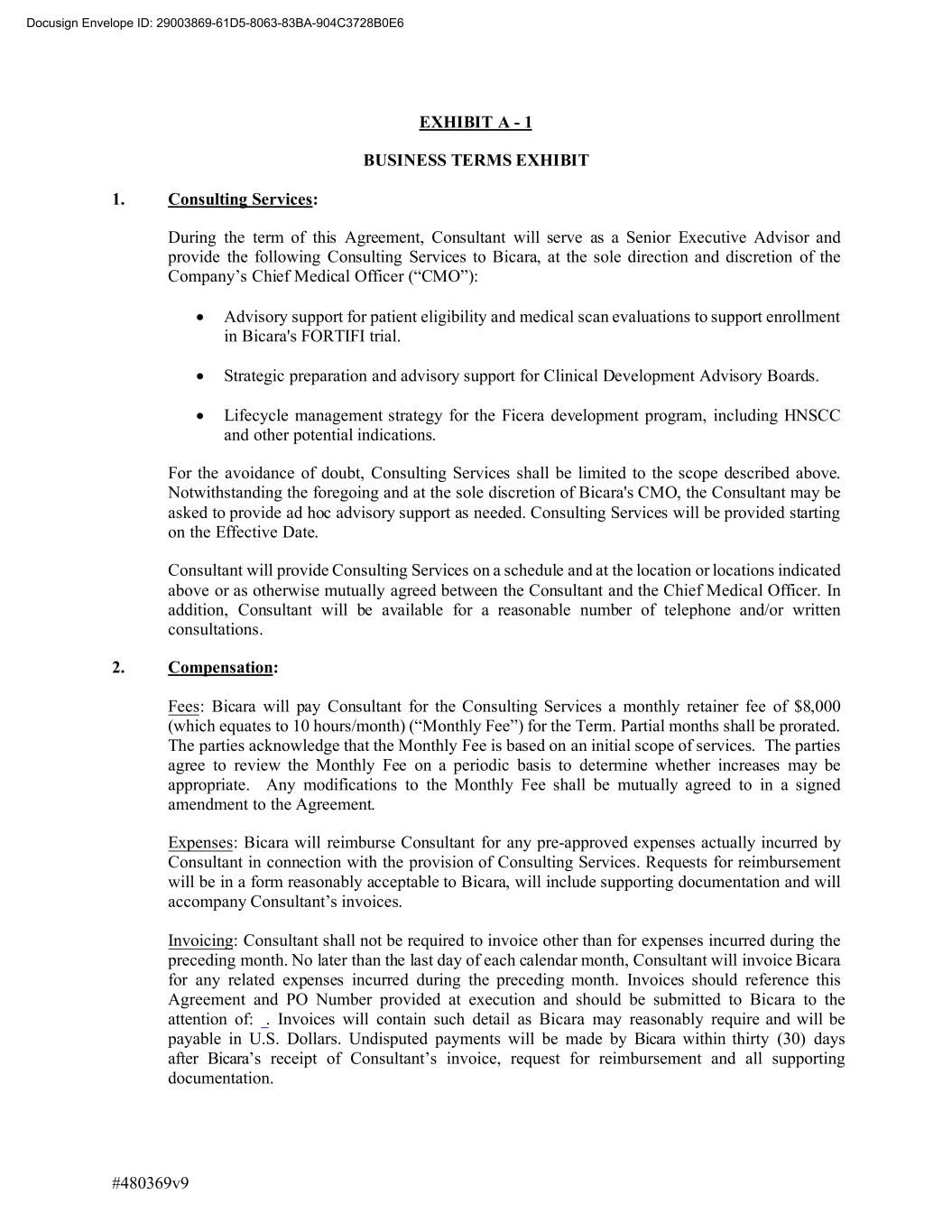
#480369v9 EXHIBIT A - 1 BUSINESS TERMS EXHIBIT 1. Consulting Services: During the term of this Agreement, Consultant will serve as a Senior Executive Advisor and provide the following Consulting Services to Bicara, at the sole direction and discretion of the Company’s Chief Medical Officer (“CMO”): • Advisory support for patient eligibility and medical scan evaluations to support enrollment in Bicara's FORTIFI trial. • Strategic preparation and advisory support for Clinical Development Advisory Boards. • Lifecycle management strategy for the Ficera development program, including HNSCC and other potential indications. For the avoidance of doubt, Consulting Services shall be limited to the scope described above. Notwithstanding the foregoing and at the sole discretion of Bicara's CMO, the Consultant may be asked to provide ad hoc advisory support as needed. Consulting Services will be provided starting on the Effective Date. Consultant will provide Consulting Services on a schedule and at the location or locations indicated above or as otherwise mutually agreed between the Consultant and the Chief Medical Officer. In addition, Consultant will be available for a reasonable number of telephone and/or written consultations. 2. Compensation: Fees: Bicara will pay Consultant for the Consulting Services a monthly retainer fee of $8,000 (which equates to 10 hours/month) (“Monthly Fee”) for the Term. Partial months shall be prorated. The parties acknowledge that the Monthly Fee is based on an initial scope of services. The parties agree to review the Monthly Fee on a periodic basis to determine whether increases may be appropriate. Any modifications to the Monthly Fee shall be mutually agreed to in a signed amendment to the Agreement. Expenses: Bicara will reimburse Consultant for any pre-approved expenses actually incurred by Consultant in connection with the provision of Consulting Services. Requests for reimbursement will be in a form reasonably acceptable to Bicara, will include supporting documentation and will accompany Consultant’s invoices. Invoicing: Consultant shall not be required to invoice other than for expenses incurred during the preceding month. No later than the last day of each calendar month, Consultant will invoice Bicara for any related expenses incurred during the preceding month. Invoices should reference this Agreement and PO Number provided at execution and should be submitted to Bicara to the attention of: . Invoices will contain such detail as Bicara may reasonably require and will be payable in U.S. Dollars. Undisputed payments will be made by Bicara within thirty (30) days after Bicara’s receipt of Consultant’s invoice, request for reimbursement and all supporting documentation. Docusign Envelope ID: 29003869-61D5-8063-83BA-904C3728B0E6
#480369v9 3. Duration of Consulting Services: The Consulting Services pursuant to this Business Terms Exhibit are expected to be performed from May 7, 2026 to December 31, 2026. The Agreement may be further extended upon mutual written agreement of the parties 4. Bicara Contact Information: 116 Huntington Ave., Suite 703 Boston, MA 02116 5. Consultant Contact Information: David Raben Address: Email: Docusign Envelope ID: 29003869-61D5-8063-83BA-904C3728B0E6
#480369v9 EXHIBIT B EU DATA PRIVACY EXHIBIT DATA PROCESSING TERMS For purposes of this EU Data Privacy Exhibit, capitalized terms used but not defined in this Exhibit will have the meaning ascribed to them in the GDPR. Bicara will serve as the Controller and Consultant will serve as Bicara’s Processor in respect of all Personal Data made available to Consultant in connection with the provision of the Consulting Services under this Agreement. As a Processor of any such Personal Data, Consultant will: (a) Process Personal Data solely for the purposes of providing the Consulting Services and in accordance with Bicara’s written instructions and not for any other purpose or in any other manner; (b) not disclose or transfer Personal Data to any third party without Bicara’s prior written consent, except as permitted under this Agreement; (c) use diligent efforts to promptly (i) investigate and remediate any Personal Data Breach by Consultant to prevent a recurrence of such breach; (ii) respond to any request for information from or complaint by a data protection authority/Supervisory Authority in relation to Personal Data that Consultant Processes for the purpose of providing the Consulting Services; and (iii) respond to any request made to Consultant by a Data Subject to exercise rights such as to access, rectify, amend, correct, share, delete or cease Processing his or her Personal Data; (d) retain Personal Data for the longer of the time period necessary to perform the Processing Services or as required by applicable law; (e) allow Bicara or its designee to audit compliance with this EU Data Privacy Exhibit with advance notice and during normal business hours; and (f) ensure that transfers of Personal Data outside of the European Economic Area are made only in accordance with EU or Member State law and pursuant to a framework deemed adequate and approved by the European Commission. Docusign Envelope ID: 29003869-61D5-8063-83BA-904C3728B0E6
Exhibit 31.1
CERTIFICATION OF PRINCIPAL EXECUTIVE OFFICER PURSUANT TO
RULES 13a-14(a) OR 15d-14(a) UNDER THE SECURITIES EXCHANGE ACT OF 1934,
AS ADOPTED PURSUANT TO SECTION 302 OF THE SARBANES-OXLEY ACT OF 2002
I, Claire Mazumdar, Ph.D., certify that:
1.I have reviewed this Quarterly Report on Form 10-Q of Bicara Therapeutics Inc.;
2.Based on my knowledge, this report does not contain any untrue statement of a material fact or omit to state a material fact necessary to make the statements made, in light of the circumstances under which such statements were made, not misleading with respect to the period covered by this report;
3.Based on my knowledge, the financial statements, and other financial information included in this report, fairly present in all material respects the financial condition, results of operations and cash flows of the registrant as of, and for, the periods presented in this report;
4.The registrant’s other certifying officer(s) and I are responsible for establishing and maintaining disclosure controls and procedures (as defined in Exchange Act Rules 13a-15(e) and 15d-15(e)) and internal control over financial reporting (as defined in Exchange Act Rules 13a-15(f) and 15d-15(f)) for the registrant and have:
(a) Designed such disclosure controls and procedures, or caused such disclosure controls and procedures to be designed under our supervision, to ensure that material information relating to the registrant, including its consolidated subsidiaries, is made known to us by others within those entities, particularly during the period in which this report is being prepared;
(b) Designed such internal control over financial reporting, or caused such internal control over financial reporting to be designed under our supervision, to provide reasonable assurance regarding the reliability of financial reporting and the preparation of financial statements for external purposes in accordance with generally accepted accounting principles;
(c) Evaluated the effectiveness of the registrant's disclosure controls and procedures and presented in this report our conclusions about the effectiveness of the disclosure controls and procedures, as of the end of the period covered by this report based on such evaluation; and
(d) Disclosed in this report any change in the registrant's internal control over financial reporting that occurred during the registrant's most recent fiscal quarter (the registrant's fourth fiscal quarter in the case of an annual report) that has materially affected, or is reasonably likely to materially affect, the registrant's internal control over financial reporting; and
5.The registrant's other certifying officer and I have disclosed, based on our most recent evaluation of internal control over financial reporting, to the registrant's auditors and the audit committee of the registrant's board of directors (or persons performing the equivalent functions):
(a) All significant deficiencies and material weaknesses in the design or operation of internal control over financial reporting which are reasonably likely to adversely affect the registrant's ability to record, process, summarize and report financial information; and
(b) Any fraud, whether or not material, that involves management or other employees who have a significant role in the registrant's internal control over financial reporting.
| Date: August 11, 2026 | By: | /s/ Claire Mazumdar | |||||||||
| Claire Mazumdar, Ph.D. | |||||||||||
| Chief Executive Officer | |||||||||||
| (Principal Executive Officer) | |||||||||||
Exhibit 31.2
CERTIFICATION OF PRINCIPAL FINANCIAL OFFICER PURSUANT TO
RULES 13a-14(a) OR 15d-14(a) UNDER THE SECURITIES EXCHANGE ACT OF 1934,
AS ADOPTED PURSUANT TO SECTION 302 OF THE SARBANES-OXLEY ACT OF 2002
I, Ivan Hyep, certify that:
1.I have reviewed this Quarterly Report on Form 10-Q of Bicara Therapeutics Inc.;
2.Based on my knowledge, this report does not contain any untrue statement of a material fact or omit to state a material fact necessary to make the statements made, in light of the circumstances under which such statements were made, not misleading with respect to the period covered by this report;
3.Based on my knowledge, the financial statements, and other financial information included in this report, fairly present in all material respects the financial condition, results of operations and cash flows of the registrant as of, and for, the periods presented in this report;
4.The registrant’s other certifying officer(s) and I are responsible for establishing and maintaining disclosure controls and procedures (as defined in Exchange Act Rules 13a-15(e) and 15d-15(e)) and internal control over financial reporting (as defined in Exchange Act Rules 13a-15(f) and 15d-15(f)) for the registrant and have:
(a) Designed such disclosure controls and procedures, or caused such disclosure controls and procedures to be designed under our supervision, to ensure that material information relating to the registrant, including its consolidated subsidiaries, is made known to us by others within those entities, particularly during the period in which this report is being prepared;
(b) Designed such internal control over financial reporting, or caused such internal control over financial reporting to be designed under our supervision, to provide reasonable assurance regarding the reliability of financial reporting and the preparation of financial statements for external purposes in accordance with generally accepted accounting principles;
(c) Evaluated the effectiveness of the registrant's disclosure controls and procedures and presented in this report our conclusions about the effectiveness of the disclosure controls and procedures, as of the end of the period covered by this report based on such evaluation; and
(d) Disclosed in this report any change in the registrant's internal control over financial reporting that occurred during the registrant's most recent fiscal quarter (the registrant's fourth fiscal quarter in the case of an annual report) that has materially affected, or is reasonably likely to materially affect, the registrant's internal control over financial reporting; and
5.The registrant's other certifying officer and I have disclosed, based on our most recent evaluation of internal control over financial reporting, to the registrant's auditors and the audit committee of the registrant's board of directors (or persons performing the equivalent functions):
(a) All significant deficiencies and material weaknesses in the design or operation of internal control over financial reporting which are reasonably likely to adversely affect the registrant's ability to record, process, summarize and report financial information; and
(b) Any fraud, whether or not material, that involves management or other employees who have a significant role in the registrant's internal control over financial reporting.
| Date: August 11, 2026 | By: | /s/ Ivan Hyep | |||||||||
| Ivan Hyep | |||||||||||
| Chief Financial Officer | |||||||||||
| (Principal Financial and Accounting Officer) | |||||||||||
Exhibit 32.1
CERTIFICATIONS OF PRINCIPAL EXECUTIVE OFFICER AND PRINCIPAL FINANCIAL OFFICER
PURSUANT TO
18 U.S.C. SECTION 1350, AS ADOPTED PURSUANT TO
SECTION 906 OF THE SARBANES-OXLEY ACT OF 2002
In connection with the Quarterly Report on Form 10-Q of Bicara Therapeutics Inc. (the “Company”) for the period ended June 30, 2026 as filed with the Securities and Exchange Commission on the date hereof (the “Report”), each of the undersigned officers of the Company hereby certifies, pursuant to 18 U.S.C. Section 1350, as adopted pursuant to Section 906 of the Sarbanes-Oxley Act of 2002, that:
1.The Report fully complies with the requirements of Section 13(a) or Section 15(d) of the Securities Exchange Act of 1934, as amended; and
2.The information contained in the Report fairly presents, in all material respects, the financial condition and results of operations of the Company.
| Date: August 11, 2026 | By: | /s/ Claire Mazumdar | |||||||||
| Claire Mazumdar, Ph.D. | |||||||||||
| Chief Executive Officer | |||||||||||
| (Principal Executive Officer) | |||||||||||
| Date: August 11, 2026 | By: | /s/ Ivan Hyep | |||||||||
| Ivan Hyep | |||||||||||
| Chief Financial Officer | |||||||||||
| (Principal Financial and Accounting Officer) | |||||||||||